Gaza Cannot Be Rebuilt With IOUs
Trump’s Board of Peace boasts US$17 billion in pledges, but only a fraction has been verifiably delivered. Meanwhile, some of Gaza’s largest documented donors sit outside the Board, exposing an institution built around one man, big promises and far smaller results.
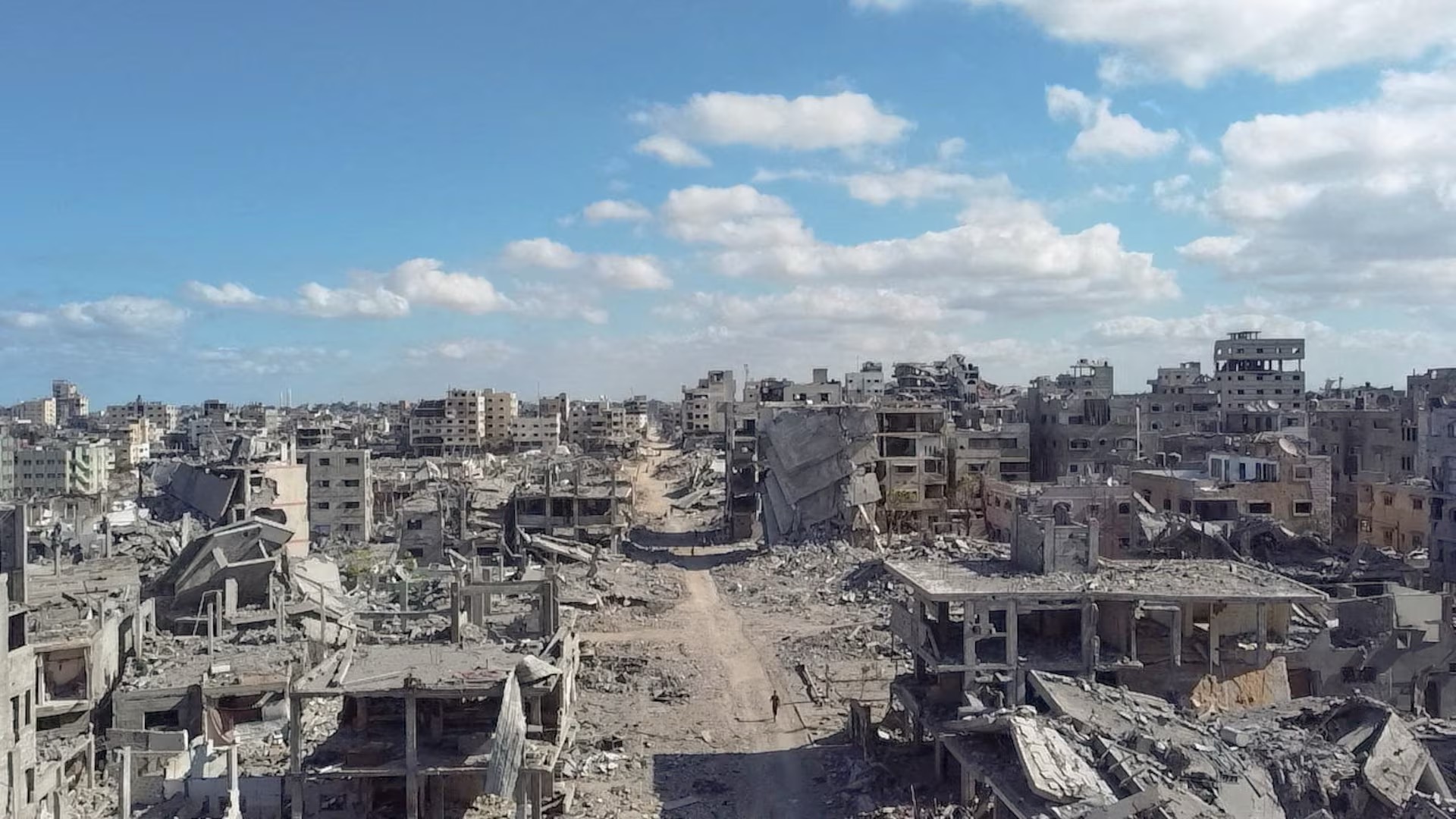
Donald Trump’s Board of Peace wants to be taken seriously as an international institution capable of overseeing Gaza’s recovery and reconstruction. It has a charter, 28 member states, an executive structure and US$17 billion in reconstruction pledges. Trump has described it in grand terms, at one point calling it the most prestigious collection of leaders ever assembled.
The problem is that the institution’s authority is heavily concentrated in one man, while its financial strength remains much more impressive in announcements than in demonstrated delivery. Its own charter gives Donald Trump personally control over invitations, substantial authority over membership and governance, and a chairmanship that does not automatically end when his presidency does. Its own report to the United Nations has meanwhile acknowledged an urgent gap between the billions promised for Gaza and the money actually disbursed.
Those two problems are connected. The Board is being sold as a durable international mechanism, but its structure is unusually dependent on Trump himself and its financial credibility still depends heavily on promises that have not yet become payments. Canada’s treatment shows how personal that governance can become. The funding numbers show how far the institution still has to go before its enormous promises can be measured against results.
Meanwhile, some of the largest documented contributors to the humanitarian response are not Board members at all.
That does not mean humanitarian aid and reconstruction money are identical. They are not. It does mean there is a useful test available for all the grand declarations: separate the money that has been announced from the money that can actually be found on a public funding ledger.
By that measure, the Board of Peace has a serious credibility problem.
The Board Has US$17 Billion in Promises
At the inaugural Board of Peace meeting on February 19, the numbers were enormous. Trump announced a US$10 billion U.S. contribution. The United Arab Emirates pledged US$1.2 billion, while Qatar, Saudi Arabia and Kuwait each announced US$1 billion. Saudi Arabia specified that its billion-dollar commitment would be delivered over several years. Other participating states offered money, troops, training, food or other assistance.
By May, the Board formally reported to the UN Security Council that it had accumulated US$17 billion in reconstruction pledges. That figure remains central to the public impression of an organization capable of financing Gaza’s recovery.
The word that matters is “pledges.”
Reuters reported in April that the Board had received only a small fraction of the US$17 billion promised by members. The Board disputed suggestions that this represented a funding crisis, arguing that it called capital only as required and had no funding constraints. Yet its own May report subsequently acknowledged exactly the underlying problem: the gap between commitments and disbursements had to be closed urgently. The report said that money committed but not disbursed marked the difference between a framework existing on paper and one delivering for people in Gaza.
Reuters’ April reporting put the amount received at less than US$1 billion. Even using US$1 billion as the upper limit, that would have represented less than six per cent of the US$17 billion announced. The Board has since continued developing its institutions and programs, but it has not published a public accounting demonstrating that anything approaching the full US$17 billion has now been transferred and deployed.
That does not mean the pledges are fraudulent or that they will never be paid. Reconstruction programs routinely receive funding in stages, particularly when security conditions, contracts and physical access determine when work can begin. But that explanation does not turn a pledge into a payment. If US$17 billion has been promised and only a fraction has been transferred, the honest description remains US$17 billion pledged, not US$17 billion delivered.
Gaza cannot spend a pledge.
This “International Organization” Is Built Around Donald Trump Personally
The financial weakness would be concerning in any reconstruction body. The governance structure makes it more significant because the Board of Peace is not simply an international organization currently chaired by the sitting president of the United States.
Its charter names Donald J. Trump personally as its inaugural chairman and separately identifies him as the inaugural representative of the United States. Those are two different roles. The chairmanship is not attached to the presidency.
Nothing in the charter says Trump ceases to be chairman when he leaves the White House. Instead, the chairman is replaced only through voluntary resignation or incapacity determined unanimously by the Executive Board. The chairman is also required to designate his own successor.
His powers are extensive. States become members by invitation. Ordinary membership lasts no more than three years unless renewed by the chairman, although states contributing more than US$1 billion in cash during the Board’s first year are exempted from that three-year limit. A chairman can remove a member, subject to a two-thirds vote by members overturning that decision. Trump also has exclusive authority under the charter to create, modify or dissolve subsidiary entities and can determine the structure and rules of subcommittees.
This is therefore not simply an organization influenced by a powerful American president. Its founding document deliberately places considerable authority in Donald Trump as an individual, and that authority can continue after he ceases to hold public office.
Canada provided an early demonstration of what that arrangement can mean in practice.
Canada Was Not Simply Outside the Board. Trump Personally Uninvited It.
Trump invited Prime Minister Mark Carney to participate in the Board on January 16. Carney’s office initially said he planned to accept, although Canada had not completed the process of joining and questions remained over the Board’s structure and financing. Six days later, Trump withdrew the invitation. Global Affairs Canada’s own briefing material records the sequence plainly: invitation on January 16, rescission by Trump on January 22.
What happened between those two dates matters.
At Davos, Carney delivered a speech arguing that the old rules-based international order was undergoing a rupture. He warned that powerful countries were increasingly using economic integration as a weapon and tariffs as leverage. Trump responded publicly and personally. He said Canada “lives because of the United States,” told Carney he should be grateful and added, “Remember that, Mark, the next time you make your statements.” Hours later, Trump revoked Canada’s invitation to the Board of Peace.
Trump did not explicitly write that he was withdrawing Canada’s invitation because Carney criticized the behaviour of powerful countries at Davos. That motive therefore cannot be stated as a proven fact. The sequence does not require embellishment, however. Reuters reported the withdrawal as an about-face following Carney’s speech, and Trump offered no governance, funding or eligibility problem with Canada when he revoked the invitation. His announcement simply told Carney that Canada was no longer invited to join what Trump called the most prestigious board of leaders ever assembled.
Whether Canada might ultimately have chosen not to participate is beside the point. The important issue is what the episode demonstrates about the institution itself.
A supposedly international organization invited a G7 country to participate. That country’s prime minister publicly challenged the conduct of powerful states. The chairman of the international organization personally attacked him, then personally withdrew his country’s invitation.
The charter allowed it because the charter places that authority in the chairman.
Canada is therefore not important to this story because it deserves sympathy for being excluded. Canada is important because its exclusion demonstrates how quickly membership in Trump’s international body can become entangled with Trump’s personal political disputes.
Then Follow the Money
Canada becomes relevant again when the financial comparison begins, although for a very different reason.
The UN’s 2026 Flash Appeal seeks US$4.06 billion to provide urgent humanitarian assistance to three million Palestinians across Gaza and the West Bank. As of OCHA’s latest reporting, US$1.61 billion has actually been funded, leaving approximately US$2.5 billion unmet. Humanitarian organizations reported reaching 1.97 million people by July, including approximately 1.6 million in Gaza.
OCHA’s current donor ledger identifies the five largest contributors as the United Arab Emirates at US$485.6 million, the United States at US$330 million, the European Commission at US$159.8 million, Sweden at US$91.9 million and Canada at US$83.3 million.
That list deserves attention.
The UAE and United States are Board members, and their documented humanitarian contributions are substantial. Any serious accounting has to acknowledge that. This is not an argument that Board members have done nothing.
But three of the five largest entries on OCHA’s current donor list are not Board member states. The European Commission participated in the Board’s inaugural meeting only as an observer and explicitly said that doing so did not make it a member. Sweden is not among the Board’s 28 member states. Neither is Canada, after Trump withdrew its invitation.
The contrast becomes even stranger because the Board’s own May report called on countries and organizations that are not members of the Board of Peace to contribute to Gaza’s reconstruction, while simultaneously admitting that the gap between its own members’ commitments and disbursements needed to be closed urgently.
In other words, an organization sitting on US$17 billion in promises was asking outsiders for money because too much of its own promised money remained promises.
“Verified” Does Not Mean Every Dollar Has Already Been Spent in Gaza
There is an important distinction in the donor numbers. OCHA’s figures are funding recorded through the humanitarian response system. They should not be described as proof that every dollar has already been converted into food, medicine or infrastructure inside Gaza.
But they are documented funding figures attached to an operating humanitarian response, with donor identities, sector allocations, funding requirements and results publicly tracked. That is a much firmer number than a political pledge whose eventual transfer remains unknown.
It is also why Canada’s latest announcement should be treated carefully.
On September 22, Carney announced another C$100 million for Palestinians in Gaza and the West Bank. C$80 million is intended for humanitarian assistance, while C$20 million will support development and security initiatives, including Palestinian police training. Ottawa says total Canadian assistance for Palestinian civilians since October 2023 now exceeds C$600 million.
That new C$100 million should not simply be added to Canada’s US$83.3 million OCHA figure and presented as money already delivered. It was just announced. Until it is transferred and recorded through the relevant mechanisms, it belongs in the commitment column.
That standard has to apply equally to Canada and Trump’s Board.
Otherwise the entire comparison becomes meaningless.
Humanitarian Aid and Reconstruction Are Different, but the Accountability Question Is the Same
It would also be misleading to suggest that Canada’s US$83.3 million in recorded humanitarian funding can simply be compared dollar-for-dollar with a Saudi or Qatari reconstruction pledge. Humanitarian assistance and reconstruction funding serve different purposes.
The humanitarian appeal pays for immediate needs such as food, health care, shelter, water, sanitation and protection. Long-term reconstruction must rebuild housing, hospitals, schools, roads, electrical networks, water infrastructure and the broader economy.
Gaza needs both.
That difference does not weaken the argument about delivery. It sharpens it. A US$1 billion reconstruction commitment should be identified as a reconstruction commitment until it is transferred. US$83.3 million recorded as humanitarian funding should be identified as humanitarian funding. Neither number should be inflated into something it is not.
The point is not to pretend Canada gave more than countries promising billions. It plainly did not.
The point is that Canada’s smaller number is currently easier to verify than many of the Board’s much larger ones.
The Board Is Strongest Where It Is Hardest to Measure
The Board’s political architecture is already substantial. It has 28 member states. It has a charter. It has an executive structure. Trump has extensive authority as chairman. Its members have announced billions of dollars.
Its measurable financial delivery is much less impressive relative to those promises.
That imbalance is what makes the institution vulnerable to criticism that it is stronger as a political construction than as a reconstruction mechanism. The Board has accumulated the appearance of enormous capacity before demonstrating comparable results on the ground.
Its own language practically concedes the point. The Board told the Security Council that undisbursed commitments are the difference between something that exists on paper and something that delivers.
That statement should be taken seriously.
The same should be true of its governance structure. If an organization calls itself international but gives one man the ability to invite governments, remove members subject to an override, shape its subsidiary bodies, remain chairman beyond his presidency and designate his successor, that concentration of authority is part of the institution’s identity, not an incidental footnote.
Canada’s exclusion after the Davos confrontation demonstrated how that authority can operate.
The money demonstrates the other weakness.
Gaza Does Not Need Another Institution That Is Rich on Paper
There is no shortage of organizations, conferences and governments willing to announce what they intend to do for Gaza. What matters now is the conversion of intention into something measurable.
Board members should receive full credit for money they actually provide. The UAE currently leads OCHA’s humanitarian donor list and the United States ranks second. Their membership in Trump’s Board does not diminish those contributions.
The same standard should apply in the opposite direction. Canada and Sweden do not become irrelevant because they are outside the Board. The European Commission does not cease being a major donor because it declined membership and attended only as an observer. Their documented funding remains documented funding.
Likewise, a US$1 billion pledge does not become US$1 billion of reconstruction merely because a head of government announced it, and US$17 billion in combined pledges does not become US$17 billion delivered merely because the number appears in an official report.
The Board of Peace has chosen to present itself as something larger than another diplomatic committee. Its charter calls it an international organization. Trump has described it in sweeping terms, and its structure gives him personal authority that can survive the end of his presidency.
That makes the standard higher, not lower.
If the Board wants to be judged as a serious international institution, it should be judged on the money it actually mobilizes, the reconstruction it actually finances and the independence and durability of the institution it has created.
So far, there is a striking disconnect. Trump’s Board has billions in commitments and considerable power concentrated in its chairman. Countries outside the Board, including one Trump personally uninvited during a public political dispute, remain among the largest documented contributors to the humanitarian system already operating for Palestinians.
Perhaps the US$17 billion will eventually arrive. If it does, it should be counted when it does.
Until then, the distinction is not complicated.
A pledge is a promise.
A payment is money.
And Gaza cannot be rebuilt with IOUs.