
Creating Diplomatic Redundancy: Routing Around the Old World Order
Governments are not lining up to replace the existing international order with a new one. They are building backup relationships around its weak points, creating diplomatic redundancy for the moments when the institutions and alliances they already have cannot deliver.
The Old Machinery Still Works. Just Not Reliably Enough
For most of the period since the Second World War, countries knew where the major machinery of international affairs was supposed to be. The United Nations provided the broad global forum. NATO anchored Western collective defence. The World Trade Organization and its predecessors established rules for international commerce. Regional organizations handled regional problems, while the United States sat at the centre of an enormous network of military, economic and diplomatic relationships.
None of that machinery has disappeared.
What is changing is confidence that every part of it will work when needed.
The UN Security Council can be immobilized by vetoes. Trade rules can be overtaken by tariffs, sanctions and economic coercion. Alliances can remain formally intact while members question how dependable particular commitments will prove in a crisis. Supply chains once treated mainly as commercial systems are now routinely discussed as matters of national security.
Governments are responding, but not by drawing blueprints for a replacement world order.
They are adding connections.
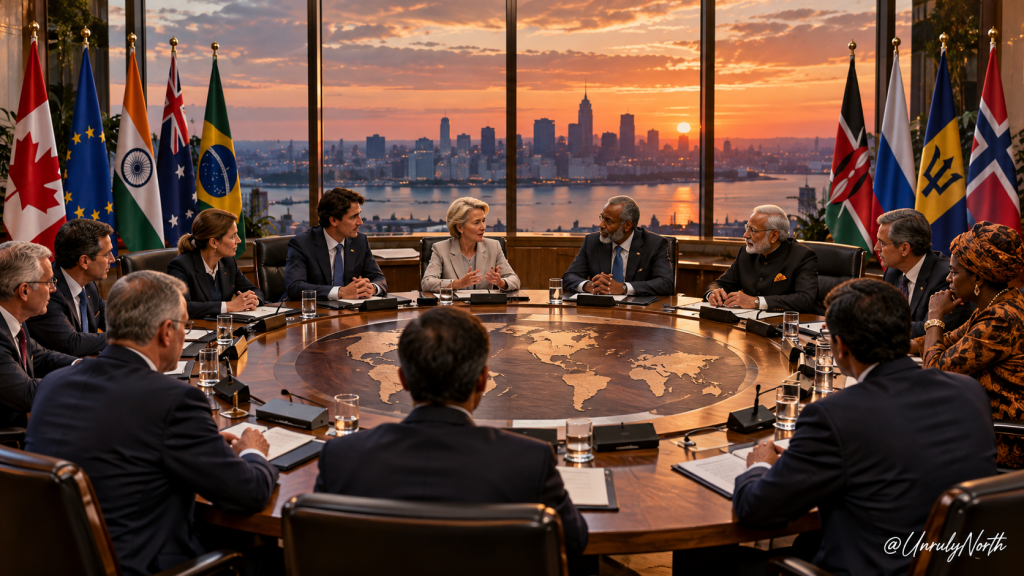
Canada is deepening relationships in Europe and with the Nordic countries while remaining tied to NATO and NORAD. European governments are expanding defence production and diversifying suppliers without abandoning the Atlantic alliance. Australia is developing closer economic, research and security relationships with Europe while maintaining its American alliance. India cooperates through organizations whose members often disagree sharply with one another. Brazil works through BRICS, the G20, the UN and regional institutions while calling for reform of global governance. Kenya and Barbados are pushing for greater influence for states that have often had less control over international rules.
These arrangements are different, but the instinct behind many of them is similar.
Countries are creating diplomatic redundancy.
Before Someone Shouts “Globalism,” Ask What They Actually Mean
That phrase will inevitably attract another word: globalism.
It is better to confront it now than pretend the accusation will not come.
“Globalist” has become so elastic that it can mean almost anything: free trade, the UN, international banking, military alliances, climate negotiations or simply governments cooperating across borders.
There are legitimate debates about globalization. Economic integration has created enormous wealth while also hollowing out industries in some communities. Long supply chains made goods cheaper while creating dangerous dependencies. International institutions can become distant from the voters affected by their decisions. National sovereignty, democratic accountability, trade, migration and economic security are real issues.
But calling every form of international cooperation “globalism” does not answer any of them.
Countries cannot opt out of geography.
Aircraft cross borders. Ships cross oceans. Diseases move between populations. Financial shocks spread between economies. Cyberattacks originate in other jurisdictions. Rivers cross national boundaries. Companies build products using materials and components from multiple continents. Wars disrupt energy and food markets thousands of kilometres away.
A country can refuse to cooperate internationally. It cannot make international problems disappear.
The useful question is therefore not whether something can be branded “globalist.” It is what authority is actually being transferred, to whom, under what rules, for what purpose, and whether the country involved retains the ability to say no.
Diplomatic redundancy does not inherently require countries to surrender that ability.
In fact, much of what is happening today is partly a reaction against excessive dependence.
The Goal Is More Options, Not Less Sovereignty
If a country relies overwhelmingly on one export market, redundancy means finding others. If it relies on one supplier for a strategically important product, redundancy means developing alternatives. If its defence depends heavily on one foreign producer, redundancy means ensuring another option exists. If one international institution becomes paralysed, redundancy means having another place where governments can still talk.
That is not borderless idealism.
It is risk management.
Canada offers a clear example. Global Affairs Canada now discusses “plurilateral arrangements,” “issue-specific coalitions” and “variable geometry”: different groups of countries working together on particular problems without pretending they must agree on everything else.
Canada can cooperate with Norway on Arctic security, Britain on military interoperability, the European Union on critical minerals and technology, and another collection of countries on climate finance. Those relationships can overlap without becoming one organization.
Canada and the Nordic countries have already been experimenting with that approach. They have discussed closer defence procurement and strategic cooperation while remaining within NATO. Norwegian Prime Minister Jonas Gahr Støre has explicitly described this as “variable geometry” rather than an attempt to build new institutions.
That distinction matters.
Canada is not withdrawing from the old system. NATO and NORAD remain fundamental to Canadian defence, while the United States remains Canada’s largest trading partner.
Ottawa is trying to increase the number of options available when one relationship or institution cannot provide the answer.
Other Countries Are Building Their Own Exits
Europe is confronting the same problem from another direction.
NATO remains central to European defence, and the United States remains deeply involved in the alliance. At the same time, European countries are expanding domestic defence production and considering more non-American suppliers. Russia’s invasion of Ukraine also demonstrated the dangers of excessive dependence on Russian energy.
Building another ammunition plant does not dissolve NATO. Buying equipment from another supplier does not erase an alliance.
It reduces the number of circumstances in which one government’s decision can leave another country without options.
Australia provides another example. Around this year’s United Nations General Assembly, Australian and European leaders discussed trade, research, security, critical minerals, cyber threats, maritime security, emerging technologies and economic coercion.
Australia is not becoming European, nor is it abandoning its relationship with the United States.
It is adding another cable to the network.
India and Brazil make the point even more clearly because neither fits neatly inside a Western diplomatic bloc.
India works with the United States, Japan and Australia through the Quad while remaining in BRICS and maintaining relationships with countries that frequently disagree with Washington. Brazil similarly operates through BRICS, the G20, the United Nations and regional institutions while demanding greater representation for developing powers.
Kenya brings the perspective of an increasingly important African state. Barbados, under Prime Minister Mia Mottley, has pushed international financial reform and drawn attention to the vulnerability of smaller states within systems largely designed by bigger economies.
These countries are not marching toward the same geopolitical destination.
They do not need to.
They need enough common language to keep talking when their interests overlap.
P4M Is a Signal, Not the Destination
That is why the new Partners for Multilateralism initiative is interesting, but it should not be mistaken for the story itself.
Australia, Barbados, Brazil, Canada, the European Union, India and Kenya were among its initial sponsors. Its declaration calls for practical cooperation, more resilient supply chains and continued support for the UN-centred international system.
P4M may become important.
It may also disappear.
Governments launch diplomatic initiatives constantly. Some grow into lasting institutions. Others produce several meetings, a declaration and eventually a webpage nobody updates.
There is no reason to treat P4M, days after its creation, as evidence of some emerging new world order.
It is better understood as a symptom.
A diverse group of governments decided another channel of communication was useful. The important question is not whether P4M survives. It is whether the habit behind it does.
Perhaps this particular flash fades.
Perhaps it starts something elsewhere: another working group, another defence partnership, another trade agreement, another crisis coalition, another group of officials who already know one another when events suddenly force their governments to cooperate.
That broader pattern is already visible.
Canada is expanding economic and security relationships. Australia and Europe are linking trade, research and strategic cooperation. Canada and the Nordic countries are developing flexible partnerships. Governments increasingly assemble different combinations of countries around particular problems rather than waiting for every major power or international institution to agree.
Redundancy Solves One Problem and Creates Another
There are risks in this.
A world of smaller coalitions could become more resilient, but also more fragmented. Wealthier countries may have an easier time assembling useful networks while poorer states remain outside them. Informal arrangements can move quickly, but they can also lack transparency and accountability.
The same mechanism that lets governments route around a paralysed institution can allow them to route around one that is merely inconvenient.
That is why the old institutions still matter.
The United Nations provides something temporary coalitions cannot: a forum in which almost every recognized state has a seat. NATO provides treaty commitments that informal partnerships cannot duplicate. International trade rules provide predictability that improvised deals cannot.
Diplomatic redundancy is not a substitute for those systems.
It is insurance against their limitations.
This Is Bigger Than Washington
Nor is this simply about the United States.
American unpredictability has encouraged some diversification, but other shocks have pushed countries in the same direction. Russia’s use of energy relationships, the pandemic’s disruption of medical supplies, competition over semiconductors and critical minerals, wars affecting global food and energy prices, and increasing use of sanctions and tariffs have all demonstrated the danger of having too few alternatives.
Even economic interdependence can become leverage.
That does not mean countries should stop trading or cooperating. It means governments are increasingly reluctant to place too much weight on a single relationship.
A system that depends completely on one component can look wonderfully efficient until that component fails.
That principle is familiar in engineering. Governments appear increasingly willing to apply it to diplomacy.
More suppliers. More markets. More security relationships. More diplomatic contacts. More places where a conversation can begin.
The Point Is Not Agreement. It Is Keeping the Line Open
None of this requires countries to become friends.
India and Europe will continue to disagree. Brazil and Canada will disagree. Australia can trade with China while competing with it strategically. Developing countries will continue challenging wealthier ones over finance, trade and representation.
Diplomatic redundancy does not eliminate disagreement.
It assumes disagreement.
That may be its most important feature.
A country can oppose another government’s position on one issue while still keeping open a relationship that becomes valuable on another. Cooperation no longer has to mean alignment across the board.
This is far less dramatic than announcing the birth of a new world order.
It is also more believable.
Governments are not abandoning the postwar system wholesale. They are becoming less comfortable having only one answer when asked what happens if an institution, supplier, market, alliance or major partner suddenly cannot deliver.
Made It This Far? Here Is What It Adds Up To
Some of the alternatives countries create will fail. Some will become little more than diplomatic theatre. Some will be abused. Others may quietly prove indispensable.
P4M could become any of those things. It has not existed long enough to tell us much.
The behaviour behind it tells us more.
Countries are looking at an increasingly uncertain international environment and deciding that one relationship, one institution and one telephone number may no longer be enough.
That is not necessarily globalism.
It is certainly not a new world order.
It is diplomatic redundancy: keeping the institutions that still work, building alternatives around the places where they do not, and making sure that when the next crisis arrives, somebody still answers the phone.