
Canada Has Goods to Sell. CANXPORT Gives Them a Way Out.
Prince Rupert’s new CANXPORT facility addresses a costly mismatch: Canadian products need overseas buyers while shipping containers return to Asia empty. Its opening gives Canada more room to export—and a practical test of its ambitions to diversify trade.
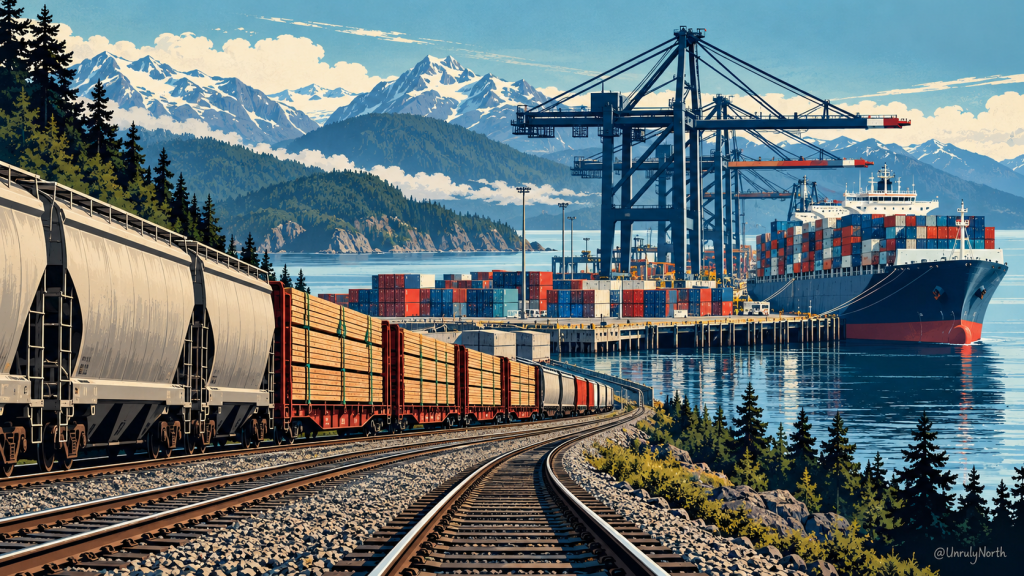
Canada’s search for new trading partners has a less glamorous companion: finding a workable way to deliver what those partners might buy. At Prince Rupert, on British Columbia’s northern coast, a newly opened facility addresses a particularly frustrating part of that problem. Canadian producers need containers for overseas sales, while containers arriving with imported goods can make the return journey across the Pacific empty.
CANXPORT, a $750-million export logistics development on Ridley Island, brings those two sides of the trade together. Its grand opening on August 27 marked the arrival of a facility designed to receive Canadian products by rail, transfer them into shipping containers, and send them onward through Prince Rupert’s existing marine terminal. Montreal-based Ray-Mont Logistics operates the facility. Canada.ca
The opportunity reaches well beyond the harbour. A producer’s access to another market depends partly on whether the final delivered price can compete there. Better transport arrangements can make an overseas order commercially worthwhile, give an existing exporter room to grow, or provide another destination when a major customer becomes unreliable.
That makes CANXPORT a concrete investment in Canada’s ability to choose where it trades. Its importance lies in the connection it strengthens between Canadian production and international customers—and in how much more that connection could eventually carry.
A Pacific ambition more than a century old
Prince Rupert’s commercial history begins long before the railway. The port sits within Tsimshian territory, where Indigenous peoples lived and traded for thousands of years. The modern city developed around an ambitious proposition: the Grand Trunk Pacific Railway would have its western terminus there, creating another major Canadian route to the Pacific.
The railway reached completion in 1914, but the economic circumstances were unforgiving. Its ambitions exceeded its commercial success, and the Grand Trunk Pacific eventually became part of the Canadian National system. Fishing became a mainstay of Prince Rupert’s economy. During the Second World War, the harbour also served as a significant embarkation point for Canadian and American personnel and equipment. www.rupertport.com
The geography remained valuable even when the original business expectations failed. Prince Rupert has a deep, ice-free harbour and a northern position that shortens voyages to important Asian ports. CN estimates its sailing advantage over Seattle at roughly 36 hours on the Shanghai route. Actual delivery times still depend on vessel schedules, handling, and inland transport, but the geographic advantage is substantial. cn.ca
Fairview Terminal, completed in 1975, later became the centre of the port’s container transformation. Converted in 2007, it handles containers transferred between ships and trains, connecting Pacific shipping with CN’s network across Canada and into the United States. Today, DP World operates Fairview, whose published annual capacity is 1.6 million TEUs. A TEU is a twenty-foot equivalent unit: one 20-foot container counts as one; a 40-foot container counts as two. www.rupertport.com
Fairview is one part of a larger port that also moves grain, coal, propane, wood pellets, and other cargo through specialised facilities. Prince Rupert handled 26.3 million tonnes in 2025, up 14 per cent from the previous year. Fairview’s container traffic reached 885,797 TEUs. Those figures describe an established trading port with room to develop, rather than a new gateway starting from scratch. rupertport.com
The gap between a railcar and a ship
The problem CANXPORT addresses is partly one of location. Imported consumer goods often travel to urban distribution centres, while Canadian agricultural and resource exports originate far from those centres. An empty container in one place does little for a producer who needs it somewhere else.
In its original explanation of the project, the port authority reported that loaded import containers substantially outnumbered loaded export containers at Prince Rupert. Tens of thousands of empty containers were passing through the port for shipment back overseas, while exporters elsewhere in Western Canada faced difficulties obtaining them. Its proposed answer was to bring more products to the containers, using rail and loading facilities near the waterfront. rupertport.com
This transfer is called transloading. Grain, for example, can arrive in a railcar designed to carry loose agricultural commodities, then be loaded into ocean containers. Lumber, pulp, and plastic resin require their own handling arrangements. The commercial purpose is to combine an efficient inland journey with a shipment suited to the overseas customer.
Prince Rupert already had businesses doing this work. Ray-Mont announced an agricultural transloading operation there in 2017, with a ten-acre site and rail infrastructure accommodating more than 100 railcars. Its intended cargo included lentils, peas, beans, wheat, and other crops. CANXPORT expands an established activity onto a much larger platform, broadening the products and volumes the port can handle. newswire.ca
It also uses Fairview’s existing marine connection. CANXPORT does not add a new berth where container ships dock. Containers loaded on Ridley Island move to Fairview for shipment. Storage away from the waterfront can hold empty containers and prepared exports until they are needed, helping reserve valuable terminal space for cargo moving between ship and shore. rupertport.com
That distinction explains why building more port capacity can involve loading equipment, storage yards, roads, and railway tracks as much as cranes standing over the water.
How much of the gap can it fill?
CANXPORT’s announced initial capacity is 400,000 TEUs of export transloading annually, with the potential to grow to 750,000 TEUs. The larger figure would represent an additional 350,000 TEUs, or an 87.5 per cent increase over the initial design. These are measures of handling capability; they are not a count of exports already shipped or orders already secured. rupertport.com
For perspective, CANXPORT’s initial capacity is equivalent to one-quarter of Fairview’s published annual container capacity. That comparison illustrates scale. It does not mean the new facility automatically increases Fairview’s capacity by 25 per cent: a container prepared at CANXPORT and shipped through Fairview uses both facilities during the same journey. rupertport.com
The precise size of Canada’s unmet export demand cannot be read from those numbers. Project announcements do not establish that 400,000 TEUs of profitable Canadian orders were previously blocked, nor that every container handled will represent business that would otherwise never have occurred. Some traffic may transfer from existing operations or other routes. Ray-Mont’s relocation and expansion from its previous Prince Rupert facility is part of the development. rupertport.com
What the evidence does establish is a significant mismatch between available containers and the ability to load Canadian exports into them at the required place and scale. CANXPORT adds substantial capacity to address that mismatch. Whether it creates new exports, makes existing exports more competitive, or does both will emerge through its operating results.
As of late September, the public opening announcements do not provide a reliable measure of its current utilisation. The facility has opened; its commercial performance will need to be judged over time.
New customers require a workable route
A Canadian exporter considering a new market must weigh freight, handling, customs requirements, financing, delivery times, and the risk of disruption alongside the price offered by a buyer. Transport Canada identifies logistics costs, unfamiliar regulations, limited capital, and transport bottlenecks among the obstacles facing businesses trying to expand beyond North America. tc.canada.ca
CANXPORT addresses part of that calculation. A workable route from inland production to an ocean container can make Canadian goods available to more buyers on more competitive terms. It also gives producers a practical basis for approaching customers they could not previously serve economically.
Consider a specialty crop exporter exploring a new Asian destination. The opportunity depends on assembling the right product, meeting the buyer’s specifications, arranging a suitable shipment, and delivering it at an acceptable cost. A facility able to handle that product regularly makes the sales proposition more credible. The exporter can discuss an actual service and route, then build repeat business around it.
The potential extends across existing markets such as Japan and South Korea and into Southeast Asia. Canada is negotiating a trade agreement with ASEAN—the Association of Southeast Asian Nations—which comprises Brunei, Cambodia, Indonesia, Laos, Malaysia, Myanmar, the Philippines, Singapore, Thailand, Timor-Leste, and Vietnam. Canada already shares the CPTPP trade agreement with four of those members: Brunei, Malaysia, Singapore, and Vietnam. www.international.gc.ca
These markets have different customers, standards, and purchasing needs. Improved access through a trade agreement can strengthen the case for selling into them; efficient transport helps turn that access into deliveries. CANXPORT provides part of the physical capacity on which those commercial relationships depend.
The national benefit is greater flexibility. A producer with several dependable customers has more choices when one market imposes restrictions, demand weakens, or a buyer pushes for a lower price. Developing those alternatives takes time. Infrastructure built before a crisis offers a better starting point than discovering, during one, that the alternative route cannot accommodate the goods.
The next stage reaches beyond CANXPORT
CANXPORT took years to bring forward. Construction was announced in 2023, when it was known as the Ridley Island Export Logistics Project. The Canada Infrastructure Bank subsequently provided a $150-million loan for the first phase. Federal and provincial contributions also supported the development. This is the result of sustained investment across governments, industry, and local partners, rather than a facility conceived in response to the latest tariff announcement. rupertport.com
Further growth depends on the surrounding network. CN is expanding the Zanardi Rapids rail crossing, a bottleneck at the entrance to the port. Its published schedule places completion in late 2027. More room to prepare export containers will be valuable only if trains can reach the facilities reliably and shipping services can carry the resulting cargo. cn.ca
South Kaien Logistics Park adds another complementary piece. Developed by the Metlakatla Development Corporation and the port authority, it is intended to expand import warehousing and transloading. IntermodeX’s LinX facility is scheduled to begin its first phase in the first quarter of 2027. Handling imports locally can help strengthen the commercial network supporting the port’s export operations, although the two facilities serve different tasks. www.rupertport.com
CANXPORT’s potential expansion to 750,000 TEUs remains a future opportunity, with no firm completion date established in the opening announcement. A proposed second container terminal is further out: the port lists it at the feasibility stage, with an estimated 2030–31 completion and proposed capacity of at least two million TEUs. That remains a development proposal. rupertport.com
The separate Ridley Island Energy Export Facility, or REEF, would broaden the port’s energy business through propane and butane exports. It is another part of Prince Rupert’s development, with its own facilities and construction programme. Its liquid-cargo capacity cannot be added to CANXPORT’s container figures to produce a meaningful combined total. www.altagas.ca
A national asset with local obligations
The benefits of expansion also depend on who participates. CANXPORT’s site-development contract went to an Indigenous joint venture involving Metlakatla First Nation, Lax Kw’alaams Band, Gitxaała Nation, and IDL Projects. Metlakatla and Lax Kw’alaams are also majority owners of Gat Leedm Logistics, which provides local container trucking services. These are direct business roles in the port’s development and operation. cib-bic.ca
Future growth must also account for the coast on which it depends. In 2019, the port authority announced a development moratorium on Flora, Agnew, and Horsey Banks near Lelu Island, acknowledging concerns about the Skeena estuary and salmon habitat. That decision provides an existing example of choosing where development should—and should not—occur. www.rupertport.com
Canada has reason to take CANXPORT seriously. It addresses a practical weakness in an established export route, provides room for substantial growth, and connects Canadian producers with infrastructure already serving Pacific trade. Its value will be demonstrated through reliable service, competitive costs, repeat customers, and benefits that extend to the communities doing the work.
Prince Rupert’s original railway promoters understood the appeal of a Canadian route to the Pacific. More than a century later, the task has become more specific: connect the goods Canada produces with the ships, containers, and customers that can carry its trade further.
CANXPORT gives more producers the means to make that connection. If Canada wants greater freedom in its trading relationships, this is the kind of investment that gives the ambition practical substance.
Sources
- Transport Canada: CANXPORT’s August 2026 grand opening
- Prince Rupert Port Authority: CANXPORT’s capacity, partners, and investment
- Prince Rupert Port Authority: Project background and the export logistics gap
- Prince Rupert Port Authority: Port history
- Canada Infrastructure Bank: CANXPORT financing and project objectives
- Prince Rupert Port Authority: South Kaien Logistics Park development