There Is No Belarus Potash Deal. There Is Just a Headline.
Trump announced a “massive” fertilizer purchase from Minsk. Lukashenko said the same day that the tonnes are already sold. Geography and freight do the rest.
On Monday, President Donald Trump told the country he had found cheaper fertilizer. “The United States is working on a massive Deal with respect to the purchase of Potash from Belarus,” he posted on Truth Social. “The pricing would be for substantially less than we are currently paying to Canada, very good news for our Farmers and Ranchers.” Bloomberg carried the post. So did CBC, The Hill, and The Washington Post.
The sentence was built to travel: massive deal, cheaper than Canada, good news for the farm. It is also a sentence that collapses the moment you put it next to two stubborn facts. First, the man who would have to sell the potash said the same day that he does not have it. Second, even if he did, Belarusian potash has to cross an ocean and a Russian rail system to reach the same American fields that already sit at the end of a Canadian freight train.
This is not a close call. It is a press release colliding with a map.
What Minsk said on the same day
Hours around Trump’s post — and reported as the same Monday — Belarusian president Alexander Lukashenko addressed the potash question directly. His office published the line. “Even if we wanted to supply other markets — Western markets — we simply don’t have the volume. It’s all under contract.” That wording appears in Meduza’s same-day report, in The Hill, in Capital Press, and in the Belarusian independent outlet Reform.news.
“Even if we wanted to supply other markets — Western markets — we simply don’t have the volume. It’s all under contract.”
— Alexander Lukashenko, Sept. 21, 2026
He was not being coy. Lukashenko said Belarus had already “shifted our exports eastward.” China, India, and Indonesia are the buyers who took the tonnes after Western sanctions closed the old route. The Globe and Mail noted that China is the largest importer of Belarusian potash, followed by India and Indonesia. Reform.news added a number that matters: in January–August of this year, Chinese customs recorded 2.58 million tonnes of potassium chloride from Belarus.
That is the first receipt. A “massive deal” requires massive uncommitted tonnes. The seller of record said those tonnes do not exist for the West in 2026. He has said versions of the same thing before. In the spring he told Russian media that free mineral fertilizers for the United States were not available this year because the goods were contracted and, in some cases, prepaid.
There is a smaller, older thread. On September 11, Lukashenko said Belarus had resumed some potash sales to the United States after Washington lifted sanctions, and that he wanted more than $40 million “stuck” in the U.S. banking system returned. CBC reported that demand. A resumed trickle plus a frozen-funds complaint is not a replacement for Canadian supply. It is a bargaining chip.
What American farms actually buy
The United States does not have a potash problem that can be solved with a social-media announcement. It has a structural import dependence. According to the U.S. Geological Survey, as summarized by Capital Press, America imported 92 percent of the potash it used last year. Canada supplied 79 percent of those imports. Russia supplied 12 percent. About 85 percent of imported potash goes into fertilizer. Domestic mines, mostly in New Mexico, do not close the gap.
Bloomberg and USDA-linked reporting put 2025 U.S. imports around 13 million tons, with nearly 90 percent from Canada in some tallies. Forbes noted that Canadian potash exports to the United States were worth about $4.2 billion, and that Canadian potash remains exempt from the tariffs Trump has aimed at other Canadian goods. That exemption is not charity. It is an admission that American farms cannot be run without the product next door.
Belarus, before U.S. restrictions, shipped more than 700,000 tons of potassium fertilizers to the United States in 2021. That figure, cited in Bloomberg’s write-through, is a fraction of annual American demand. You do not swap a continental supplier for a historic side account and call it a supply strategy.
The rail line that already works
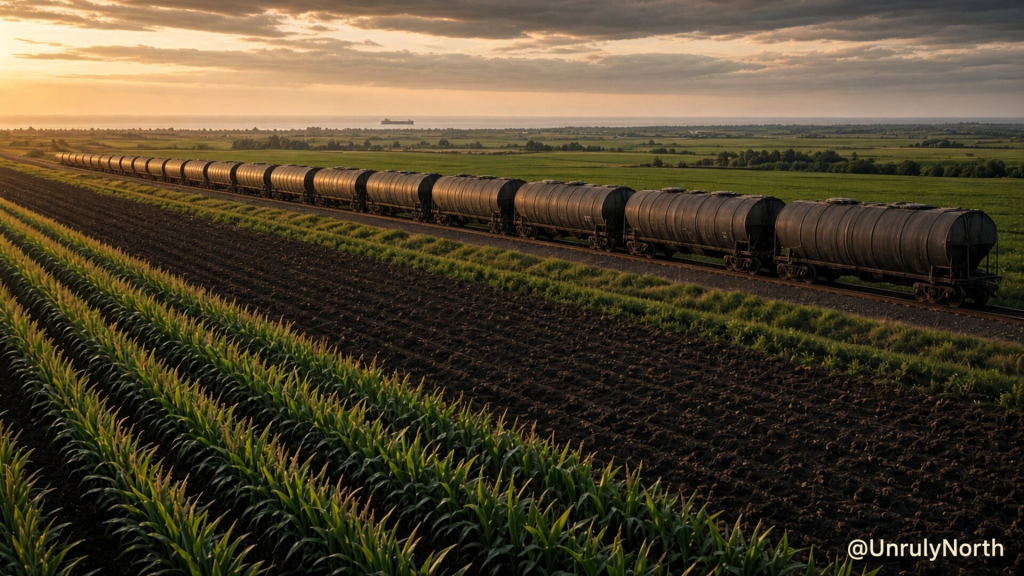
Canadian potash is not an abstraction. It is mined in Saskatchewan, where all ten of Canada’s active potash mines sit, and where nearly a third of world production originates, according to Natural Resources Canada figures cited by CBC. From those mines, unit trains run south into the American Midwest.
The haul is known: on the order of 1,000 to 1,800 miles, typically a few days on rail. The cars, warehouses, dealer network, and application calendar are built around that corridor. Nutrien and Mosaic spent decades pointing their lowest-cost Saskatchewan mines at the nearby American market.
That is why Trump’s comparison — a mine-gate price in Belarus versus the invoice from Canada — is a trick. Farmers do not buy potash at a Belarusian shaft. They buy it delivered to a Midwest retailer in the window when they can put it on the ground. The Canadian product is already inside that window.
Saskatchewan Premier Scott Moe, who has an obvious interest in defending his province’s industry, still asked the right logistical question: “Does anyone believe Belarusian blood potash shipped through Russia is going to be more affordable, more sustainable or more ethical than potash shipped from Saskatchewan — right here in North America?” That is his statement. Discount the politics if you want. Do not discount the miles.
The ocean that eats the discount
Belarus is landlocked. For more than a decade the efficient export door was the Lithuanian port of Klaipeda. The European Union shut that door. Lithuania halted Belaruskali transit in February 2022. An EU court this summer dismissed a final challenge to those sanctions. The old Baltic machine is not standing by for an American purchase order.
What replaced it is a Russian detour. Belarusian potash now moves by rail through Russia to Baltic terminals such as Ust-Luga and Bronka, and at times toward Arctic options. From there it needs a ship across the Atlantic, a U.S. port — historically the Gulf, then barge up the Mississippi for a large share of offshore fertilizer — then more rail or truck into farm country. Industry voices describing that chain put ocean legs in the 4,500-to-5,500-mile range and total delivery in weeks, not days. CBC noted that sanctions and the loss of Klaipeda have already made those supplies expensive to ship to the United States through Russia’s Arctic.
Every extra handoff is a line item: Russian rail, port handling, ocean freight, insurance, discharge, storage, and a second inland move. Potash is a bulk commodity. Freight is not a rounding error. A lower price at the mine can disappear before the first hopper reaches Iowa.
Josh Linville, a Missouri-based fertilizer analyst at StoneX, has been the most useful skeptic in the coverage because he talks like someone who prices product rather than speeches. He told Canadian outlets he doubts Belarusian potash will play a major role in U.S. supply or in lowering the prices farmers pay. “You can say ‘we will take your tonnes,’ but if they can’t get them out of their own country, it doesn’t matter. It’s a hollow point,” he told The Globe and Mail.
To CBC he added the market detail that undercuts the whole pitch: “I’m afraid the impact would be limited. We have not struggled to find potash. We have more than enough to go around. It is phosphate and nitrogen that we need help with.” Even if Klaipeda reopened, he said, the relatively low current value of potash makes it hard to justify the Baltic-to-Atlantic haul.
Read that again. The fertilizer squeeze hitting farms is not primarily a potash shortage. It is nitrogen and phosphate, tightened by wars and shipping chokepoints. Trump announced a solution to the input that is already available next door.
The volumes that are not there
Canada produced on the order of 25 million tonnes of potash in 2024 in the Globe’s comparison. Belarus produced about 12 million. Belarus is a major producer. It is not a spare Canada. And the 12 million is not sitting in a warehouse waiting for Washington. Lukashenko said it is contracted. Chinese customs numbers show where a large block of it already went.
Globe reporting also noted a basic commercial fact: more U.S. buying from Belarus would mean competing with China and India for product and paying to move it across an ocean. Joshua Mayfield, an analyst at Hallgarten & Co., put the hierarchy in one line: “It is the market that decides how much potash will be needed,” not the president.
University of Regina economist Jason Childs, speaking to CBC about the same announcement, said he was skeptical “just because you’ve got so much more transportation to deal with.” Unless Belarus has some hidden production-cost miracle that survives freight, he did not see a big boon for the American farmer.
The White House and the U.S. Trade Representative’s office did not fill in the blanks. No tonnage. No delivered price. No route. No start date. No buyer of record. Trump’s post treated a talking point as a contract. Journalism is allowed to notice that the contract is missing.
Why announce it now
The politics are not subtle. Washington is in another trade fight with Canada. Canadian potash was carved out of the tariff war because American agriculture cannot absorb the alternative. That carve-out is awkward if the story of the year is that Canada is taking advantage of the United States. A cheaper foreign supplier would be a useful prop. Belarus, after a year of sanctions relief traded for prisoner releases, was available as a prop.
The thaw is real enough on paper. Washington lifted restrictions on Belarusian potash producers after Minsk released political prisoners. Special envoy John Coale has shuttled to Minsk. The Kyiv Independent documented the sequence: sanctions eased, prisoners released in batches, talk of a “big deal.” Last week Coale’s visit produced 25 releases — far fewer than the 200 he had previewed, The Hill reported. Lukashenko said there are “no political prisoners in Belarus.”
This is the government Trump wants as a fertilizer partner. Belarus allowed Russian forces to use its territory as a staging ground for the 2022 assault on Ukraine. Potash is one of Minsk’s hardest-currency exports. Buying it at scale would not be a neutral commodity swap. It would be a political gift to a regime Europe still sanctions and that Canada’s premier called a source of “blood potash.”
None of that would matter if the tonnes were real, cheap delivered, and sitting on a dock. They are not. What is real is the calendar. Midterm elections are in November. Farm states have been living with high input costs. Fertilizer prices have been blamed on wars, including Russia’s war in Ukraine and the disruption around Iran and the Strait of Hormuz. A president who can post that he found cheaper potash has a message for Ohio, Iowa, Wisconsin, and the rest of the map that votes on grocery bills and diesel.
The Globe and Mail said the quiet part in a single clause: Republicans are facing an uphill battle in November, including in key farming states. You do not need a conspiracy for the timing to be obvious. You need a deadline and a constituency.
A headline is not a shipment
There is a charitable reading of Monday’s post: leverage on Ottawa, a signal to farmers, a nudge to Minsk. Diplomacy often starts as noise. The simpler reading is better. The seller said he is tapped out. The route runs through Russia and an ocean. Historic volumes are a rounding error against Canadian rail. Analysts who trade this market say potash is not the scarce nutrient, and that a Baltic-to-Midwest haul is hard to justify at current prices. No contract. No delivered-cost sheet. The only finished product on Monday was the post.
American farmers will still buy potash from the place that can put it on a train this week. That place is Saskatchewan. If Belarus someday has spare tonnes, an open port that is not a Russian chokepoint, and a landed price that beats Canada after freight, the market will notice without a Truth Social thread. Until then, the “massive Deal” is a story about an election season, not about a fertilizer plant.
Show the receipts and the story is short. Lukashenko said the potash is contracted. The map said the rest would be eaten by freight. The announcement went out anyway. That is not a supply chain. That is a headline looking for a midterm.