
NATO Is Buying Drones. Ukraine’s Harder Lesson Is Learning Speed.
The easiest lesson to take from Ukraine is also the one most likely to mislead NATO. Battlefield video offers a clean visual argument: a small first-person-view drone finds an armoured vehicle, a reconnaissance drone exposes an artillery position, an uncrewed boat threatens a warship, or a long-range drone reaches an airfield far behind the front. The price difference is dramatic, so the conclusion writes itself. Tanks are finished. Crewed aircraft are relics. Warships are too expensive to survive.
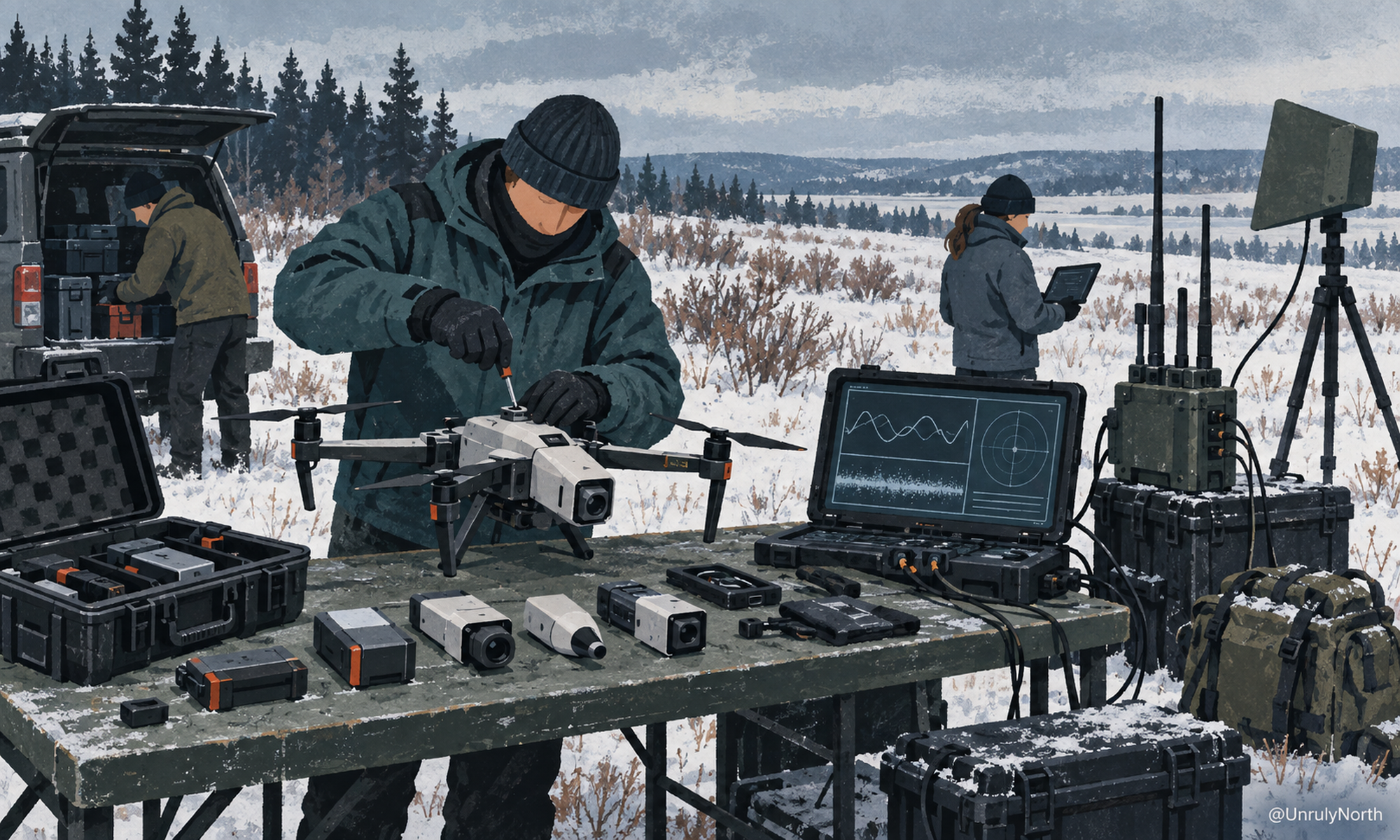
Ukraine has proved something harder and more useful. Conventional military power survives only when it is connected to a system that can sense, communicate, disperse, jam, repair, replenish and change. Drones matter enormously, but the decisive capability is the institution around them. The side that learns faster can make a good weapon better, rescue a failing tactic, exploit an exposed network or force the enemy to redesign its answer.
That distinction matters to Canada because Ottawa is now building its own drone and counter-drone machinery. The federal government launched a Defence Drone Initiative on July 23, 2026, to accelerate development, testing, adaptation and production of uncrewed systems. The Canadian Army’s MINERVA initiative is meant to tighten the feedback loop among soldiers, engineers, industry and government. Those are sensible starts. Their value will depend less on the announcement than on how quickly a battlefield observation can become a tested change in software, hardware, tactics or production.
NATO Has Not Ignored the Drone War
NATO is not sleepwalking through this change. At its July 2026 summit, Allies announced more than US$40 billion in counter-drone investment over five years, a goal of training five times as many drone operators by the end of 2027, and a marketplace for NATO-tested, NATO-compatible systems. Those are commitments, not completed spending, and the difference matters. Still, they show that the alliance understands the scale of the threat.
The alliance has also adopted a Rapid Adoption Action Plan that aims to integrate new technological products within 24 months. Its 2026 Innovation Scale-Up Package is intended to make demand clearer, widen access to financing and connect production with more manufacturing capacity. NATO is trying to move faster. The unresolved question is whether a two-year target can keep pace with a battlefield on which useful countermeasures can lose effectiveness in weeks or months.
That is the gap Ukraine keeps exposing. A force can be well equipped on the day an exercise begins and still be poorly prepared for a war that changes its technical assumptions six months later. Readiness is not only the amount of ammunition, fuel, equipment and trained personnel on hand. It is also the ability to rewrite software, qualify a new interceptor, reprogram an electronic-warfare system, alter a flight profile, shift a production line and return the improvement to the field before the enemy gains a durable edge.
The Threat Does Not Hold Still
Russia’s increased use of jet-powered attack drones is a current example. Reuters reported on September 15 that Ukrainian military data showed Russia increasing its use of faster jet drones roughly sixfold over three summer months. Ukraine had become increasingly effective against slower Shahed-type systems. The faster drones changed the problem. During a July test, some Ukrainian interceptor drones proved difficult to control at speeds above 400 kilometres per hour, according to sources who described the exercise to Reuters.
The episode does not prove that defence is futile. It proves that success has a shelf life. A countermeasure changes the attacker’s incentives, the attacker alters the weapon or tactic, and the defender must answer again. Ukraine’s developers are working on faster interceptors and other responses. Russia will study those responses. Neither side gets to declare the problem solved.
This is why the drone itself can become a distraction. A reconnaissance drone may locate a target, but the effect depends on whether the information reaches a weapon quickly enough to matter. A strike drone can destroy a vehicle but cannot occupy ground. An interceptor drone can defeat some uncrewed aircraft, but it cannot replace the high-end systems needed against ballistic missiles, advanced cruise missiles or crewed aircraft. The real unit of military power is the connected system: sensors, communications, weapons, logistics, software, electronic warfare, maintenance and people.
Electronic Warfare Is Part of the System
Ukraine and Russia have both used electronic warfare to interfere with navigation, control links, communications and targeting. The contest pushes operators toward new frequencies, hardened links, greater autonomy, alternative navigation and tactics that reveal less about their location. A 2026 Carnegie analysis describes rapid adaptation as a core military capability and argues that drones, data fusion, networked warfare and affordable precision are changing operating concepts as well as weapons.
For NATO, the lesson is broader than buying more jammers. Western forces became more networked because networks improve awareness, coordination and precision. That advantage becomes a vulnerability when access is assumed to be permanent. A resilient force needs redundant communications, multiple ways to navigate, passive sensors, disciplined electronic emissions and units trained to keep operating when digital services degrade.
That demand reaches beyond combat units. Engineers need access to operator feedback. Software teams need a secure path to issue updates. Procurement officials need authority to buy limited quantities for testing without locking the entire force into an immature design. Commanders need exercises that expose dependence on GPS, stable communications and fixed headquarters instead of quietly preserving those conveniences so the exercise looks successful.
The Cost of the Defensive Shot Matters
Ukraine has also forced NATO to confront the economics of interception. An expensive missile may be entirely justified against a ballistic missile, a sophisticated aircraft or another high-value threat. It becomes a poor default against every cheap incoming drone. The defender can win the engagement and still lose the industrial contest if each interception consumes a weapon that costs far more and takes far longer to replace than the threat it destroys.
Reuters reported on September 16 that European militaries are exploring cheaper missiles and interceptors after Ukraine and the Middle East exposed the limits of small high-end inventories. The emerging answer is layered defence: electronic warfare, guns, interceptor drones and lower-cost missiles deal with threats they can handle, while scarce premium interceptors remain available for targets that require them. Industry executives interviewed by Reuters stressed that manufacturing capacity, qualification and replenishment now matter as much as missile design.
This does not make advanced systems obsolete. Strategic air defence, undersea warfare, high-end aircraft, long-range strike and sophisticated intelligence cannot be recreated with commercial components and enthusiasm. The problem is a force composed almost entirely of exquisite systems: too few to absorb losses, too costly to fire at mass threats and too slow to replace at wartime consumption rates. NATO needs a high-low mix that preserves the capabilities only advanced systems can provide while adding the affordable mass needed to stay in the fight.
Standards Must Enable Change
NATO’s institutional challenge is to build that mix without sacrificing interoperability. Common standards allow forces from different countries to communicate, share data, refuel, rearm and fight together. Standardization is combat power. It becomes a liability only when it freezes technology in place or forces every modest update through a process slower than the enemy’s innovation cycle.
The practical answer is to decide which parts of a system must remain stable and which must be designed to change. A major warship, fighter or strategic air-defence system requires years of engineering and testing. A sensor’s software, an electronic-warfare library, a small drone payload or a battlefield application may need a different acquisition rhythm. Open interfaces, replaceable payloads, reserved power and data capacity, controlled software updates and rapid test pathways are not administrative details. They determine whether an expensive platform can remain useful as the threat changes.
Speed still needs accountability. Defence failures can kill people, and rushed procurement can turn urgency into waste. But a system designed only to avoid buying the wrong thing can create a larger operational risk: fielding yesterday’s solution after the enemy has moved on. NATO needs to manage both dangers instead of treating delay as the safe choice.
Canada Has a Test in Front of It
Canada’s recent programs make this argument immediate rather than theoretical. The Defence Drone Initiative is exploring standardized payloads, interfaces, safety systems, low-collateral counter-drone interceptors and a competitive supplier pool. MINERVA is built around practical collaboration among soldiers, engineers and industry. Canada also signed a May 2026 arrangement with Ukraine to support production of Ukrainian uncrewed aerial systems in Canada.
Ottawa should resist the temptation to treat these programs as proof that adaptation has been solved. Their success should be measured by elapsed time and operational effect. How long does it take to turn a soldier’s report into a design change? How quickly can the change be tested safely? Can a qualified supplier move from prototype to limited production before the threat changes again? Can the Canadian Armed Forces accept a useful allied system without restarting the entire learning process? Can the production base replenish losses at the rate a real conflict would impose?
Those measures are less glamorous than a procurement announcement. They are also closer to the reality of war. Canada can buy the right drone and still build the wrong military if every update waits on a peacetime process that assumes the technical problem will remain stable.
Learning Speed Is Combat Power
Ukraine should not be copied as a universal blueprint. Its war reflects specific geography, industrial limits, political constraints, intelligence support and an enemy with its own strengths and weaknesses. NATO has capabilities Ukraine does not, including more advanced airpower, larger alliance networks and different strategic depth. A future opponent will present problems Ukraine has not faced.
That is precisely why adaptation is the durable lesson. Reuters reported on September 17 that Ukrainian and Western officials see battlefield innovation moving in weeks while NATO systems are often developed and bought over years or decades. The alliance does not need to reproduce the Ukrainian force of 2026. It needs institutions capable of absorbing the next disruptive change before a crisis makes the lesson lethal.
Tanks still matter, but they need reconnaissance, electronic protection, air defence, engineering, deception and logistics. Fighters still matter, but they depend on survivable bases, weapons stocks, resilient communications and countermeasures that can be updated. Warships still matter, but they operate among missiles, drones, submarines, sensors and electronic threats. Every platform is only as durable as the system that supports and changes it.
NATO is buying drones. It is expanding training, testing, procurement and production. Those moves are necessary. The harder task is building a military culture that can admit when a system is failing, learn from operators, modify the design, scale the answer and share it across the alliance before the enemy gets comfortable. The future force is not simply the one that starts with the best equipment. It is the one that can still improve after the shooting starts.