
Trump Wanted NATO to Spend More. Allies Are Building Alternatives to US Arms.
Canada and Europe are buying, building and financing alternatives to American weapons suppliers. The shift is uneven but consequential: allies taking greater responsibility for their defence are also seeking greater control over the industries and technology behind it.
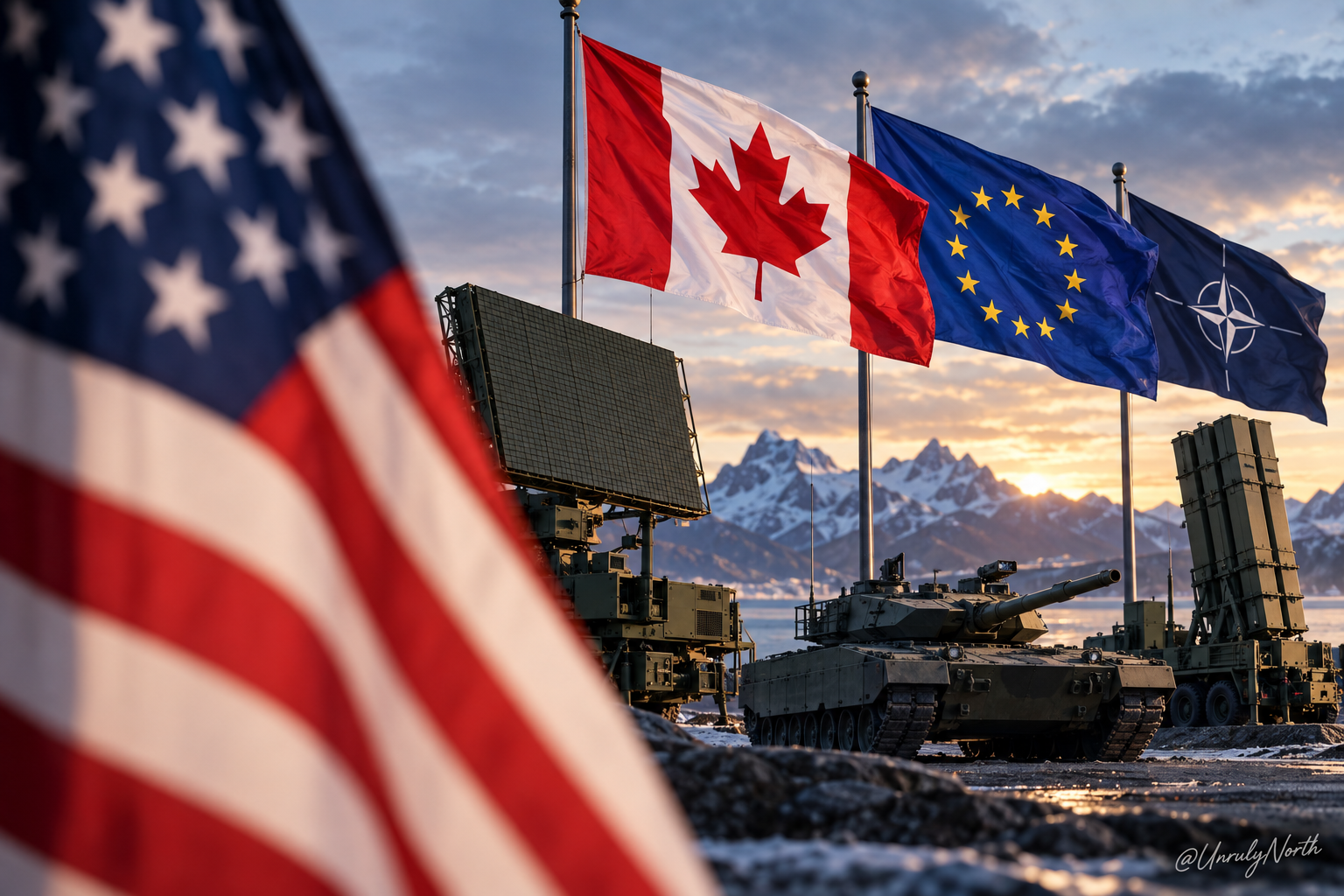
Donald Trump wanted NATO allies to spend more on their own defence. Increasingly, they are doing so while building alternatives to the American companies that expected to benefit. The contradiction is becoming concrete: a European air-defence system chosen over Patriot, Australian radar technology heading to Canada, European missile production expanding, and procurement rules designed to keep more of the spending inside Europe and partner countries.
The stakes extend beyond lost contracts. For decades, American weapons sales helped bind allied militaries to Washington through training, maintenance, ammunition, technology and long-term support. When allies invest in the capacity to supply themselves, they acquire more than industrial jobs. They gain room to make decisions without having to assume that American political goodwill will always be available.
According to NATO’s defence-spending figures, European allies and Canada increased their combined expenditure by nearly 20 per cent in real terms in 2025, taking it above US$571 billion in constant 2021 prices. The Hague summit commitment goes further: by 2035, at least 3.5 per cent of GDP for core defence requirements, with up to another 1.5 per cent for broader defence and security-related investment. That is a commitment, not money already spent, and the full five per cent is not an arms-buying budget.
Russia’s full-scale invasion of Ukraine is fundamental to this rearmament. So are longstanding industrial weaknesses and the need to replace equipment and replenish ammunition. Trump did not invent those problems, and several of the programmes now strengthening European capacity predate his second presidency. His contribution is a different incentive: making dependence on the United States look more politically hazardous.
That judgement should not be inflated into a claim that Europe has stopped buying American weapons. SIPRI’s March 2026 assessment found that the United States supplied 48 per cent of European states’ major-arms imports in 2021–25; American arms exports to Europe rose 217 per cent from the preceding five-year period. These are measures of transfer volume, not procurement spending, and Europe includes Ukraine. Nevertheless, they decisively contradict the idea of an accomplished continental boycott.
The consequential change is where governments want the next generation of dependence to reside. Washington can sell more weapons during an unprecedented spending surge while simultaneously losing future opportunities, industrial influence and the privilege of being the unquestioned supplier.
Three different ways to move money away from US arms companies
What the evidence can establish
| Action | What it means |
| Financial divestment | Selling investments or excluding companies from an investment portfolio. |
| Procurement substitution | Choosing another supplier instead of an American offer or abandoning a contemplated US purchase. |
| Industrial diversification | Building alternative production, technology and partnerships, whether or not an American contract is cancelled. |
All three can reduce exposure to the US military-industrial complex. They are not interchangeable, and their contract values cannot honestly be added together as a total of American sales lost.
Canada is putting alternatives into agreements
For Canada, the argument is inseparable from sovereignty. Trump combined trade pressure with repeated suggestions that Canada should become the 51st state, as Reuters documented in March 2025. A government faced with that behaviour does not need to prove that Washington will interrupt military support before it starts reducing avoidable exposure. The point of contingency planning is to act before an unfriendly possibility becomes an operational emergency.
Geography and NORAD make the American relationship indispensable to Canadian defence planning. They do not require every important procurement to strengthen American industrial dominance. The following decisions show how Ottawa is beginning to widen its options, although their stages of implementation differ considerably.
- Australian radar: formal acquisition arrangements. On 22 June 2026, Canada signed arrangements with Australia and BAE Systems Australia for Arctic over-the-horizon radar, including technology-rights and industrial-benefits agreements. Ottawa committed C$2.5 billion to procuring the Australian capability; the broader Canadian programme had previously been announced at more than C$6 billion. Those are different figures, not competing prices for the same contract. The official announcement puts the programme into its delivery phase, targeting initial operational capability in December 2029. It is a substantial non-US technology partnership serving continental defence.
- German submarines: preferred supplier, negotiations still required. On 6 July 2026, Ottawa selected Thyssenkrupp Marine Systems as preferred supplier for up to 12 submarines, using the 212CD platform shared with Germany and Norway. Canada said it intended to conclude contracting by the end of 2027, with the first four boats delivered in 2034. The announcement expressly allows a turn to reserve supplier Hanwha Ocean if negotiations fail. This is a major prospective European partnership, not a completed fleet purchase or a cancelled American submarine order.
- Future combat aircraft: observer participation. On 21 July 2026, National Defence announced that Canada would become the first observer nation in the Global Combat Air Programme, the British-Italian-Japanese project developing a next-generation combat aircraft. This creates a route to assess future industrial participation outside a US-led programme. Observer status is not a purchase, full development membership or evidence that Canada has replaced its F-35 acquisition. Its immediate significance is access to another long-term technological conversation.
- Domestic procurement: an explicit policy target. Canada’s Defence Industrial Strategy sets a goal of awarding 70 per cent of defence acquisitions to Canadian firms within a decade and introduces a Build–Partner–Buy approach. Domestic capability comes first where feasible, allied collaboration follows, and foreign purchases remain available. The target is not an achieved procurement share. Nor does a contract awarded to a Canadian firm automatically eliminate foreign components, ownership or licensing restrictions. Its importance is the declared direction of purchasing policy.
- European procurement access: a concluded international agreement. The EU Council formally concluded Canada’s SAFE agreement on 15 June 2026, following its February signature. Canada became the first non-European country participating in the instrument through such an agreement. This opens an additional route for Canadian companies and products into eligible European procurement. Subsequent orders will determine its economic value. The agreement creates the institutional conditions under which future spending can support a wider industrial network.
These measures matter together. A country that merely changes the nationality on a purchase order can remain dependent on an outside supplier. A country that secures technology rights, maintenance knowledge, industrial participation and access to several partners has a better chance of retaining useful choices throughout the equipment’s service life.
Across Europe, the shift reaches aircraft, missiles and factories
The European evidence ranges from a direct competitive loss for an American system to investments that preserve alternatives for the future. Treating every European purchase as a rebuke to Trump would distort the chronology. Treating them all as routine shopping would miss the strategic significance of countries deliberately sustaining the ability to equip themselves.
- Denmark: SAMP/T NG instead of Patriot. Copenhagen selected the Franco-Italian SAMP/T NG air-defence system over the American Patriot competitor, as Reuters reported. Thales’s April 2026 contract announcement put the start of deliveries in 2028, through prime contractor Eurosam. This is a clear example of procurement substitution. A supplier choice alone cannot establish how much weight officials assigned to each political, industrial or military consideration. The commercial result is unambiguous: a European win in a competition involving an American alternative.
- Spain: abandoning a contemplated F-35 purchase. In August 2025, a defence-ministry spokesperson confirmed to Reuters that Spain was no longer considering the F-35 and was concentrating on European options. This removed a prospective American sale; it was not cancellation of an existing Spanish F-35 contract. Choosing Europe also leaves difficult capability questions. A future aircraft programme and an aircraft available for purchase today are not interchangeable answers to an immediate military requirement.
- Poland: missile production and technology transfer. The 2023 UK–Poland Narew agreement, worth more than £4 billion, covered over 1,000 CAMM-ER missiles and more than 100 launchers, with manufacturing knowledge transferred to Poland. In April 2026, Warsaw announced a further investment agreement for missile motors and warheads at MESKO. This builds Polish and European capacity rather than simply importing finished weapons. It is not complete separation: the British announcement explicitly identifies the US Integrated Battle Command System as part of the wider architecture.
- Germany: a continuing European fighter production line. Berlin contracted for 20 additional Eurofighters in October 2025, with deliveries planned from 2031. The Bundeswehr says formal preparation began in June 2024. That chronology rules out presenting the order as something invented in response to Trump’s second term. Nevertheless, buying aircraft from the European consortium sustains engineering, production and upgrade capacity that would otherwise be lost or weakened. It is industrial diversification, not evidence that Germany has renounced American aircraft.
- Germany: expanded ammunition manufacturing. Rheinmetall opened its new Unterlüß ammunition plant in 2025 after investing almost €500 million. The company’s opening announcement described an eventual capacity of up to 350,000 artillery shells annually. That is a capacity objective, not verified annual output already achieved. A functioning factory, however, is materially different from a declaration of ambition: it creates additional production infrastructure from which European customers can replenish ammunition without relying exclusively on external supply.
- France: domestic artificial intelligence for defence. A French defence-ministry statement dated 8 January 2026 disclosed a framework agreement awarded to Mistral AI on 16 December 2025, explicitly linking it to technological sovereignty. This is a procurement framework, not proof that American software has been comprehensively replaced. It shows the autonomy argument reaching the digital systems through which militaries analyse information and support decisions, rather than stopping at aircraft and armoured vehicles.
- Norway and Germany: a shared submarine industrial base. Their 212CD programme entered production in 2023 under an initial contract covering four Norwegian and two German submarines. Norway’sproduction announcement also described a shared maintenance facility at Haakonsvern. These were the initial contracted quantities, not a claim about the programme’s eventual total. The case demonstrates European design, production and sustainment cooperation predating the current US administration. Canada’s subsequent preferred-supplier decision could extend that network. It should not be falsely counted as the displacement of an American submarine contract.
- Britain and France: renewing a European strike-missile supply. In July 2025, the two governments announced additional Storm Shadow/SCALP purchases and production-line upgrades, alongside work on a successor. This strengthens a European source of long-range strike weapons and the industrial expertise behind it. It is an extension of an established partnership, not a newly invented replacement for every American missile. Its strategic value lies in preserving an additional supply and development route.
- NATO surveillance: selecting Sweden’s GlobalEye. In July 2026, NATO selected Saab’s GlobalEye for negotiations over up to ten airborne early-warning and control aircraft. Saab explicitly stated that it had not yet signed a contract or received an order at the announcement. The proposed system combines Swedish sensors and command technology with a Bombardier Global 6500 aircraft, giving it a Canadian industrial connection. Reuters reported the selection as a win over a Boeing alternative. This is a significant supplier choice, with contracting and delivery still distinct steps.
Denmark gives this industrial story its sharpest political edge. An ally buying equipment for collective security has also had to defend Greenland’s sovereignty against pressure from the alliance’s dominant member. The agreement announced on 18 September 2026 envisaged an expanded US military presence while leaving Greenland within the Kingdom of Denmark. Even a settlement does not erase the planning lesson of the confrontation: alliance membership is a poor reason to stop assessing dependence.
The larger shift is in the rules governing the money
Individual contracts are visible. Procurement rules can change the market beneath them. The EU’s Security Action for Europe instrument provides up to €150 billion in loans to member states for defence investment through common procurement. Its baseline eligibility rules limit components originating outside the EU, the EEA-EFTA states and Ukraine to 35 per cent of estimated component costs, with additional agreements able to open eligibility further.
That is not a universal prohibition on American weapons, nor a requirement governing every European defence purchase. Within the scheme, however, financing and industrial eligibility are deliberately connected. For a category of more complex systems, contractors must also have the ability to decide how the product’s design is defined, adapted and developed. The policy asks who can change the equipment, not simply where the final assembly takes place.
The distinction is crucial. A domestic factory can provide jobs while leaving the customer reliant on foreign licences, components or technical decisions. Sovereign capability is stronger when the buyer can sustain equipment, obtain ammunition, adapt it to changing threats and preserve access to the information needed to operate it. A flag on a factory is not sufficient evidence of that control.
This is why ammunition, software and intellectual property belong in the same argument. Ammunition determines whether a force can continue fighting. Software and technical rights help determine whether its equipment can evolve. A procurement policy that prizes only the initial purchase price can miss the long-term cost of having too few alternatives when circumstances change.
There is also an industrial feedback effect. Consistent orders can justify production facilities and retain skilled workers; established capacity can make subsequent domestic or allied orders more feasible. The effect is not automatic. Governments must still specify useful equipment, enforce contracts and resist the temptation to label every subsidy a strategic necessity. But spending that builds a durable capability can alter the options available to the next government.
Actual financial divestment has a different purpose
Investment exclusions belong in this story, but on their own terms. The following documented cases concern institutional portfolios rather than military purchasing. Their motivations cannot honestly be folded into a single Trump-driven campaign.
- Norway’s KLP and Oshkosh. In June 2025, KLP and its funds excluded the US weapons manufacturer Oshkosh, citing weapons sales to Israel and inadequate documentation of due diligence concerning potential involvement in violations of humanitarian law. KLP reported holding approximately NOK19 million in Oshkosh shares before the exclusion. Its simultaneous exclusion of Germany’s Thyssenkrupp makes clear that this was an ethical investment decision, not a buy-European policy.
- Norway’s KLP and Caterpillar. In June 2024, KLP excluded Caterpillar over risks linked to the use of its equipment in the West Bank and Gaza. Before the exclusion, the funds held about NOK728 million in shares and bonds. Caterpillar is a diversified equipment manufacturer, not a pure arms producer; the military and human-rights exposure explains its relevance. KLP’s assessment should be identified as its assessment, rather than presented as a court judgement.
- Canada’s Concordia University Inter-Generational Fund. In October 2025, the university confirmed that none of the funds managed by CUiF held investments in weapons manufacturers. This establishes a documented weapons-free portfolio position. The statement does not itemize sales of particular US defence stocks, so it cannot support an invented list of American companies divested or a dollar estimate of withdrawn investment.
These distinctions expose another uncomfortable truth: reducing dependence on American arms companies is not necessarily reducing militarism. European rearmament can transfer business to European manufacturers while greatly increasing overall weapons spending. Ethical divestment may seek to restrict financing associated with harm; industrial diversification usually seeks to make military power more reliable. They can affect the same companies for profoundly different reasons.
American dependence will not disappear on a procurement timetable
Some of the hardest gaps concern the capabilities that allow entire forces to operate effectively. The International Institute for Strategic Studies has identified European dependence on US intelligence, surveillance, reconnaissance and aerial refuelling. Buying European fighters or missiles does not by itself provide the information, supporting aircraft and operational depth needed to use them in a major conflict. These are separate investment problems, and solving them demands more than changing a preferred supplier.
The strongest limit on the argument comes from governments’ own purchasing decisions. On 7 July 2026, even after selecting European air defence, Denmark announced that it would initially acquire two Boeing P-8A maritime patrol aircraft. Copenhagen can reduce dependence in one capability while choosing an American supplier in another. That does not erase the SAMP/T decision; it establishes the actual scope of the change.
Canada’s fighter debate requires the same discipline. National Defence’s 2026–27 capital-project plan still describes F-35 acquisition, training and infrastructure work, including planned aircraft acceptance at Luke Air Force Base. A review, an alternative manufacturer’s sales pitch and Canadian observer status in another fighter programme are not evidence of a completed F-35 cancellation. Confusing them would turn a defensible account of diversification into wishful thinking.
The same caution applies to headlines about factories. A plant’s maximum capacity is not its present production; an announced delivery date is not equipment in service. Procurement changes cannot instantly supply trained crews, maintenance organizations or years of operational experience. Replacing a mature system can also introduce new costs and risks that have to be justified against the dependence it reduces.
American companies are responding rather than passively surrendering the market. Reuters reported from the July 2026 Farnborough Airshow that US manufacturers were offering more local production and industrial partnerships as European customers demanded greater control. Such arrangements can improve supply resilience without removing American corporate participation. Their value depends on the rights and capabilities actually transferred, not the nationality of the ribbon-cutting ceremony.
Nor would exchanging one external monopoly for another necessarily solve the underlying problem. For smaller states, useful autonomy often means shared production with reliable partners, several sources of supply and enforceable access to technology. Trying to manufacture everything at home could consume resources without producing a credible force. Leaving every critical function dependent on one foreign capital is the opposite failure.
A stronger alliance can also mean less American leverage
The American military-industrial complex has benefited from an alliance in which buying American frequently reinforced both military cooperation and long-term dependence. More capable allies will still need cooperation. They have increasingly good reasons to bargain over the dependence.
Trump’s pressure contains a contradiction that cannot be resolved by demanding gratitude. If allies are expected to carry more of the defence burden, they must develop the budgets, institutions and industrial capabilities to do so. Those same capabilities give them choices about suppliers and strategy. Threatening their economic interests or sovereignty makes the case for acquiring those choices more urgent.
The outcome is not predetermined. Domestic procurement targets can fail, European projects can stall, and American manufacturers can retain customers by offering equipment and partnerships that meet real needs. The documented shift is more specific: governments are writing alternatives into agreements, financing rules and production facilities. Those decisions can outlast the political dispute that helped make them attractive.
For Canada and Europe, the test will be whether the spending produces usable equipment and lasting control over its support and development. For Washington, the consequence may be an alliance that contributes more to collective defence while becoming harder to pressure through industrial dependence. An ally capable of carrying its own weight is also more capable of choosing where it buys the equipment.
Sources, dates and how the examples are classified
This article was researched on 19 September 2026. Links identify government announcements, procurement documentation, company disclosures, institutional investment statements and independent reporting. Announcements are described at their documented stage; future delivery and capacity figures remain targets. Supplier statements establish what companies announced, not independently verified performance. Financial exclusions are distinguished from procurement and industrial policy. No total of “US investment lost” is calculated because the examples measure different things and several do not replace an identifiable American contract.