
Canada Has No Provincial Border Checkpoints. It Still Has Trade Barriers
Ottawa removed all 53 of its exceptions under the Canadian Free Trade Agreement by June 30, 2025. Its broader federal trade and labor mobility law took effect on January 1, 2026. Much of the unfinished work now rests with the provinces, where the remaining barriers are less visible but still very real.
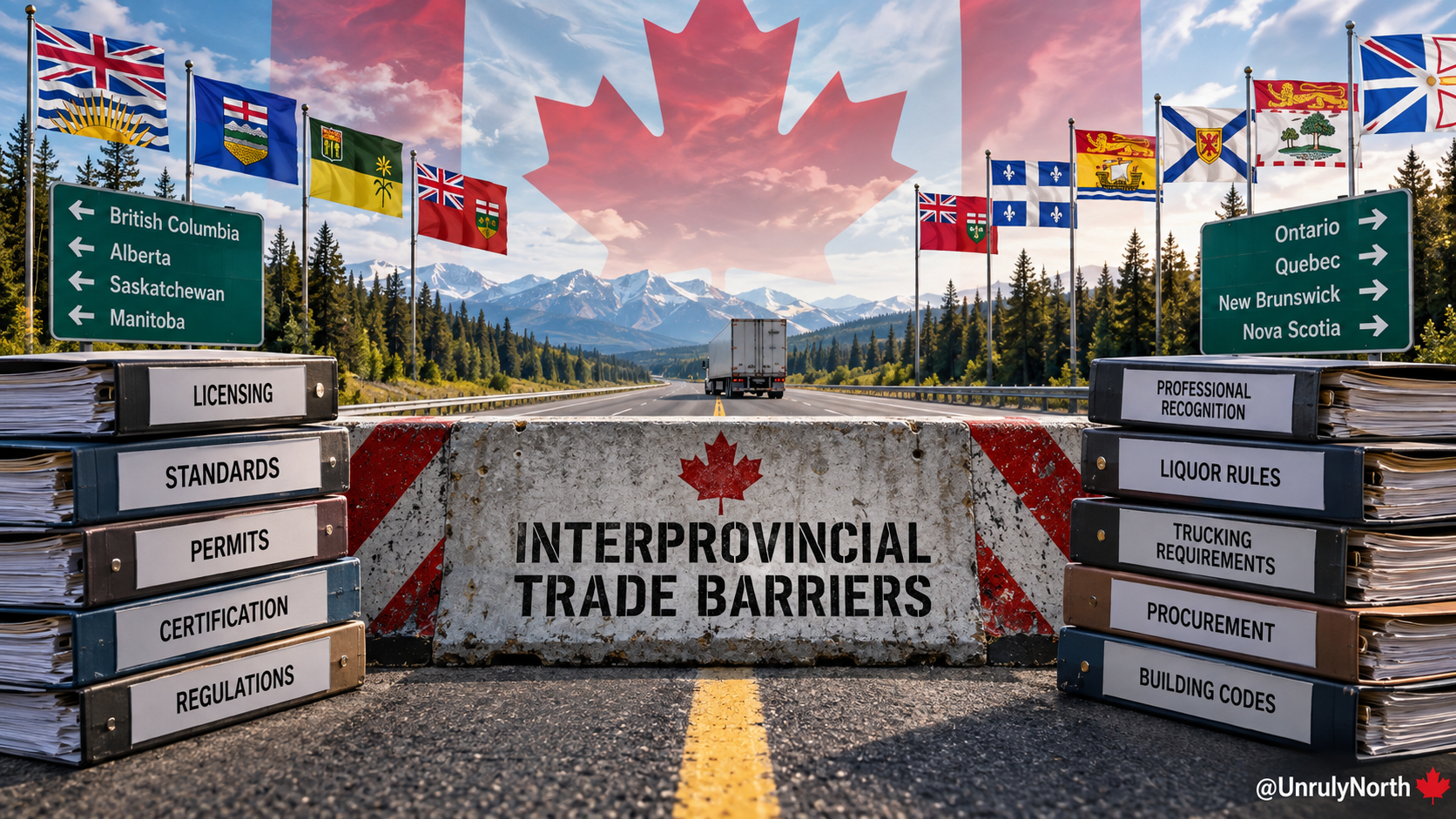
Most Canadians have never thought of a provincial boundary as a trade border. There are no customs booths between Ontario and Manitoba, no tariffs collected when a truck enters Saskatchewan, and no provincial border guards asking what someone bought in Alberta. You can drive from one end of the country to the other without showing a passport, declaring goods, or paying a provincial import duty. That makes the phrase “interprovincial trade barrier” sound almost abstract, because the border itself appears to be completely open.
The barriers are real, but they usually do not sit beside the highway. They are found in licensing rules, product standards, permits, professional regulations, procurement policies, liquor systems, trucking requirements, and other provincial rules that determine whether a company can actually sell, transport, install, or provide something after it crosses the provincial line. A product can move freely from one province to another while the legal permission to sell or use it does not move nearly as easily.
That distinction is the key to understanding Canada’s internal trade problem. The country does not generally have tariffs between provinces, and the Constitution limits governments from using tariff-like measures to block goods from elsewhere in Canada. What Canada does have is a patchwork of provincial regulatory systems that sometimes require businesses and workers to meet another set of rules simply because they crossed from one province into another.
The simplest way to describe it is this: the paperwork is the border.
A major part of the economy most Canadians rarely see
Internal trade is not a minor corner of the Canadian economy. Statistics Canada reported that provinces and territories traded about $527 billion in goods and services with one another in 2024, equal to roughly 17 percent of the country’s gross domestic product. Millions of Canadians work for companies that depend directly or indirectly on business conducted across provincial lines.
Not every obstacle in that trade is caused by government regulation. Canada is a vast country, and geography imposes costs that no premier or prime minister can legislate away. Statistics Canada found that transportation costs remain one of the most common problems reported by businesses trading between provinces. Shipping something from Toronto to Calgary will always cost more than moving it from Toronto to Hamilton because Calgary is much farther away.
But distance is one thing. Requiring a business to navigate a second licensing system, repeat a certification process, redesign a product, or comply with a different set of administrative rules is another. Those are costs created by policy rather than geography, and those are the barriers governments have been trying to reduce.
What a trade barrier actually looks like
Imagine an Ontario company that manufactures a product legally and sells it throughout the province. The company has met Ontario’s rules, passed whatever inspections are required, and built a business around those standards. A customer in Manitoba wants to buy the same product. The truck carrying it can drive across the provincial boundary without stopping, but that does not automatically mean the company is free to sell, install, or service the product under exactly the same conditions.
The Manitoba market may involve a different certification, registration, permit, labeling standard, product rule, or regulatory process. None of those requirements looks like a traditional border. There is no guard demanding payment and no tariff printed on an invoice. Yet the economic effect can still be significant because the company has to spend time and money satisfying another set of rules before it can do the same business in another part of the same country.
Some of those differences may be justified. Others may amount to little more than duplication. The internal trade debate is largely about separating the two.
Alcohol is one of the clearest examples
Alcohol has long provided one of the easiest ways to explain Canada’s invisible internal borders. A Canadian consumer could order clothing, electronics, books, or household goods from a business in another province with little thought about provincial boundaries, yet buying wine or spirits directly from a producer in another province could be far more complicated.
The problem was not a customs booth. It was the provincial liquor system. Provinces have extensive authority over the sale and distribution of alcohol, which meant that removing federal restrictions did not automatically create a single national market. Ottawa could change federal law, but provincial governments still had to decide whether producers elsewhere in Canada could sell directly to their residents and under what conditions.
That distinction became especially clear in 2026. By then, the federal government said it had removed the remaining federal restrictions affecting direct interprovincial alcohol sales, but provincial participation was still required before Canadians could enjoy a genuinely open direct-to-consumer market. In July 2026, nine provinces signed an agreement covering direct sales between participating jurisdictions, with most beginning implementation and British Columbia committing to a later start for all alcohol categories.
This is what an interprovincial trade barrier looks like in practice. The bottle was never physically stopped at the provincial line. The barrier existed in the rules governing whether the producer was allowed to sell the bottle directly to the consumer in the first place.
Trucking shows how different rules add real costs
The trucking industry offers another useful example because trucks cross provincial boundaries every day. There are no internal customs inspections, but provinces have historically maintained different rules concerning vehicle weights, dimensions, permits, equipment, oversized loads, and other operating requirements.
Some differences are clearly legitimate. Provinces have to protect roads and bridges, and infrastructure conditions are not identical across Canada. A weight restriction may exist because a bridge cannot safely handle heavier vehicles, or because a particular road was not designed for them. That is not an unreasonable trade barrier. It is a transportation and safety rule.
The problem comes when different jurisdictions maintain different requirements without a clear safety or infrastructure reason. A trucking company operating nationally may have to understand and comply with several different systems even when the vehicle is performing essentially the same job everywhere. That means additional permits, changes to equipment, different operating procedures, and more administrative work.
Nova Scotia offered a clear example when it changed its rules in 2025 to allow more commercial vehicles registered elsewhere in Canada to operate in the province. Before that change, some vehicles legally registered in another Canadian jurisdiction could not operate there under the same terms. The province still retained road and safety protections, but it removed a regulatory obstacle that had made national trucking more complicated than necessary.
That is the broader issue. Canada does not need to abandon vehicle safety rules to improve internal trade. It needs to decide whether thirteen different versions of those rules are always necessary.
Even a prefabricated house can hit a provincial border
Construction provides another example that ordinary Canadians can understand. A company that manufactures factory-built or modular homes may design a model that meets recognized standards and performs safely in one province. If another province requires a different approval process or additional standards, the manufacturer may have to redesign, recertify, or re-document the same structure before selling it there.
Nova Scotia moved to reduce this problem in 2025 by changing how it treated factory-built structures that met the National Building Code. The province said the previous approach could force manufacturers to redesign similar structures for different provincial requirements, adding cost and delay.
The home itself does not somehow become unsafe at the provincial boundary. What changes is the regulatory jurisdiction responsible for approving it.
Again, there may be sound reasons for regional differences. Climate, snow loads, seismic conditions, local infrastructure, and other factors can justify different construction requirements. The issue is not whether all building rules should be identical from Victoria to St. John’s. The issue is whether a province should require a second process where another recognized Canadian standard already provides the protection it needs.
Workers encounter the same problem
Goods are only half the story. Canadian workers can also encounter provincial barriers even though they are free to move anywhere in the country.
A qualified electrician, engineer, architect, tradesperson, or other regulated professional does not become less educated or experienced after crossing a provincial border. Yet many professions are regulated provincially, which means a worker may still have to register with another regulator, submit documentation, verify credentials, pay additional fees, or complete another recognition process before working legally in a different province.
Canada already has labor mobility provisions under the Canadian Free Trade Agreement, so it would be inaccurate to suggest that qualified workers normally have to repeat their entire education or apprenticeship when they move. The remaining problems are more often administrative: how quickly credentials are recognized, what information must be supplied, and whether another jurisdiction accepts equivalent qualifications without unnecessary delay.
Governments have been working to make that process more predictable. In August 2026, federal, provincial, and territorial internal trade ministers approved a 30-day service standard for labor mobility applications. Jurisdictions have also been developing common approaches to recognizing certain forms of occupational safety training, including Working at Heights and Mobile Elevating Work Platforms.
The goal is not to weaken professional standards. A province still has every reason to make sure someone performing dangerous or highly skilled work is qualified. The question is whether a Canadian who has already been certified under a comparable system should have to repeatedly prove the same qualification.
Why Ottawa cannot simply erase the remaining barriers
At this point, an obvious question arises. If these barriers cost businesses money and make the national economy less efficient, why doesn’t the federal government simply outlaw them?
The answer lies in the structure of Canada itself.
Canada is a federation, not a unitary state. Provinces have substantial constitutional authority over property and civil rights, professions, local commerce, licensing, public safety, and many other areas that affect business activity. Ottawa has important powers over interprovincial and international trade, but those powers do not allow the federal government to take over every area of provincial regulation simply because a national system might be more convenient.
The Supreme Court of Canada’s 2018 decision in R. v. Comeau is central to understanding that limit. The case began after Gerard Comeau, a New Brunswick resident, bought alcohol in Quebec and brought it back home. He challenged the New Brunswick law that restricted the amount of alcohol he could personally import, arguing that Section 121 of the Constitution Act, 1867 required goods from one province to be “admitted free” into another.
The Supreme Court rejected the argument that Section 121 creates absolute free trade inside Canada. The Court ruled that tariffs and tariff-like measures whose purpose is to obstruct interprovincial trade are prohibited, but legitimate provincial regulatory schemes can still exist even if they incidentally make interprovincial commerce more difficult.
That distinction is important because it protects provincial authority to regulate health, safety, the environment, professions, transportation, and other legitimate public interests. A province does not automatically violate the Constitution simply because its rules differ from those next door.
The real target is duplication, not regulation
This is where the debate is often oversimplified. “Removing trade barriers” can sound like code for abolishing regulation, but that is not what serious internal trade reform requires.
Food still has to be safe. Electricians still have to be qualified. Trucks still have to operate within safe limits. Buildings still have to meet appropriate structural standards. Provinces still have legitimate reasons to regulate businesses and professions.
The question is whether those safeguards need to be proved again every time a business or worker crosses a provincial boundary.
If Saskatchewan and Ontario have comparable safety standards, Ontario may not need a company to repeat the same testing. If an electrician is fully licensed under a recognized Alberta system, Nova Scotia may not need to reproduce the entire assessment. If a truck is operating safely under a national or equivalent provincial standard, another jurisdiction may not need to impose a second administrative regime unless there is a specific local reason.
That concept is called mutual recognition, and it is increasingly at the center of Canada’s internal trade reforms.
Mutual recognition offers a different approach
Mutual recognition does not require every province to adopt identical laws. Instead, provinces agree to accept one another’s rules where those rules achieve a comparable result.
Imagine a product that can legally be sold in Manitoba. Ontario has two choices. It can require the manufacturer to meet another Ontario-specific process, or it can recognize Manitoba’s standard as equivalent and allow the product to be sold without duplicating the work.
The second approach preserves provincial authority while reducing unnecessary barriers.
Canada took an important step in this direction with the Canadian Mutual Recognition Agreement on the Sale of Goods, signed in 2025. Its general principle is that many goods legally sold in one participating Canadian jurisdiction can be sold in another without additional testing, certification, or other requirements unless a government has specifically preserved an exception.
The agreement does not cover everything. Important areas such as food, alcohol, tobacco, cannabis, live animals, and plants remain outside its broad application, and governments still retain specific powers to protect legitimate public interests. But the principle behind it is significant because it offers a way to create a more integrated national market without forcing every province to write identical legislation.
Ottawa had removed all 53 federal CFTA exceptions by June 30, 2025
The federal government has already taken major steps on the part of the system it controls.
The Canadian Free Trade Agreement came into force in 2017 and covers most economic activity unless a government specifically identifies an exception. Those exceptions function as carve-outs, allowing governments to preserve particular rules or policies that would otherwise be covered by the agreement.
Ottawa originally maintained 53 federal exceptions.
By June 30, 2025, the federal government had removed all 53 of them. The final step removed the last 20 federal exceptions, many of them related to government procurement.
The Carney government also passed the Free Trade and Labour Mobility in Canada Act as part of Bill C-5. It received royal assent on June 26, 2025, and the legislation and regulations came into force on January 1, 2026.
The principle behind the law is straightforward. Where a provincial or territorial requirement is comparable to a federal requirement, meeting the provincial rule can satisfy the federal government instead of forcing a business through another duplicate process. The law also helps workers with provincial or territorial occupational authorization obtain comparable federal authorization in areas where the legislation applies.
That was a major federal reform, but it did not cancel provincial law.
Ottawa removed Ottawa’s barriers.
It cannot automatically remove everybody else’s.
That is why the premiers now matter so much
The next stage of Canada’s internal trade effort depends heavily on provincial and territorial governments. Ottawa can encourage cooperation, negotiate agreements, use federal powers where appropriate, and remove duplication from its own rules, but it cannot simply rewrite every provincial licensing system, transportation code, liquor regime, or professional regulation.
That is why recent meetings between federal, provincial, and territorial internal trade ministers have focused increasingly on mutual recognition, labor mobility, transportation, construction, and other areas where provincial participation is essential. In August 2026, ministers continued work on broader mutual recognition and adopted the 30-day service standard for labor mobility applications.
This does not mean the provinces have done nothing. Several have already removed or simplified barriers, signed recognition agreements, and changed rules that once made interprovincial commerce more difficult. The political challenge is that every change has to be negotiated across governments that have different laws, industries, priorities, and political pressures.
That process is slower than passing one federal law because Canada is not one regulatory jurisdiction. It is a federation of governments that have to decide how much of their authority they are willing to recognize in one another.
Not every provincial difference is a problem
A national market does not require every rule in Canada to be identical.
British Columbia and Newfoundland do not have identical geography, infrastructure, industries, or environmental conditions. Quebec has language policies that other provinces do not. Northern provinces may have transportation and construction concerns that differ from those in southern Ontario. Public health and agricultural risks can also vary.
Different rules can therefore be completely reasonable.
The more useful test is whether a difference has a clear purpose.
If a truck faces a lower weight limit because a bridge cannot safely carry more, the justification is obvious. If a worker needs additional training because a particular job presents a distinct hazard, the requirement may be entirely defensible. If a province needs a specific food-control measure because of a genuine health or agricultural risk, that too can make sense.
But where no meaningful difference exists, governments increasingly have to explain why Canadians should pay the cost of complying with another system.
Canada’s internal borders were hiding in plain sight
Most Canadians were never especially aware of interprovincial trade barriers because they did not look like borders. There were no gates, no customs booths, and no border officers standing along the Trans-Canada Highway. Canadians could cross from one province to another so easily that the country appeared to operate as one seamless market.
Economically, it never quite did.
The borders were hidden in licensing systems, liquor rules, transportation codes, professional regulations, procurement policies, building standards, and administrative processes. Businesses experienced them as extra forms, extra fees, extra approvals, extra testing, and extra delays rather than as tariffs.
That is now changing. Ottawa had removed all 53 federal exceptions under the Canadian Free Trade Agreement by June 30, 2025. Its broader federal mutual-recognition and labor mobility framework came into force on January 1, 2026. Provinces have also begun opening direct alcohol sales, reconciling trucking rules, speeding credential recognition, and recognizing more standards from elsewhere in Canada.
The remaining challenge is not to abolish provincial regulation. It is to make governments justify duplication.
If a product is safe and legal in one province, another province should be able to explain why it needs a second approval. If a worker is qualified in one jurisdiction, another should be able to explain why that qualification is not enough. If a truck meets a safe Canadian standard, another province should have a clear reason before imposing another requirement.
Sometimes that reason will exist.
When it does not, the remaining barrier is no longer protecting Canadians from a meaningful risk. It is simply making Canadians prove the same thing twice.
And that is the part of Canada’s internal market the premiers now have to finish.