
Ukraine Has Democratized Warfare
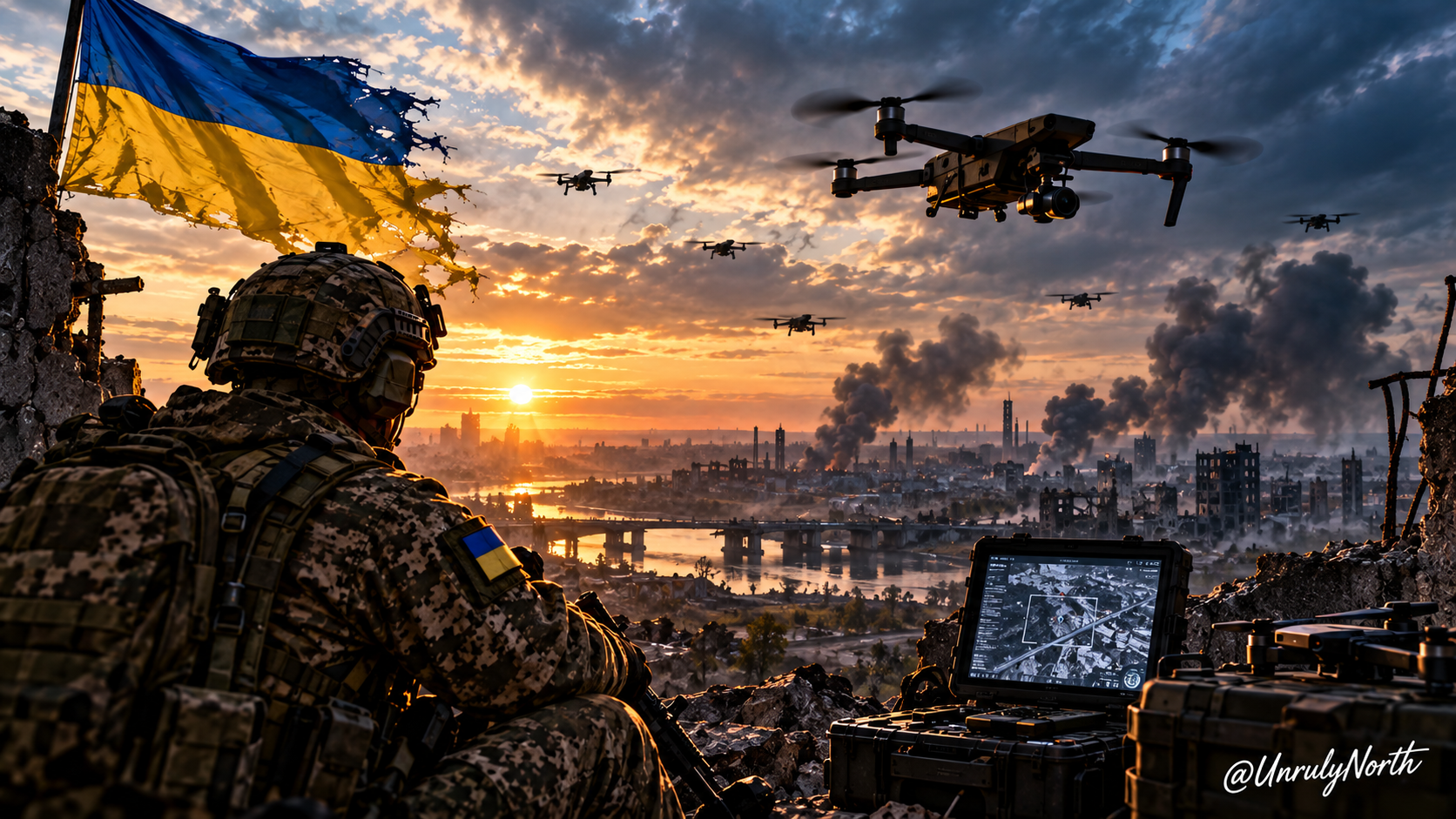
The war in Ukraine has not made fighter aircraft, tanks or precision missiles obsolete. It has done something potentially more consequential: it has shattered the assumption that sophisticated warfare belongs only to countries wealthy enough to buy the most sophisticated weapons.
For much of the precision-guided era, military power followed a familiar hierarchy. Wealthy states built stealth aircraft, satellites, cruise missiles, submarines and elaborate command networks. Countries without the money or industrial base to compete bought what they could, adapted older equipment and generally entered conventional war knowing they faced an enormous technological disadvantage.
Ukraine has complicated that equation.
A soldier with a relatively inexpensive drone can now search for a target kilometres away, identify it, relay its position and sometimes attack it without ever seeing it directly. Small units can possess reconnaissance and precision-strike capabilities that, not very long ago, would have required aircraft, artillery observers, specialized communications equipment and a substantial military organization behind them.
Ukraine did not invent drones. It did not invent electronic warfare, satellite communications or precision weapons. What it has demonstrated is what happens when commercial technology, military technology, software, improvisation and mass production collide on a battlefield where both sides are under relentless pressure to adapt.
Ukraine has not made warfare cheap. It has made sophisticated warfare cheaper to enter.
That is what it means to say Ukraine has democratized warfare.
Not democracy in the political sense, and certainly not warfare becoming cleaner or less destructive. It means capabilities that once helped separate major military powers from everyone else have become dramatically more accessible.
That should force Western militaries to reconsider not only what they buy, but how quickly they buy it, how many weapons they expect to lose, how rapidly they can replace them and what they believe the next major war will actually look like.
The Battlefield Is Becoming Transparent
One of the defining changes visible in Ukraine is the increasing transparency of the battlefield.
Reconnaissance drones, thermal cameras, satellites, electronic surveillance and persistent communications networks have made hiding large military formations increasingly difficult. A concentration of vehicles can attract drones. An artillery unit that remains in one position after firing can expose itself. Radio transmissions can help reveal headquarters. Supply routes well behind the apparent front can become hunting grounds.
The Pentagon has described the principle with unusual simplicity: if a force can be seen, it can increasingly be hit.
That does not mean manoeuvre warfare is finished. It means movement, concealment, dispersion, electronic warfare, deception and speed are becoming inseparable from it.
The result is almost paradoxical. Armies may need to spread themselves farther apart physically while becoming more tightly connected electronically. Soldiers, artillery, aircraft, drones and sensors do not necessarily have to occupy the same patch of ground if they belong to the same information network.
The important military formation of the future may therefore be less visible than the formation of the past. Power comes not simply from assembling large numbers of weapons in one place, but from connecting weapons dispersed across enormous areas and allowing them to find targets for one another.
Precision Is No Longer a Luxury Product
This may be the most disruptive change of all.
For decades, precision warfare was expensive. A state wanting to strike individual targets accurately at significant distance needed specialized aircraft, precision-guided bombs, cruise missiles or other advanced weapons.
Ukraine has demonstrated another route.
An inexpensive first-person-view drone can locate a vehicle and attack a vulnerable point. Larger one-way attack drones can travel hundreds of kilometres. Uncrewed surface vessels can threaten warships. Drones can serve as scouts, communications relays, decoys, electronic-warfare platforms and weapons.
None of them can do everything that an advanced fighter or cruise missile can do.
They do not need to.
They only need to perform a useful military task at a price and scale that allow commanders to deploy them repeatedly.
The Pentagon has described this emerging combination as precise mass: large numbers of lower-cost autonomous or uncrewed systems operating alongside traditional military forces. The United States created its Replicator initiative around precisely that idea, seeking to field thousands of attritable autonomous systems rather than forcing every task onto a comparatively small number of exquisite platforms.
The Russia-Ukraine war did not invent mass. Nor did it invent precision.
It has shown that the old choice between them was probably false.
Modern militaries increasingly require both.
The $67 Million Missile
At the opposite end of the technological spectrum sits the American Conventional Prompt Strike hypersonic weapon.
The missile is intended for extraordinarily demanding missions: travelling at hypersonic speed over long distances and striking valuable, heavily defended targets whose destruction may justify a weapon of exceptional sophistication.
It is also exceptionally expensive.
In July 2026, the U.S. Government Accountability Office reported that the estimated unit cost of the Conventional Prompt Strike missile stood between approximately $63 million and $71 million, with an average estimate of about $67 million per missile. The GAO also found production capacity remained below the level the military ultimately wants.
None of that makes the missile pointless. If a $67-million weapon can destroy a strategic target that cannot realistically be reached another way, its price alone does not determine its value.
But Ukraine forces another question.
What happens when the war lasts four years?
A military cannot fight every engagement with a $67-million missile. It cannot replace every lost aircraft with something requiring years to manufacture. It cannot intercept every cheap incoming threat with a multimillion-dollar defensive missile and assume the economics will eventually take care of themselves.
The problem is not that America is developing hypersonic weapons. The problem would be believing hypersonic weapons represent the future while cheap drones are merely an improvised wartime sideshow.
They are two ends of the same future arsenal.
One provides extraordinary capability against extraordinary targets. The other provides something Western militaries have allowed to wither: mass.
Winning the Battle and Losing the Economics
Air defence demonstrates the problem more clearly than almost anything else in Ukraine.
Russia has used large numbers of one-way attack drones alongside ballistic and cruise missiles, forcing Ukraine to confront several different threats simultaneously. Not every drone needs to penetrate Ukrainian defences for the attack to impose costs.
A cheap incoming weapon still has to be detected. Someone has to determine whether it is real, dangerous or acting as a decoy. Air-defence systems may have to activate. Aircraft may scramble. Personnel remain on alert. Electronic-warfare systems operate. Interceptors may be launched.
The attacker is therefore imposing costs even when the weapon is destroyed.
If a drone costing tens of thousands of dollars repeatedly requires an interceptor costing hundreds of thousands or millions, the defender can win the tactical engagement while losing the economic exchange.
That is why future air defence cannot simply mean buying progressively better missiles.
It requires layers: electronic warfare, guns, interceptor drones, cheaper missiles, mobile systems and eventually perhaps directed-energy weapons, with the most expensive interceptors reserved for threats that actually require them.
The goal is no longer merely to shoot down the incoming weapon.
The goal is to shoot it down for the right price.
Russia Is Learning Too
There is a comforting version of the war in which Ukraine is the innovative side while Russia remains a lumbering military machine slowly feeding outdated equipment into battle.
Reality is less reassuring.
Russia has adapted.
Its drone programs, electronic warfare, counter-drone tactics and long-range strike operations have evolved substantially during the conflict. Systems are modified. New countermeasures appear. Successful ideas spread. Failed approaches disappear.
The process works in both directions. Ukraine develops a new technique. Russia looks for a countermeasure. Ukraine adapts to the countermeasure. Russia adjusts again.
Warfare begins to resemble continuous product development.
That clashes badly with a defence procurement culture in which militaries can spend years defining requirements, additional years developing a platform, additional years testing it and then expect the finished product to remain technologically relevant for decades.
Ukraine’s battlefield is moving too quickly for that.
The United Kingdom’s Ministry of Defence has acknowledged this explicitly. Its Defence Drone Strategy says technological adaptation in Ukraine has sometimes occurred in weeks, days and even hours, requiring hundreds of software and hardware modifications and much tighter feedback between frontline operators and developers.
That may prove more revolutionary than the drone itself.
The Tank Is Not Dead. Neither Is the Fighter.
Every major war produces declarations that some established weapon has become obsolete.
The tank is dead. The fighter is dead. The aircraft carrier is dead. Artillery is yesterday’s technology.
Ukraine supports none of those conclusions cleanly.
What it does demonstrate is that expensive systems operating without protection, information and supporting forces become extraordinarily vulnerable.
A tank without reconnaissance, electronic warfare, infantry, engineering support and protection from drones is an expensive target. That does not make the tank useless. It means combined-arms warfare has become even more combined.
Aircraft tell a similar story. Russia’s inability to eliminate Ukrainian ground-based air defences early in the invasion prevented it from enjoying the kind of uncontested air superiority Western air forces have often assumed in recent conflicts.
That hardly proves aircraft are irrelevant. It demonstrates how important control of the air remains.
The future may instead belong to combinations: crewed fighters accompanied by cheaper autonomous aircraft, decoys and electronic-warfare systems; tanks operating beneath layers of friendly reconnaissance and counter-drone protection; surface warships working alongside uncrewed boats and underwater vehicles.
The expensive platform remains.
It simply stops being the entire centre of gravity.
The Arsenal Becomes an Ecosystem
This is where the lesson becomes larger than drones.
A military designed primarily around individual platforms asks: How capable is our fighter? How powerful is our ship? How accurate is our missile?
A military designed around a network asks different questions.
Can the drone detect the target?
Can it communicate that information without being jammed?
Can artillery receive the coordinates immediately?
Can another drone confirm the strike?
Can the enemy’s communications be disrupted?
Can replacements be manufactured faster than systems are destroyed?
Can soldiers alter software or tactics before the enemy’s countermeasure becomes dominant?
The individual platform still matters. But increasingly, the value of the platform depends upon everything connected to it.
Who Is Actually Learning?
Western governments are beginning to respond, although at different speeds.
Britain’s Defence Drone Strategy openly draws lessons from Ukraine, including the ability of lower-cost systems to defeat more exquisite capabilities, the need for scalable manufacturing and the inadequacy of traditional procurement timelines when technology can change within weeks.
NATO has gone further than simply observing the battlefield. The NATO-Ukraine Joint Analysis, Training and Education Centre was created specifically to move Ukrainian combat experience into Alliance training, doctrine and transformation.
In September 2026, Ukrainian personnel worked with Polish and German officers in Poland on the battlefield implications of unmanned systems, electronic warfare, intelligence and decision-making. NATO’s own account said those lessons were causing participants to reconsider assumptions about manoeuvre, command and control and the employment of forces in technologically saturated combat.
Canada has now begun making a particularly interesting change.
On September 10, Ottawa announced a Defence Drone Initiative Marketplace modelled on Ukraine’s Brave1 system. Nearly 400 Canadian suppliers have qualified, and initial contracts of up to $50 million are intended to increase the Canadian Armed Forces’ existing drone inventory tenfold.
The government’s stated ambition goes considerably further: developing Canadian industrial capacity capable of manufacturing millions of drones over the next two years.
That matters because Canada is not merely buying a Ukrainian-inspired weapon.
It is beginning to copy a Ukrainian-inspired procurement system.
The important innovation may therefore not be the quadcopter at all.
It may be the feedback loop connecting the soldier, engineer, software developer, procurement officer and factory.
The Lesson Is Not to Buy a Million Cheap Drones
There is an equally dangerous way to misunderstand all of this.
NATO should not conclude that the solution to expensive traditional forces is simply replacing them with enormous numbers of inexpensive drones.
Ukraine itself demonstrates why.
Electronic warfare can disable drones. Communications can be jammed. Weather interferes with operations. Operators can be located and attacked. Counter-drone systems continuously improve. Cheap systems often lack the destructive power, survivability or reliability required for harder targets.
The Royal United Services Institute has specifically warned NATO against interpreting Ukraine’s heavy reliance on drones as proof that conventional firepower can simply be discarded. Ukraine’s reliance on unmanned systems has also been driven by shortages of artillery, ammunition, aircraft and other traditional capabilities.
The lesson is subtler.
A modern military can no longer afford to put nearly all of its money into weapons it cannot afford to lose.
It needs exquisite systems and disposable systems.
It needs precision and mass.
It needs $67-million missiles for the handful of targets worth $67-million missiles, while refusing to use them to solve problems that a weapon costing one-thousandth as much could solve adequately.
It needs factories capable of replacing losses.
It needs ammunition stockpiles deep enough to survive a war measured in years rather than weeks.
And it needs procurement systems capable of accepting that the perfect weapon delivered in 2037 may be considerably less useful than the imperfect weapon soldiers actually need next month.
The Next War May Look Strangely Familiar
The most striking thing about Ukraine is how many technological eras coexist on the same battlefield.
Soldiers shelter in trenches that would be recognizable to troops from 1916 while satellites orbit overhead.
Artillery designed around principles more than a century old receives targeting information from drones.
Artificial intelligence helps process information while troops string camouflage nets above positions because a small quadcopter may be searching for them.
Fibre-optic drones trail physical cables across the battlefield precisely because electronic warfare has become sophisticated enough to make radio control unreliable.
Modern warfare is not steadily replacing old technology with new technology.
It is stacking new technology on top of the old.
The next great military advantage may not belong to the country with the single most advanced weapon. It may belong to the country that can connect the most useful weapons, manufacture them fastest and change them before the enemy catches up.
For decades, wealthy militaries largely measured technological superiority by building weapons their adversaries could not afford.
Ukraine has offered another definition.
Military advantage may increasingly belong to the force that can see faster, communicate faster, manufacture faster, improvise faster and distribute precision across enough inexpensive systems that destroying any single one barely matters.
That does not make the trillion-dollar weapons program irrelevant. It means the trillion-dollar weapons program can no longer be the entire theory of victory.
The fighter still matters. So does the cruise missile. So does the tank, the submarine, the artillery battery and the hypersonic weapon.
But beside them now sits a machine built from commercial electronics, inexpensive components and a war’s worth of accumulated ingenuity.
It may cost a few thousand dollars.
And everyone can have one.
Reporting and source material: U.S. Government Accountability Office; U.S. Department of Defense material on Replicator and “precise mass”; United Kingdom Ministry of Defence Defence Drone Strategy; NATO-Ukraine Joint Analysis, Training and Education Centre; Government of Canada Defence Drone Initiative announcements; Royal United Services Institute analysis of drones, air power, electronic warfare and conventional firepower in Ukraine.