
Canada Is Rebuilding Its Military. The Real Test Is Whether It Can Keep Fighting.
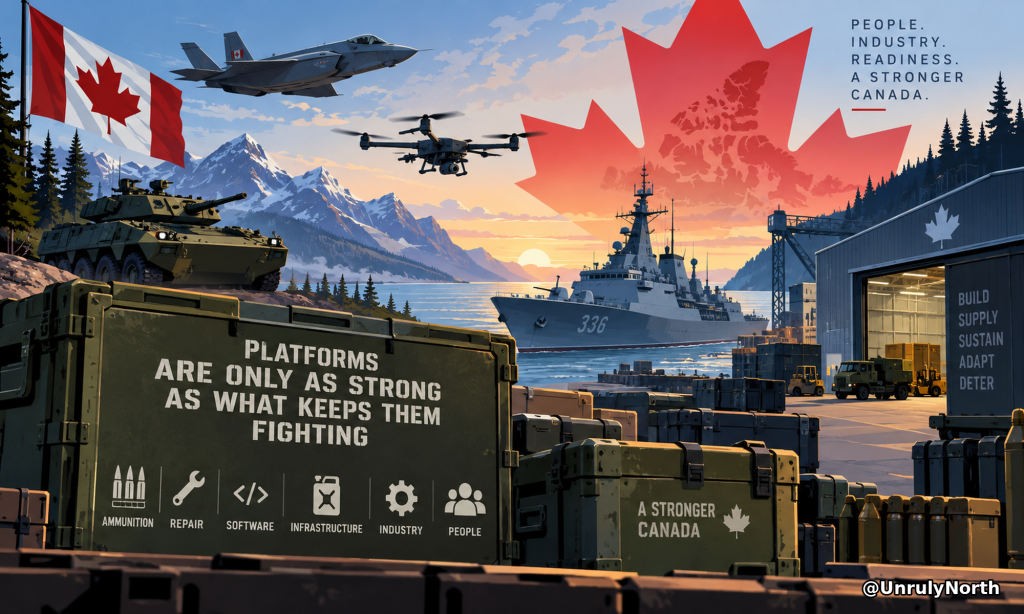
Canada is not rebuilding its military from a position of comfortable strength. In the latest published departmental results, only 59.6% of key maritime fleets, 51% of key land fleets and 42.3% of key aerospace fleets were serviceable enough to meet training, readiness and operational requirements in 2024-25. Those figures do not mean every unavailable ship, vehicle or aircraft was broken; planned maintenance is part of any fleet. They do show why Ottawa's new spending cannot be judged by contract announcements alone.
The country is entering a major defense buildup while the war in Ukraine keeps demonstrating how quickly modern combat exposes weak stockpiles, slow repair systems, vulnerable supply chains and technology that cannot adapt. Canada has a rare chance to rebuild around that reality. It can also spend an extraordinary amount of money and end up with impressive platforms surrounded by the same old fragility.
The useful question is not whether Canada should buy fighters, ships, armored vehicles, drones or long-range weapons. It needs a credible mix of all of them. The test is whether the force can keep those systems armed, connected, protected, repaired and relevant after an adversary starts attacking the network around them.
Readiness Is a System
A fighter is not combat power by itself. It depends on weapons stocks, protected and dispersible bases, runway repair, trained maintainers, spare parts, secure data links, tankers, sensors and software that can be updated when the threat changes. A warship depends on magazine depth, layered air and drone defense, functioning ports, repair capacity and undersea awareness. An armored formation depends on engineers, fuel, ammunition, drones, electronic warfare, short-range air defense, deception and communications that still work when satellite navigation does not.
Canadian procurement debates often collapse that system into the platform because the platform is visible. Governments can announce a ship. They can photograph a fighter. They can put a contract value in a news release. Ammunition reserves, repair depots, software rights, spare parts and trained technical personnel are less theatrical. They are also what decides whether a costly platform remains useful after the first phase of a conflict.
The Department of National Defence's own 2024-25 results explain the gap. The land fleet missed its serviceability target because of underfunding, aging equipment and high operational tempo. Aerospace serviceability was hurt by personnel shortages, supply-chain disruption, obsolescence and rising maintenance demands. These are not separate administrative problems sitting outside combat capability. They are combat capability.
The Drone Initiative Is a Test Not a Victory
Canada's Defence Drone Initiative, launched on July 23, 2026, is promising because it addresses part of the process problem. The program is meant to connect Canadian Armed Forces and Canadian Coast Guard requirements with Canadian companies, researchers and manufacturers through prototyping, operational testing, limited acquisitions and possible production.
Its initial areas include low-cost tactical surveillance drones, uncrewed ground vehicles for logistics, maritime surface and underwater systems, standardized drone munitions and payloads, lower-cost counter-drone interceptors and technologies that could contribute to a sovereign long-range precision capability.
The qualifications matter. Entry into the supply arrangement does not guarantee a contract. The government also stated that it had not made an acquisition decision on deep precision strike. That makes the initiative a pathway, not a delivered capability. Treating a procurement mechanism as if it were equipment already in service would repeat the habit Canada needs to break.
Still, the model points in the right direction. Reuters reported on September 17 that Ukrainian units can adapt technology and tactics in weeks while NATO systems often take years or decades to develop and buy. Canada cannot run every purchase at drone speed. A submarine, fighter or warship demands long engineering, certification, infrastructure and safety work. But small drones, jammers, sensors, counter-drone systems and software can be obsolete before a traditional procurement cycle reaches the operator.
Canada needs more than faster procurement. It needs different speeds for different capabilities, with disciplined testing and oversight at each speed. Acceleration without accountability can produce waste and unsafe equipment. A process designed only to avoid administrative mistakes can deliver yesterday's answer after the threat has changed.
Ammunition Changes the Arithmetic
Ukraine has also stripped away the peacetime assumption that a small inventory of exquisite weapons is enough. NATO says the war has driven allies to replenish depleted stockpiles, reopen or expand production lines and address critical raw materials and supply chains. Reuters reported on September 16 that European militaries are seeking larger inventories of cheaper, mass-producible missiles and interceptors alongside premium systems.
The point is not that cheap weapons replace sophisticated ones. A high-end interceptor may be necessary against a ballistic missile or advanced aircraft. It is an industrial and financial failure to use the most expensive available response against every low-cost drone. Layered defense combines electronic warfare, guns, interceptor drones, lower-cost missiles and advanced interceptors so the response can match the threat.
Canada has begun to confront the production problem. Its 2026 Defence Industrial Strategy identifies ammunition as a sovereign capability, and the government announced $1.4 billion to expand domestic ammunition production. The strategy says a planned Canadian nitrocellulose facility is expected to begin production in 2029. The renewed defense policy also commits more than $9 billion over 20 years to strategic supply and the ability to surge production during high-demand operations.
Those commitments are substantial, but the timelines prove the point. Industrial capacity does not appear when a war starts. Facilities, skilled workers, explosives, rocket motors, electronics, test ranges and licensed intellectual property must already exist or be available through dependable allies. Every munition fired begins a race between consumption and replacement.
Ukraine Is a Lesson Not a Template
Canada should not copy Ukraine's force structure as if geography, alliances and missions did not matter. Ukraine is fighting a large land war against an invading neighbor. Canada must defend enormous maritime and Arctic approaches, contribute to continental aerospace defense, operate with NATO allies and retain forces for domestic emergencies. Those demands still require crewed aircraft, ships, armored forces and long-range sensors that cannot be replaced by a shopping list of small drones.
What transfers is the pressure test. Persistent surveillance makes movement and concealment harder. Electronic warfare changes quickly. Supply nodes and repair facilities become targets. Software must adapt to new threats. Consumption can outrun production. Canada should apply those lessons to its own geography and commitments instead of turning one battlefield's most visible technology into a universal answer.
Sovereignty Includes Repair and Software
Sovereign capacity does not mean manufacturing everything in Canada. That would be costly, unrealistic and often slower than working with trusted allies. It means knowing which capabilities cannot be left entirely outside Canadian or allied control, then securing the production rights, repair capacity, components and supply agreements needed to keep them available.
Repair deserves more attention than it receives. A damaged vehicle restored near the theater in days contributes more combat power than one shipped across an ocean for months. The same is true of aircraft components, sensors, radios and electronic-warfare equipment. A force that cannot repair what it owns shrinks as a conflict continues, even if no new platform is destroyed.
Software creates the same dependency in less visible form. Modern military systems rely on code for sensors, communications, electronic countermeasures and mission planning. Canada does not need unrestricted access to every vendor's proprietary code. It does need enough technical control, open architecture and contractual freedom to integrate new Canadian or allied technology without renegotiating every urgent change from the beginning.
Measure What Can Survive
Ottawa will naturally report money committed, contracts signed, jobs projected, equipment ordered and delivery dates met. Those figures matter, but they measure government activity more readily than military endurance. A program can arrive on schedule and still leave the force with thin stockpiles, exposed infrastructure, long repair pipelines or no affordable answer to massed low-cost threats.
Parliament and the public should ask harder questions. How many days of sustained operations can current stocks support? How quickly can damaged systems return to service? Which parts have only one supplier? How long does an operator-requested software change take? Can industry raise output within six months? Which bases, depots, ports and communications nodes are single points of failure?
Those questions should also follow personnel. Drones, resilient networks and adaptable platforms require maintainers, software specialists, electronic-warfare personnel, logisticians, intelligence analysts and commanders trained to use them. Equipment without the people and training to employ it at scale is inventory, not capability.
Canada will spend far more on defense over the coming decade than it did during the years that produced today's gaps. That money can restore real capacity. It can also be absorbed by a familiar system that counts platforms while leaving ammunition, repair, infrastructure, software and people to fight over what remains.
Ukraine's clearest procurement lesson is not that drones defeated tanks, or that cheap weapons made advanced platforms obsolete. It is that every weapon depends on the system around it. Canada's rebuilding effort will succeed only if that system can absorb damage, replace losses, adapt faster than the threat and keep fighting after the announcement photos are over.