Trump TV, the Press Ban, and the Presidency as Personal Propaganda
Trump TV arrived as the White House barred major news outlets and disrupted independent presidential coverage. The issue is bigger than media access: it is about press freedom, government propaganda, personal branding, narrative control, and the corruption of public power.
Donald Trump did not launch Trump TV in isolation. It appeared during a confrontation over one of the oldest constitutional protections in the United States: freedom of the press.
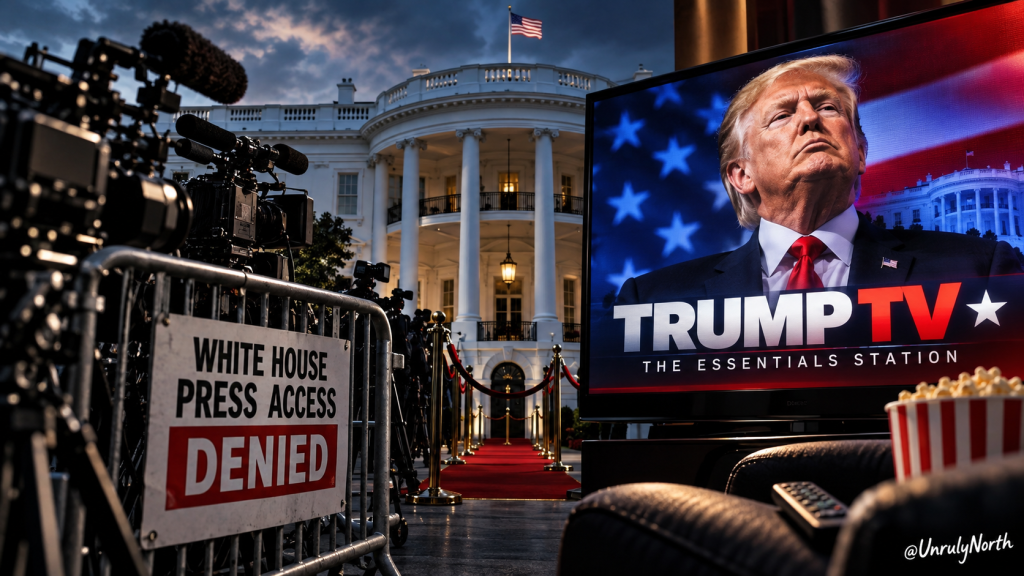
His administration barred CNN, MS NOW and Politico from the White House after Trump attacked their reporting as fake. Security then denied their journalists entry, and the organizations went to federal court alleging violations of their First Amendment rights. When CNN could no longer perform its scheduled role in the independent television pool, ABC, CBS, Fox and NBC refused to replace it. The networks suspended the pool rather than accept a system in which the White House could reject one of its participants because the president disliked its journalism.
Then, on September 21, the White House launched “TRUMP TV: The Essentials Station.” The administration controls the round-the-clock stream and selects the material it shows about Donald Trump. The White House itself promoted the service under both “Trump TV is Here” and “TRUMP TV: The Essentials Station.”
The timing transforms what might otherwise have been another presidential communications stunt into something far more important. The administration was restricting independent news organizations while creating its own continuous version of the presidency.
Trump TV sits at the intersection of freedom of the press, government propaganda, presidential self-aggrandizement, narrative control and institutional corruption. Those issues do not require speculation. They emerge from the actions themselves and from the power the White House used to carry them out.
Freedom of the press means more than permission to publish
The First Amendment does not give every journalist unrestricted access to every room in the White House. Security matters. Space is limited. Presidents conduct private meetings, and reporters cannot demand entrance to every presidential event.
That narrow point, however, does not settle the constitutional issue. Once the government establishes press access, it cannot simply distribute that access according to whether officials approve of a journalist’s reporting.
The controlling precedent stretches back nearly half a century. In Sherrill v. Knight, the U.S. Court of Appeals for the District of Columbia Circuit examined the denial of a White House press pass. The court found that White House press access directly implicated First Amendment interests.
The court rejected arbitrary or content-based criteria. It also required the government to justify a denial and provide basic procedural protections. Those protections included notice and an opportunity for the journalist to respond.
The judges also recognized something larger than the journalist’s personal interest. The public has an interest in preventing the government from arbitrarily excluding reporters from sources of information about how the country operates.
That principle matters because freedom of the press protects more than a newspaper’s ability to print a story after the government shuts the door.
It protects the press’s ability to gather information independently.
Trump has already tested this constitutional boundary
The issue resurfaced during Trump’s second presidency.
In 2025, the White House sharply restricted Associated Press access after the AP refused to adopt Trump’s preferred name, “Gulf of America,” for the Gulf of Mexico. Federal Judge Trevor McFadden concluded that the administration had discriminated against the AP because of its editorial viewpoint.
His ruling did not grant every journalist an automatic right to every presidential event. Instead, it made a narrower point. If the government opens an event to selected journalists, it cannot punish one organization because officials dislike its editorial position.
The current confrontation follows the same basic fault line.
CNN, MS NOW and Politico do not need to prove that the Constitution guarantees them a permanent seat in every room. The important question is why the administration excluded them.
Trump supplied much of that answer himself.
He attacked their journalism as fake news. He accused them of spreading fiction and lies. He tied their removal directly to their cumulative coverage of his presidency.
That turns a dispute about access into something much more serious. The president did not merely criticize journalists. His administration used government authority against organizations whose reporting he condemned.
A free press cannot depend on presidential approval
News organizations make mistakes. They can publish weak stories, show ideological bias or deserve harsh criticism. Politicians and citizens remain free to challenge their reporting.
The president also has that right.
But the President of the United States holds something ordinary critics do not: executive power.
That distinction matters.
Trump calling CNN dishonest represents political speech. The White House removing CNN’s access because Trump considers its journalism dishonest represents state action.
A free press would mean very little if constitutional protection extended only to journalism the government considered accurate, fair or respectful. Independent journalism exists precisely because the government does not get to decide which questions reporters may ask or which conclusions they may reach.
The White House cannot turn disagreement with journalism into an informal licensing system in which compliant organizations retain access while disfavoured outlets wait outside.
That would give every newsroom a reason to consider the price of angering the president before publishing a story.
The First Amendment exists in part to prevent that pressure.
The television pool made the consequences visible
The fight moved beyond three news organizations when CNN lost its place in the independent television pool.
Presidents routinely operate in spaces too small for every broadcaster to attend. Television networks therefore rotate responsibility for covering restricted events. One network supplies cameras and crews, then shares the video and audio with the others.
CNN was scheduled to perform that role when the White House blocked its access.
ABC, CBS, NBC and Fox could have replaced CNN and allowed the system to continue. Instead, they joined CNN in suspending the pool.
Fox’s participation matters. It makes it harder to dismiss the confrontation as a simple fight between Trump and liberal media organizations.
The networks recognized a broader institutional problem. If the White House could reject one participant because it objected to that network’s reporting, the administration would gain leverage over an independent system.
That leverage could affect every member of the pool.
The suspension also produced immediate consequences. Independent television coverage weakened. Some presidential events depended more heavily on material supplied directly by the administration. The public lost part of the independent audiovisual record it normally receives from the White House.
Then Trump TV switched on.
Trump TV gives the government its own version of Trump
The name tells us a great deal.
The White House did not call the channel Presidential Television or White House Live. It called it Trump TV.
The administration selects its speeches, appearances, ceremonies and highlights. It chooses which events matter and which version of the president viewers see. It determines what qualifies as “essential.”
That is not journalism.
Independent newsrooms also select stories and footage, but they operate separately from the officials they cover. A newsroom can decide that a presidential failure deserves more attention than a presidential success. Reporters can challenge claims, interview opponents and investigate contradictions.
Trump TV has no such independent role.
The administration controls both the subject and the presentation.
That difference becomes even more important when the same White House restricts journalists who produce accounts it dislikes. Independent cameras become harder to access while government-controlled cameras become easier to watch.
The issue is not merely who owns the equipment.
It is who controls the record.
Trump TV is propaganda
There is no reason to treat “propaganda” as a word that requires a court judgment before anyone can use it.
Propaganda describes communication designed to shape public attitudes in favour of a government, political cause or leader. It does not have to consist entirely of lies.
Effective propaganda often uses authentic speeches, real photographs and accurate facts. Selection does much of the work. The producer decides what to emphasize, what to repeat and what to leave out.
Trump TV fits that description.
The government produces it. Trump’s administration selects the programming. Trump himself dominates its subject matter. The channel promotes the president’s speeches, ceremonies, achievements and preferred version of his presidency.
Press-freedom advocates have therefore described the operation as government propaganda.
Whether Trump TV violates federal laws that restrict certain uses of public money for government propaganda raises a separate legal question. Courts and oversight bodies can address that issue if necessary.
The political description does not depend on that legal determination.
Government propaganda does not stop being propaganda simply because the government may legally produce it.
The Trump brand is swallowing the presidency
Presidents have promoted themselves for generations. Franklin Roosevelt mastered radio. Ronald Reagan understood television. Barack Obama’s administration produced White House video. Every modern president has tried to present the administration in favourable terms.
Trump did not invent political vanity.
What stands out is the degree to which he has personalized the institution around himself.
The government channel carries his surname. It promotes his speeches and accomplishments. It places the Trump brand directly onto a media product created by the White House.
That is unmistakably egotistical political branding.
The description of Trump as narcissistic requires one important distinction. No political article should pretend to diagnose a psychiatric disorder from a distance. “Narcissistic,” however, also has an ordinary non-clinical meaning. People use it to describe extreme self-centering, vanity and an excessive fixation on personal importance.
Trump’s political conduct provides abundant material for that discussion without requiring a medical diagnosis.
His presidency repeatedly places his name, image, grievances and accomplishments at the centre of government communication. Trump TV takes that personalization one step further by attaching his personal brand directly to a government media operation.
The presidency begins to resemble another Trump property.
A public office is not a personal media company
That personalization matters because the presidency does not belong to its occupant.
It is a public institution.
Government communications have a legitimate purpose. Administrations need to explain policies, announce decisions and provide information. Problems arise when public communications become difficult to distinguish from the personal promotion of the individual controlling them.
Trump TV crosses deeply into that territory.
The channel does not merely explain federal policy. Its branding makes Donald Trump himself the product.
At the same time, his administration has restricted organizations that produce independent coverage he dislikes. Those two developments cannot reasonably be examined as unrelated events.
One reduces unwanted scrutiny.
The other amplifies preferred imagery.
Together, they strengthen presidential control over the narrative.
Narrative control becomes dangerous when backed by state power
Every politician tries to influence the public narrative. Campaigns repeat favourable statistics, stage attractive events and promote flattering stories.
That is ordinary politics.
A healthy democratic system counters that effort through independent institutions. Journalists investigate claims. Opposition parties challenge them. Courts review executive actions. Citizens encounter competing versions of events.
Trump’s approach moves beyond ordinary message management when the government uses access itself as leverage.
His administration did not merely complain about CNN, MS NOW and Politico. It removed their journalists from White House access after he attacked their reporting.
That changes the incentive structure for everyone else.
A newsroom does not need the government to censor an article directly to feel pressure. If critical reporting risks losing access to presidential events, the threat itself can influence behaviour.
That is the danger of a chilling effect.
The government does not need to silence every journalist. It only needs to increase the cost of displeasing it.
Meanwhile, Trump TV guarantees that the administration’s preferred version remains available around the clock.
Institutional corruption does not require a suitcase of cash
People often use “corruption” as shorthand for bribery or stolen money. Institutions can also become corrupted when officials redirect public powers toward private or personal interests.
That is the relevant concern here.
White House press access serves a public purpose. The press pool allows independent witnesses to document presidential power. Government communications help explain government actions.
Those mechanisms begin to lose their public character when an administration uses access to punish unwanted scrutiny while turning official communications into promotion of the president’s personal brand.
The question is not whether Trump TV constitutes a criminal corruption offence.
The issue is institutional corruption: whether the presidency’s authority and resources increasingly serve Donald Trump’s personal political interests rather than the broader purposes of the office.
The combination matters. Trump attacks an outlet. His administration removes its access. Independent broadcasters resist. The White House then expands its own Trump-branded media operation.
Each action strengthens the next.
Controlling access helps control the story
The strategy does not require Trump to abolish CNN or close newspapers.
It works at a more practical level.
Discredit independent sources. Increase the cost of producing unwanted coverage. Control access to the spaces where presidential power operates. Expand government-produced alternatives. Repeat the administration’s preferred narrative until it becomes the easiest version for supporters to consume.
None of those actions alone destroys a free press.
Together, they shift power toward the government.
That is why the argument that CNN can still broadcast from somewhere outside the White House misses the point. Of course it can.
Freedom of the press involves more than the ability to publish commentary from a studio.
Journalists need access to information, witnesses, events and officials. When government controls that access, the rules governing it matter.
A president who can reward favourable journalism with proximity and punish hostile journalism with exclusion gains a powerful tool for shaping coverage without ever ordering a newspaper to stop printing.
This is bigger than CNN, Politico or MS NOW
People who dislike the three organizations may feel little sympathy for them.
That is precisely why constitutional principles matter.
Rights cannot depend on whether the current target enjoys public affection.
A government that establishes the power to punish CNN for unwanted journalism also establishes a power that another administration could use against Fox, a conservative newspaper, an independent website or any other organization that becomes inconvenient.
The identity of today’s target does not limit tomorrow’s precedent.
Trump has already suggested that additional news organizations could face similar treatment.
The First Amendment exists because the government should not decide which journalism deserves protection according to whether the president likes it.
Independent journalism can be flawed and still remain independent.
Government propaganda can contain accurate information and still remain propaganda.
Those distinctions can coexist.
The issue is who gets to document presidential power
Trump TV may never become popular. It could remain a curiosity watched mainly by committed supporters and political obsessives.
Its ratings do not determine its importance.
The institutional model matters more.
A president hostile to major parts of the independent press has used government authority against organizations whose coverage he rejects. Independent networks responded by suspending their television pool rather than accept those terms. At almost the same moment, the White House launched a continuous media channel carrying Trump’s personal name.
That sequence brings several issues together that should never have been separated: freedom of the press, propaganda, presidential ego, narrative control and corruption of public institutions.
The First Amendment does not guarantee Donald Trump favourable coverage. It does not give journalists unlimited access to every presidential space. It does something more important: it limits the government’s ability to use public power to determine which viewpoints receive favourable treatment.
Trump TV represents the opposite instinct. It gives the administration a platform on which it chooses the images, the speeches, the accomplishments and the version of Donald Trump that viewers receive.
Independent journalism exists to provide the versions he cannot choose.
That is why the fight over Trump TV and White House press access is not really a dispute about television. It is a dispute over who gets to document power, who gets to challenge its preferred narrative, and how far a president can bend public institutions toward the protection and promotion of himself.