Trump’s Strongarm Strategy Is Strengthening China
Trump is trying to contain China through tariffs, pressure, and strategic competition. But by alienating allies, weakening U.S. credibility, and retreating from clean-energy industries Beijing is dominating, his policies may be making China relatively stronger.
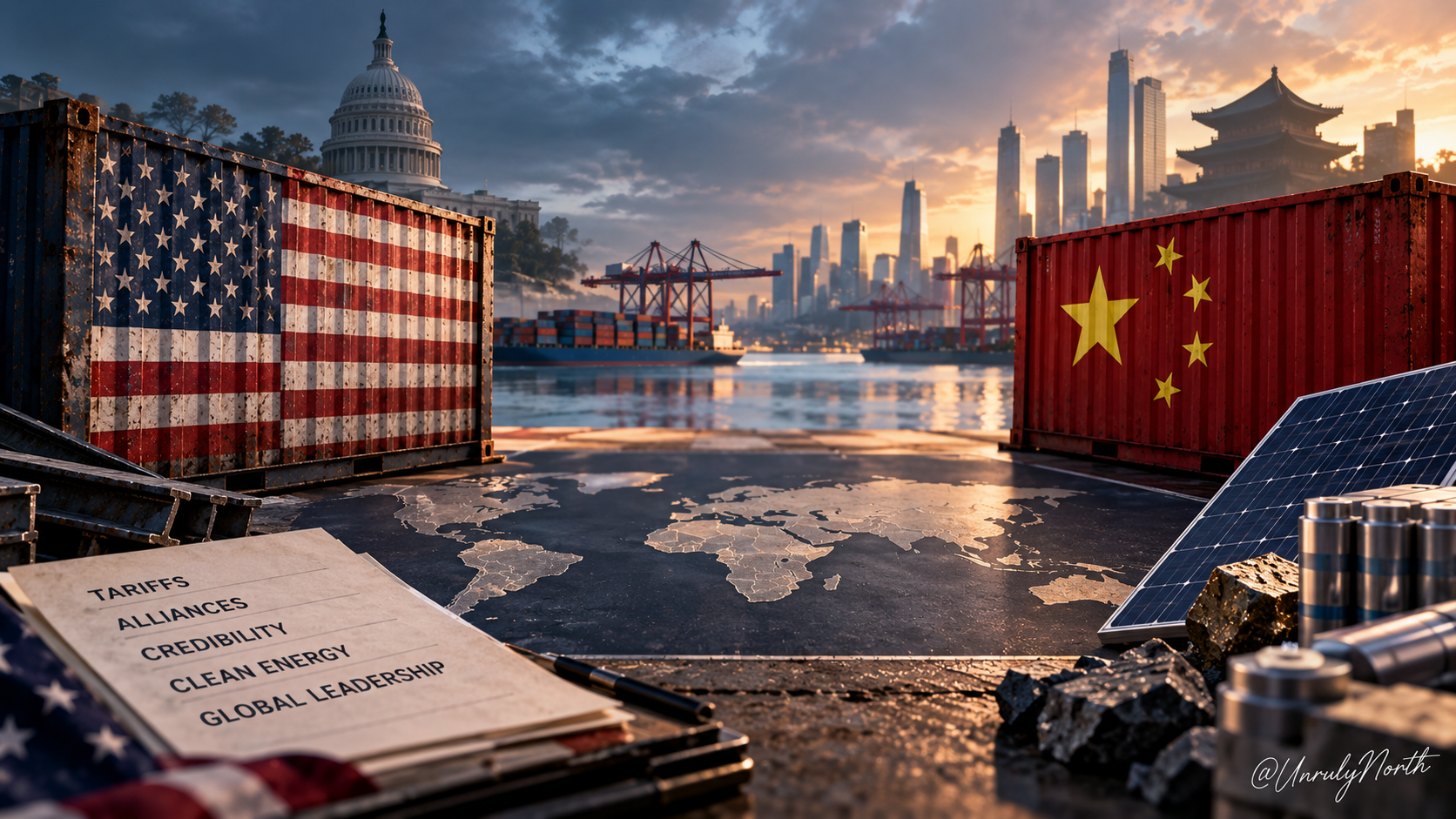
Donald Trump has made competition with China one of the organizing principles of his second presidency. His administration has imposed tariffs, tightened controls on strategic goods, pushed allies to spend more on defense, pursued new sources of critical minerals, and repeatedly presented China as the central economic and strategic challenge to American power. Yet a contradiction runs through that strategy. While Washington tries to constrain Beijing directly, several of Trump’s other policies are weakening advantages that the United States spent decades building and that China has struggled to reproduce.
The problem is not that Trump wants China to become stronger. There is no evidence for that claim, and the administration has taken substantial measures intended to weaken Chinese leverage. The problem lies in how power works. Power is relative. China does not need to defeat the United States economically or persuade America’s allies to switch sides. Beijing benefits whenever Washington becomes less economically indispensable, less technologically competitive, less predictable as a negotiating partner, or less trusted as a security guarantor.
That is why Trump’s strongarm approach deserves examination as part of the China story. The administration increasingly treats tariffs, market access, military protection, and even established relationships as sources of leverage that Washington can renegotiate. Countries have noticed. Canada is deepening its relationship with Europe. European governments are expanding their defense industries and looking beyond American suppliers. Asian allies are debating how much confidence they can place in future American commitments. At the same time, the United States is retreating from parts of the clean-energy economy while China invests on an industrial scale.
The result could prove deeply ironic. An administration determined to restore American dominance may be accelerating the construction of a world that has less need to depend on the United States.
Tariffs have hurt China, but they have not isolated it
Trump’s trade war has imposed real costs on China. That should not disappear from the analysis. Washington and Beijing pushed tariffs as high as 125 percent during their latest confrontation before backing down through a series of truces and negotiations. The United States has also tried to rebuild domestic production and reduce strategic dependence on Chinese supply chains. Those efforts address genuine vulnerabilities, particularly in critical minerals, batteries, and advanced manufacturing.
But damaging bilateral trade is not the same as isolating China from the world economy.
As Trump prepares to meet Xi Jinping in Washington on September 24, China’s export economy remains formidable. Reuters reports that China’s global trade surplus is on course to exceed $1 trillion for a second consecutive year. Companies that shifted production out of China to escape tariffs have also discovered how difficult it can be to reproduce China’s dense networks of suppliers, skilled workers, infrastructure, and industrial capacity elsewhere. Some have moved production back.
Beijing has also found markets beyond the United States. Southeast Asia offers a particularly important example. Reuters reported this month that ASEAN countries had spent more than $20 billion on Chinese-made clean-energy products in 2026, including batteries, electric vehicles, solar equipment, and grid components. That represented a 50 percent increase from the previous year. The region imported about $4.1 billion in Chinese solar panels and nearly $7 billion in energy-storage batteries, while solar imports rose roughly 90 percent.
Diversification weakens American leverage
This matters because Trump’s strategy often assumes that access to the American market gives Washington overwhelming leverage. It certainly gives Washington enormous leverage, but governments and corporations also respond to that leverage by looking for alternatives. If American market access becomes less predictable, diversification becomes insurance.
Every new supply chain, trade agreement, export market, or production hub that reduces reliance on the United States can dilute American influence. China does not need every diverted relationship to flow directly toward Beijing. A more fragmented trading system already works against the privileged position the United States enjoyed when access to its market, financial system, and political partnership carried fewer perceived political conditions.
The more countries build multiple supply chains and multiple strategic relationships, the less any one country can dictate terms. That does not produce automatic Chinese dominance, but it gives Beijing more room to operate in a system where Washington holds less exclusive leverage.
Washington is retreating from technologies Beijing treats as strategic industries
The clean-energy divide presents the clearest example of how American domestic policy can affect competition with China.
China invested more than $625 billion in clean energy in 2024, according to the International Energy Agency. In 2025, it added nearly 500 gigawatts of renewable generating capacity, more than 60 percent of the worldwide increase. China installed nearly 370 gigawatts of solar and 117 gigawatts of wind in that year alone.
Those figures do not describe a boutique environmental program. They describe industrial policy on a scale few countries can match.
Beijing’s strategy extends far beyond building wind farms and solar arrays. China now accounts for roughly 85 percent of global solar supply-chain manufacturing capacity and about 80 percent of lithium-ion battery supply-chain capacity. Its share exceeds 95 percent at some individual stages of production. Chinese exports of clean-energy technologies exceeded $165 billion in 2025, representing about half of global trade in those technologies when intra-European Union trade is excluded.
Those industries matter even to governments that place little priority on climate policy. Batteries matter to vehicles, electrical grids, drones, and military systems. Critical minerals matter to electronics and weapons. Solar and storage increasingly shape electricity costs and energy security. Power electronics, inverters, and grid equipment will sit inside infrastructure that countries expect to use for decades.
The United States is moving in the opposite direction
Trump’s administration has moved sharply away from much of that industrial strategy. On his first day back in office, Trump halted new federal offshore-wind leasing and ordered agencies to stop new or renewed wind approvals while the government reviewed the industry. The Department of Energy later announced the termination of 321 financial awards supporting 223 projects, worth about $7.56 billion. DOE says it has also eliminated about $9.5 billion in government-supported wind and solar projects while restructuring, revising, or eliminating a much larger portfolio of previous energy loans and commitments.
The administration argues that these programs wasted taxpayer money, distorted energy markets, and supported unreliable generation. That represents its stated policy rationale, and the economics of individual projects vary. Some projects undoubtedly deserve scrutiny.
The strategic question, however, reaches beyond whether every canceled grant represented good policy. It asks what happens when one of the world’s two largest powers reduces support for emerging industries while the other builds overwhelming scale in them.
The consequences have already reached American manufacturing. Reuters found that the repeal of the $7,500 electric-vehicle tax credit and other policy changes disrupted the American EV and battery expansion, contributing to factory delays, cancellations, and altered investment plans. A separate BlueGreen Alliance analysis cited by Reuters linked administration policy changes to about $83 billion in delayed or canceled clean-energy and manufacturing investments across 223 projects, although that figure comes from an advocacy organization rather than a government audit.
China is building scale while America debates whether the sector matters
Meanwhile, China retains enormous control over the materials beneath these industries. Reuters reported this month that China still controls roughly 70 to 95 percent of refining capacity for several critical minerals and 98 percent of lithium-iron-phosphate cathode materials.
The Trump administration has recognized that vulnerability and committed billions to alternative critical-mineral supplies, including Project Vault. Yet its policies toward batteries and electric vehicles can work against the demand that would help new American supply chains achieve commercial scale.
That is the contradiction. Washington recognizes Chinese dominance as a national-security problem while weakening parts of the domestic market that could support competitors to Chinese producers.
China still burns enormous quantities of coal. Its clean-energy buildout does not make Beijing an environmental altruist, nor does it erase serious concerns about subsidies, industrial overcapacity, and dependence on Chinese supply chains. But none of those facts changes the industrial reality. Beijing recognized solar, batteries, electric vehicles, and energy technology as strategic industries and built them accordingly.
The United States now risks treating parts of that same technological transition primarily as a culture-war question while China treats it as a long-term contest for manufacturing power.
Strongarming allies can make them stronger without making America stronger
Trump has long argued that America’s allies rely too heavily on American protection. On that point, his pressure has produced measurable results. NATO members have increased defense spending, and European governments now take military production more seriously than they did a decade ago.
But Washington does not automatically benefit from every form of greater European independence.
A Reuters investigation published September 17 found that Trump’s approach has also reduced confidence in the durability of the American commitment to NATO and encouraged countries including Canada, Germany, and Poland to consider non-American weapons suppliers. Europe is working to build more of its own military capacity, while France has expanded a European nuclear-deterrence initiative that Finland joined this month.
European governments describe these efforts as complementary to NATO, not replacements for it. Even so, the reason for the hedging matters. Uncertainty about Washington now forms part of European defense planning.
That development presents another strategic paradox. Trump wanted allies to shoulder more of the defense burden. More capable allies can strengthen NATO. But if those same governments build defense industries, nuclear arrangements, procurement systems, and strategic plans specifically because they doubt American reliability, the United States can lose influence even while Europe becomes stronger.
Canada is learning the same lesson
Canada shows the same process outside traditional military planning.
Prime Minister Mark Carney has pushed for much deeper cooperation with the European Union in critical minerals, defense, artificial intelligence, energy, and digital infrastructure. European Commission President Ursula von der Leyen floated the concept of Canada becoming an “associate member” in some form. Trump reacted by calling the idea potentially hostile and threatening additional tariffs against Canada. Carney then went to the European Parliament and argued for greater resilience among middle powers.
Whatever form the Canada-EU relationship eventually takes, the strategic incentive has become clear. Canada depended extraordinarily heavily on one market for decades because close integration with the United States appeared both economically efficient and politically safe. When Washington uses that dependence as leverage, Ottawa gains a reason to reduce it.
That does not mean Canada turns toward China. In fact, Canada’s strategy explicitly seeks greater resilience against excessive dependence on both China and the United States. Yet Beijing still benefits from any international system in which Washington possesses less exclusive leverage over its partners.
The same logic applies across the world. If countries regard dependence on one great power as dangerous, they build alternatives. They diversify suppliers, develop domestic production, negotiate new trade agreements, and strengthen relationships with other middle powers.
That produces a more multipolar system. China has spent years arguing for precisely such a reduction in American primacy.
Credibility becomes a strategic asset only when other countries believe it
Economic pressure alone does not explain the changing calculations around the United States. Trump’s approach to negotiations and military force also matters because countries make long-term decisions partly around whether they expect agreements with Washington to survive.
Iran offers a stark example.
In May 2025, after the fifth round of nuclear talks, a senior U.S. official described the negotiations as constructive and said the two sides had made further progress. Oman, which mediated the talks, reported “some but not conclusive progress.” Deep disagreements remained, especially over uranium enrichment, and nobody could guarantee an agreement. But negotiations continued.
Israel launched its surprise attack on Iran on June 13. Trump told Reuters that his administration had known about Israel’s plans. A sixth U.S.-Iran negotiating round scheduled through Oman collapsed after the attack. Nine days after Israel struck, American forces attacked Fordow, Natanz, and Isfahan.
The pattern repeated in 2026
U.S. and Iranian negotiators met again in Geneva on February 26, 2026. Oman’s foreign minister said they had made “significant progress” and announced plans for further discussions. On February 27, the Omani mediator said a peace agreement remained within reach if diplomacy received the necessary space.
Trump said that same day that he remained dissatisfied and warned that “sometimes you have to use force.” On February 28, the United States and Israel launched the attack that began the current war with Iran.
No outside observer can establish Trump’s private intentions during those negotiations. The chronology, however, creates a problem that requires no mind-reading. Governments considering negotiations with Washington can see that Iran entered talks twice, heard mediators and American officials describe progress, and then faced military attacks before diplomacy produced a settlement.
That affects the value of future American assurances. Diplomacy works partly because both sides believe negotiations can provide a path away from war. If governments conclude that talks offer no protection against attack while negotiations continue, they gain an incentive to harden their positions, seek military deterrence, or look for alternative patrons.
Doubt itself becomes an advantage for Beijing
China can exploit that uncertainty even without presenting itself as a more trustworthy actor. The relevant question is not whether Beijing behaves better. It is whether governments believe they need additional relationships because they cannot safely depend on Washington alone.
Concerns in Asia already show the sensitivity of that question. Reuters reported this week that officials in Taiwan and Japan worry Trump could treat aspects of U.S. support for Taiwan as negotiating leverage in his talks with Xi. Taiwan remains one of the most dangerous potential flashpoints between the United States and China.
Even the perception that Washington might make security commitments transactional gives Beijing something it could not easily create on its own: doubt inside the American alliance system.
China does not need to copy the American military network
The military comparison also needs precision. China has not rejected overseas power projection. It operates a base in Djibouti, and the Pentagon says the People’s Liberation Army continues to consider additional military facilities. The Pentagon’s 2025 China report points to Chinese activity at Cambodia’s Ream Naval Base and says Beijing has explored possible access or facilities across Africa, Asia, the Middle East, and the Pacific.
But China still operates nothing comparable to the worldwide American network of bases, access agreements, and military infrastructure.
Washington continues to regard that network as essential to its own power. Trump’s reaction to Diego Garcia makes the point clearly. In February, he said the United States retained the right to “militarily secure” the joint U.S.-UK facility if future developments threatened American access to it.
That does not make American overseas bases inherently illegitimate, and it does not make China’s growing military reach benign. It does expose a tension in the Trump worldview. Washington complains about the burden of maintaining the international system while fiercely protecting the infrastructure that allows the United States to project power through that system.
China has built influence differently. Military modernization forms one part of the strategy, but manufacturing, trade, ports, infrastructure, minerals, batteries, telecommunications, and energy technology provide other forms of leverage. Beijing can gain influence without trying to replicate every American carrier group or overseas installation.
That is why America’s alliances and economic relationships matter so much. They multiply American power at a cost China cannot easily match. Japan, South Korea, Australia, Canada, and the NATO states do not simply add military strength. They provide markets, intelligence, industrial capacity, political legitimacy, technology, and strategic geography.
If Washington treats those relationships primarily as unpaid invoices or opportunities for coercion, it misunderstands what they contribute.
The world does not have to choose China for China to gain
The strongest version of the argument does not claim that Trump’s policies will make China the new global hegemon. China faces serious obstacles of its own, including demographic pressures, debt, a troubled property sector, distrust among neighboring states, industrial overcapacity, and dependence on foreign demand.
The more consequential possibility is that Trump’s approach strengthens China in relative terms.
American primacy never rested on military spending alone. It rested on an international network in which other countries often found it advantageous to use American technology, buy American weapons, hold dollars, trade through American-led institutions, study at American universities, rely on American security guarantees, and place long-term confidence in American commitments.
Trump’s strongarm strategy puts several of those advantages under pressure at the same time.
Tariffs encourage diversification, while threats against allies encourage independent defense capacity. Military attacks during active diplomatic processes raise questions about the value of negotiations. Retreat from renewable-energy and electric-vehicle policy leaves more industrial space for Chinese competitors. Attempts to weaponize economic dependence teach other governments that dependence itself carries risk.
None of these developments guarantees a Chinese victory. They do something more subtle and, in the long run, potentially more damaging to American influence. They make the world less centered on the United States.
America can win individual fights and still lose strategic ground
That distinction matters because Washington can win individual confrontations while weakening its overall position. It can force an ally to spend more on defense while encouraging that ally to buy fewer American weapons. It can impose tariffs on China while Chinese companies expand in Southeast Asia and other markets. It can cancel renewable-energy programs while Chinese manufacturers deepen their dominance of batteries, solar equipment, and critical-material processing.
Washington can also demand concessions through economic and military pressure while convincing other governments to reduce their exposure to American power.
Trump’s strategy assumes that the sheer size of the United States gives Washington leverage that others must ultimately accept. In the short term, that often proves true. Few countries can ignore the American market, military, or financial system.
The longer-term response, however, may be precisely the one Washington does not want: countries building enough alternatives that the next American threat carries less weight.
China does not have to engineer that outcome. It only has to take advantage of it.
The central question in the U.S.-China competition is therefore not simply whether Trump can impose higher costs on Beijing. It is whether the United States can pressure China without dismantling the relationships, industries, and credibility that made American power greater than the sum of its military and economic parts.
If Washington weakens those foundations faster than it weakens China, then an administration committed to confronting Beijing may discover that it has spent years making its principal competitor relatively stronger.