The Line Keeps Moving: How Trump Tests the Limits of Presidential Power
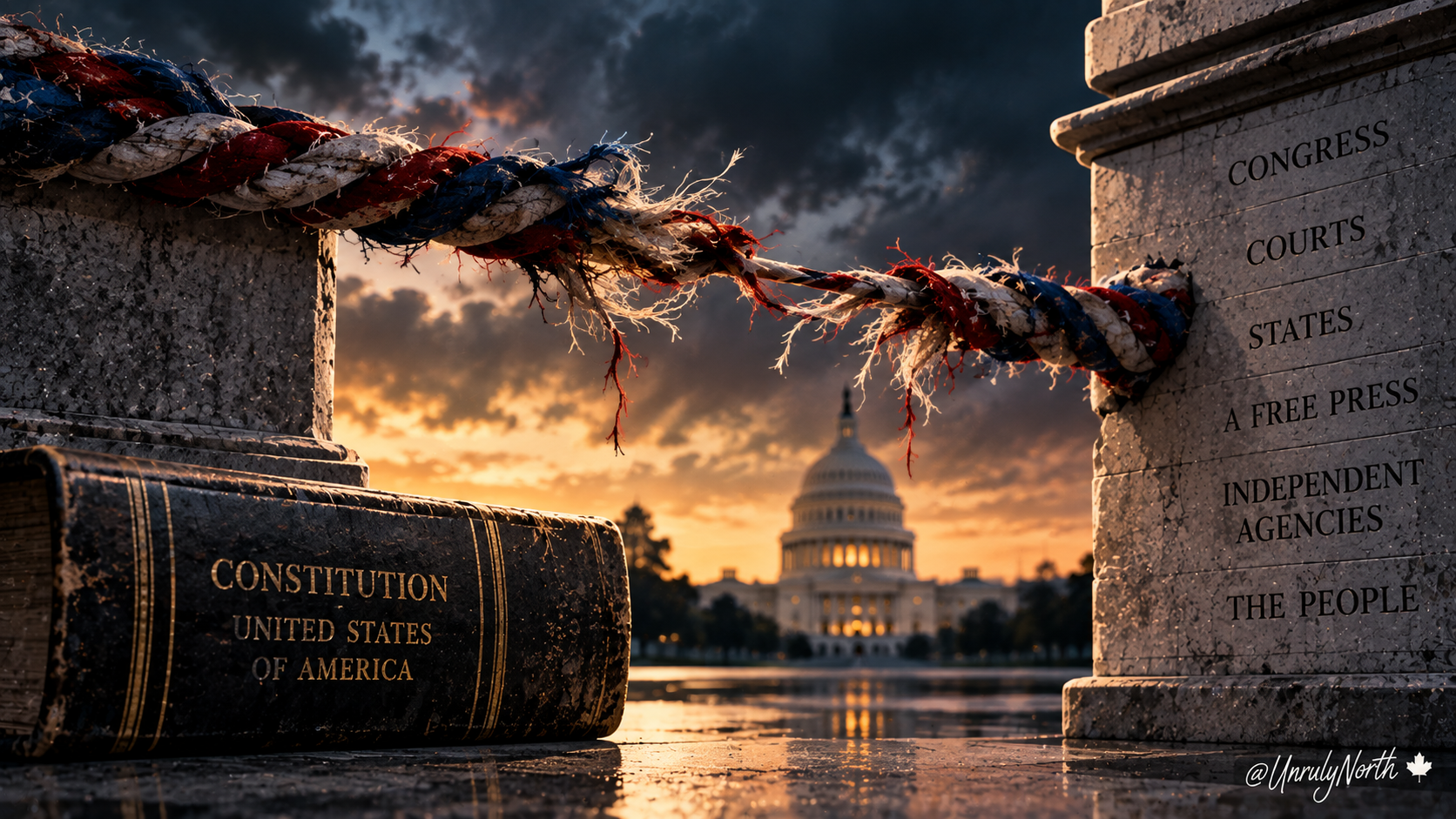
Donald Trump has spent much of his second presidency testing a basic question in the American system: where does presidential power actually end? The Constitution divides authority among Congress, the courts, the states and the executive branch. Congress writes laws, controls spending and holds powers that presidents can exercise only when lawmakers delegate them. The Senate confirms senior officials, while courts decide whether the executive branch has crossed legal or constitutional boundaries.
Those limits look clear on paper, but the system depends on institutions choosing to defend them. Congress must protect its authority. States must challenge federal actions when they believe Washington has gone too far. Courts need plaintiffs who can bring cases, and judges must issue remedies that actually matter. Senators must defend their confirmation powers rather than allow temporary appointments to become permanent workarounds.
Trump has repeatedly tested those points of resistance. He has lost major cases, including cases before a Supreme Court dominated by conservative justices. Yet a defeat rarely ends the underlying fight. His administration often changes the statute, narrows the policy, changes the justification or turns to another institution that might provide the authority it wants.
The check works, but the objective often survives.
That pattern now stretches across tariffs, federal agencies, immigration, presidential appointments, war powers and even Trump’s ambitious construction projects in Washington. Taken together, these disputes show a presidency that treats uncertain legal boundaries as questions to test rather than warnings to stop.
Tariffs Show How the Line Can Move
Trump’s global tariff campaign offers one of the clearest examples because the Constitution gives Congress the power to impose tariffs and taxes. Trump nevertheless used the International Emergency Economic Powers Act, or IEEPA, to impose sweeping tariffs on imports from countries around the world.
Congress passed IEEPA in 1977 to give presidents broad economic powers during national emergencies. Previous presidents used it to freeze assets, impose sanctions and restrict financial transactions. None had turned it into a general tariff law.
The Supreme Court rejected Trump’s interpretation in February 2026. In a 6-3 ruling, the Court found that IEEPA did not grant the tariff authority Trump claimed. Chief Justice John Roberts emphasized Congress’s constitutional role over tariffs and taxation.
Trump did not abandon the tariff campaign. His administration immediately turned to other trade laws, including statutes that Congress had already placed at the president’s disposal. Those laws gave Trump narrower powers, but they still offered routes toward many of the same policy goals.
That outcome captures the larger problem. The Supreme Court enforced a legal boundary, but Congress had already delegated several alternative powers. Trump lost the right to use one statute, then reached for another. The Court checked one claim without ending the broader struggle over presidential control of trade policy.
The Ballroom Turned Architecture Into a Power Struggle
Trump’s White House ballroom gives the same pattern a far more visible form. What began as a large ceremonial space became a roughly $400 million project on the site of the demolished East Wing. Trump initially promoted the ballroom as a privately funded improvement that would allow the White House to host much larger events.
Preservation groups soon raised a more basic question. Could the president make such a sweeping change to the White House complex without specific approval from Congress?
A federal judge concluded that the above-ground ballroom required congressional authorization. The court allowed underground work connected to legitimate security requirements, but it stopped the administration from treating the entire ballroom as a security project. Congressional Republicans later introduced legislation that would authorize and fund the project.
The legal fight matters because the administration did not simply accept the original distinction between ceremonial construction and security infrastructure. Government lawyers argued that hardened structures, drone protection and military facilities linked the ballroom to national security. The judge rejected the attempt to extend that exception across the whole project.
Trump’s allies then turned to Congress, where lawmakers could supply the authority the court said the project lacked. The system therefore worked, but it worked through several stages. A president pushed ahead, a court imposed a limit, and congressional allies searched for a legislative route around the obstacle.
The Arch Has Now Acquired a Military Purpose
Trump’s proposed triumphal arch near Arlington National Cemetery raises an eerily similar issue. He originally presented the 250-foot monument as a grand entrance to Washington and a symbol of America’s 250th anniversary.
The project soon attracted opposition from preservationists, veterans and others. A federal judge required the administration to provide advance notice before starting work, while planning and legal questions remained unresolved.
Then Trump announced on September 20 that the arch would also function as a “military complex.” He said it would house drones, snipers and ammunition. Trump also claimed that the military had requested those features, although the Defence Department offered Reuters no separate explanation and Trump identified no specific threat that required them.
Critics immediately questioned the new rationale. Retired Marine Colonel Mark Cancian told Reuters that the military features appeared difficult to explain because major military installations already sit nearby. Democratic Representative Don Beyer argued that the administration had added the military component to strengthen its legal position. Those comments represent their assessments, not proof of Trump’s private motive.
The chronology still matters. Trump proposed a civilian monument, opponents challenged it, and the project later acquired a substantial military role while those challenges continued. The same administration had already tried to connect the ballroom to national-security authority.
The courts will decide what that change means legally. Politically, the episode shows how quickly a disputed project can acquire a new justification when the original path encounters resistance.
The Kennedy Center Shows the Power of Appointments
The Kennedy Center illustrates a different route because Trump did not rely on emergency powers or military authority. He used appointments.
Congress created the John F. Kennedy Center for the Performing Arts as a memorial to President John F. Kennedy. After returning to office, Trump replaced board members with allies and became chairman himself. The new leadership then moved to place Trump’s name on the institution.
A federal judge ruled that the board could not rename the Kennedy Center because Congress had established its legal name. Workers removed Trump’s name from the facade after the ruling. The board later pursued other ways to associate the property with Trump, including a proposed plaza name and new inscriptions. The court blocked those efforts as well.
The fight escalated further when Trump linked a planned $257 million renovation to the naming dispute. His administration has also faced a court order requiring advance notice before any steps toward demolishing the existing structure.
The Kennedy Center dispute demonstrates why presidential power cannot be measured only through executive orders. Boards, commissions and political appointments can change how institutions operate before a court ever becomes involved.
Control the institution, and many decisions become administrative rather than legislative. Courts then have to determine where management authority ends and Congress’s authority begins.
The Supreme Court Has Both Strengthened and Restrained Trump
The Supreme Court plays the most complicated role in this story. It has increased presidential authority in some areas while rejecting Trump in others.
The Court has moved toward broader presidential control over independent agencies. The fight over Federal Trade Commission Commissioner Rebecca Slaughter challenged a decades-old legal structure that protected some independent officials from dismissal simply because a president disagreed with them. The Court’s conservative majority allowed Trump to remove Slaughter while the broader dispute proceeded, signalling support for stronger presidential control over executive officials.
That approach helps Trump because it reduces the independence of officials who might resist White House policy. It also creates presidential powers that future Democratic and Republican administrations will inherit.
Yet the Court has rejected several major Trump initiatives. It struck down the IEEPA tariff scheme and refused to allow new Postal Service restrictions on mail ballots to take effect before the 2026 midterm elections.
This mixed record makes the Court difficult to describe simply as either an ally or opponent of Trump. It has strengthened the presidency as an institution while policing some specific claims made by the president who currently occupies the office.
That distinction may prove more important than any single ruling.
Congress Cannot Check Power It Refuses to Use
Congress occupies an equally uncomfortable position. Lawmakers often complain about executive power while leaving much of the machinery that enables it intact.
Presidents did not invent most of the emergency, trade and national-security powers they now exercise. Congress delegated many of them through legislation passed over decades. Each delegation gave future presidents more room to act without returning to lawmakers for permission.
War powers provide the starkest example. U.S. and Israeli strikes against Iran began on February 28, 2026, without Congress passing a specific authorization for the conflict. Members of Congress later introduced measures designed to reclaim a role in the decision. Republican Representative Thomas Massie went further in September by filing articles of impeachment against Defence Secretary Pete Hegseth over military action that Massie says Congress never authorized.
The conflict has continued for months. Reuters reported on September 20 that the war remained active and continued to affect regional security and energy markets.
Trump did not create the long erosion of congressional war powers. Presidents from both parties have expanded military operations without declarations of war, while Congress has often allowed its own authority to weaken.
That history does not excuse Congress from responsibility. It makes congressional inaction part of the story.
Removing the People Who Can Say No
Trump has also tested the system by removing officials who provide oversight from inside the executive branch.
Soon after beginning his second term, Trump fired at least 17 inspectors general. Federal law required him to give Congress 30 days’ notice and provide reasons for those dismissals.
U.S. District Judge Ana Reyes later found that Trump had violated the Inspector General Act. She nevertheless declined to restore eight watchdogs to their positions. Reyes noted that Trump could dismiss them again after following the proper procedure.
The ruling exposed a significant weakness in legal accountability. A court can find that the president broke a procedural rule without restoring the situation that existed before the violation. Trump lost the legal argument, but the inspectors general still did not return to their posts.
His administration has pursued a similar strategy with entire agencies. Trump ordered dramatic reductions at several bodies that Congress created by law. The administration fired most employees at some agencies and halted many of their functions.
Twenty-one Democratic state attorneys general challenged those moves. During arguments on September 16, federal appellate judges questioned whether the president could effectively eliminate agencies without Congress. One judge noted that an agency cannot operate without employees.
That dispute goes directly to the separation of powers. If only Congress can abolish an agency, a president should not gain the same result simply by removing everyone who makes the agency function.
The Justice Department Raises Another Boundary
Federal prosecutions create an even more sensitive test because prosecutors can impose enormous costs before any jury reaches a verdict.
The Justice Department pursued cases against former FBI Director James Comey and New York Attorney General Letitia James, both longtime Trump adversaries. Courts later dismissed those cases because of questions surrounding the appointment of Lindsey Halligan as interim U.S. attorney.
Halligan had served as Trump’s personal lawyer and had no previous prosecutorial experience. The Justice Department appealed the dismissals. During arguments on September 15, federal appellate judges expressed concern that the government’s interpretation could allow a president to install temporary prosecutors repeatedly and avoid Senate confirmation.
Comey and James describe the prosecutions as political retaliation. The administration disputes that accusation and argues that prosecutors had legitimate reasons to investigate them. Those competing claims remain contested.
The structural issue goes beyond either defendant. The Constitution gives the Senate a role in confirming senior federal officials. If an administration can maintain a succession of temporary prosecutors without Senate approval, that congressional check loses much of its force.
The Justice Department has also openly defended a broad presidential role in federal investigations. In April, then-acting Attorney General Todd Blanche said Trump had both a right and a duty to influence investigations.
That position places another old institutional norm directly under pressure.
Resistance Comes From Many Directions
No single institution has consistently restrained Trump. Instead, resistance has come from a loose network of courts, states, lawmakers, advocacy groups and private organizations.
Democratic state attorneys general have brought some of the most consequential lawsuits. Civil-rights organizations, immigration lawyers and preservation groups have challenged other policies. Judges appointed by presidents from both parties have ruled against the administration.
Trump’s own judicial appointees have sometimes rejected his arguments. Conservative Supreme Court justices have also joined decisions that limited his policies.
Private institutions matter as well. Some organizations have fought presidential pressure in court, while others have negotiated with the administration. Those choices affect how quickly executive power encounters resistance.
Republicans have occasionally challenged Trump too, although congressional Republicans have supported most of his agenda. Massie’s opposition to the Iran war shows that resistance does not fall entirely along party lines. The same principle applies to judges who rule against presidents who appointed them.
Checks and balances work best when institutions defend their own constitutional roles. They weaken when officials treat every conflict as a question of party loyalty.
Speed Gives the Presidency a Built-In Advantage
One advantage runs through almost every confrontation: presidents act faster than the institutions designed to restrain them.
A president can sign an order, remove an official or redirect an agency almost immediately. Government lawyers can announce a new interpretation of a statute within days. Military operations can begin before Congress completes a debate.
Opponents must then catch up. Lawyers prepare complaints, establish standing and request injunctions. Judges consider the arguments. The government appeals, and appellate courts review the dispute. Months can pass before the system produces a final answer.
During that time, agencies may lose employees, programs may stop and money may remain frozen. Construction can advance. Investigations can continue. Military operations can expand.
That delay creates a crucial difference between a president eventually losing a legal case and the system preventing him from achieving part of his objective.
Trump has repeatedly operated inside that gap. The inspectors general provide a clear example. A judge eventually ruled that he violated the law, yet the officials remained out of office. The legal system established the rule after the administration had already changed the institution.
This does not make judicial review meaningless. It shows why timing matters almost as much as the final ruling.
What Trump Leaves Behind May Matter More
Trump does not operate outside the American constitutional system. He pushes aggressively against its ambiguities, delegated powers and procedural weaknesses.
His allies in Congress help when legislation can provide authority that courts deny him. Political appointees reshape institutions from within. Government lawyers search for alternative statutes when one source of authority fails. Supreme Court rulings have strengthened presidential control in some areas even while blocking Trump in others.
The people trying to restrain him use the same fragmented system. States sue, judges issue injunctions, private organizations challenge federal action and individual lawmakers sometimes defend congressional authority. No single institution carries the entire burden because the Constitution intentionally divided that responsibility.
That structure can create resilience, but it can also create delay. Every confrontation forces another institution to decide whether it will defend its authority. Each successful workaround then becomes part of the record that future presidents can study.
The ballroom, the arch and the Kennedy Center may seem minor beside tariffs, prosecutions or war. Yet they expose the same governing method in unusually visible form. Trump encounters an obstacle, tests its boundaries and searches for another route when the first one closes.
The lasting question therefore extends beyond Donald Trump. Courts can reject individual claims, and Congress can reclaim powers that it has allowed to weaken. What matters most is the legal and institutional framework that remains when this presidency ends.
Future presidents will inherit every authority that survives these fights. They will also inherit every weakened check.
The real measure of this period will not be how often someone eventually tells Donald Trump no. It will be how much farther the next president can go before anyone has to say it again.