
From Gaza to the West Bank: How Israeli Policy Is Redrawing Palestinian Territory
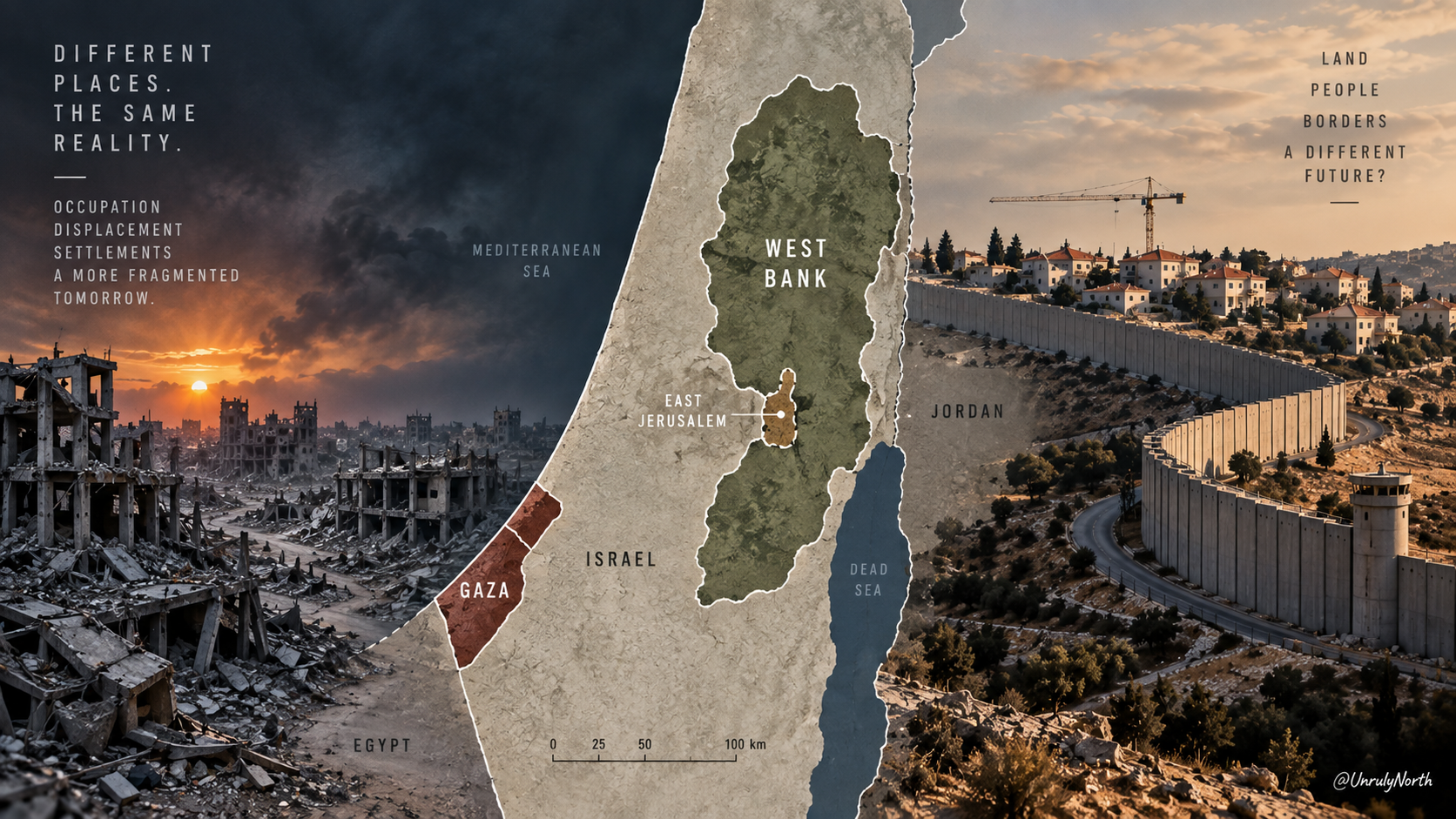
The Territorial Reality: Displacement, Destruction, and the Illusion of Peace
Donald Trump chairs an organization called the Board of Peace while his administration attempts to sell Israel 40,000 2,000-pound bombs. Concurrently, Israel is accelerating West Bank settlement construction—a project its own finance minister explicitly presents as a strategy to block Palestinian statehood. Meanwhile, Benjamin Netanyahu faces an International Criminal Court (ICC) arrest warrant for alleged war crimes, and a United Nations investigative commission has concluded that Israeli authorities committed genocide in Gaza.
These are not four unrelated stories.
Taken together, they expose a central reality obscured by treating the Israeli-Palestinian conflict as if history began with Hamas’s October 7, 2023, attack. While Gaza is the site of the greatest destruction, the territorial struggle spans much further. In the West Bank and East Jerusalem, settlements, land seizures, demolitions, and settler violence continue without any plausible link to dismantling Hamas.
The evidence does not point to a single secret master plan, but to something harder to dismiss: a years-long Israeli state policy to expand permanent control over occupied territory, transfer in civilians, displace Palestinians, and actively prevent a contiguous Palestinian state. Since October 7, these processes have rapidly accelerated.
This is a critique of state policy, territory, and power. It is not an indictment of Judaism or Jewish people, nor are Palestinian civilians or Muslims globally responsible for Hamas’s crimes. Reducing a geopolitical struggle over sovereignty to a religious conflict shields those exercising political power from scrutiny.
October 7 Was an Atrocity, Not the Beginning
The Hamas-led attack on October 7, 2023, killed approximately 1,200 people in Israel and took 251 hostages. UN investigators found Hamas and other armed groups responsible for war crimes, including murder, torture, and deliberate attacks on civilians. These crimes require no qualification; legitimate Palestinian grievances do not make them “legitimate resistance.”
However, condemning October 7 does not require pretending the conflict began that morning.
The mass displacement of Palestinians dates back to the 1948 war, and Israel captured the West Bank, East Jerusalem, and Gaza in 1967. Since then, Israeli settlements have spread, accompanied by a complex system of military zones, land seizures, and strict movement restrictions.
Recognizing this pre-2023 history prevents Hamas from becoming a universal justification for all Israeli state actions. Hamas does not govern the West Bank. A new settlement is not a raid on a rocket factory. Demolishing a Palestinian home for lacking a building permit does not suddenly become a military necessity because October 7 occurred. The attack transformed Israel’s security environment, but it did not create a legal right to permanently annex occupied territory or erase pre-existing Palestinian rights.
Gaza’s Destruction and the Legal Record
By September 2026, Gaza health authorities reported over 73,000 Palestinians killed. While this Hamas-administered figure does not separate combatants from civilians, international organizations continue to cite it. Regardless of the casualty breakdown, the physical devastation is undeniable:
- Mass Displacement: Over 320,000 homes have been damaged, affecting 1.7 million people.
- Stalled Reconstruction: A year after the October 2025 ceasefire, large-scale rebuilding remains non-existent.
- Ongoing Casualties: Palestinians live in improvised shelters and ruins. In September 2026, a strike-damaged building collapsed without any new bombardment, killing 21 people, including 11 children.
In September 2025, a UN Independent International Commission of Inquiry concluded on reasonable grounds that Israeli authorities and security forces had committed and were continuing to commit genocide against Palestinians in Gaza.
The Commission identified four acts under the Genocide Convention: killing members of the protected group; causing serious bodily or mental harm; deliberately inflicting conditions calculated to bring about physical destruction; and imposing measures intended to prevent births.
While the International Court of Justice (ICJ) has not yet issued a final judgment on South Africa’s genocide case, it has imposed binding provisional measures requiring Israel to prevent genocidal acts. It is factually false to claim the ICJ has already found Israel guilty, but it is equally false to claim no authoritative international body has found evidence of genocide.
Separately, the ICC issued an arrest warrant for Netanyahu in November 2024, alleging war crimes—including starvation as a method of warfare—and crimes against humanity.
The West Bank Exposes the Territorial Agenda
While Gaza sees the highest death toll, the occupied West Bank reveals the clearest picture of Israel’s territorial policy. Between January and August 2026, the UN documented over 1,600 settler attacks and the displacement of over 4,000 Palestinians. Sixty percent of displacements were directly driven by settler attacks, making it the leading cause.
This is not neighborly friction. It is coordinated violence involving livestock attacks, destroyed infrastructure, and intimidation. Whether labeled politically as ethnic cleansing or legally as forcible transfer, the physical outcome is identical: Palestinian communities are being forced off their land.
The “E1” project perfectly illustrates this strategy. Located between East Jerusalem and the massive Ma’ale Adumim settlement, Israel tendered 2,167 new housing units there in September 2026. This project aims to sever East Jerusalem from surrounding Palestinian territory and cut the West Bank in half. Finance Minister Bezalel Smotrich publicly celebrates this expansion as a deliberate tactic to prevent a Palestinian state.
The ICJ’s 2024 advisory opinion supports this assessment, ruling that Israel’s settlement policies and infrastructure amount to the unlawful annexation of large parts of the occupied territory. The court firmly rejected the argument that security concerns justify permanent acquisition of occupied land.
The “Board of Peace” Disempowers Palestinians
The U.S.-backed “Board of Peace” requires intense scrutiny. Welcomed by UN Security Council Resolution 2803 but operating independently of the UN, it is a highly centralized, invitation-only organization chaired by Donald Trump.
The Board’s architecture vests unprecedented power in one figure. Membership is limited to Trump’s invitees. States contributing over $1 billion bypass standard three-year term limits. The chairman holds veto power, sets the agenda, serves as the final authority on the charter, and appoints his own successor. This structure alienated traditional allies: France declined, Britain delayed, China held out, and Canada’s invitation was revoked after Prime Minister Mark Carney criticized the coercive politics behind it.
Furthermore, Jared Kushner’s “New Gaza” concept treats the territory as a massive real estate venture—proposing data centers and residential towers while ignoring fundamental questions of Palestinian land ownership and sovereignty. UN experts warned against treating Gaza as a “real estate paradise,” asserting that reconstruction decisions belong to Palestinians, not foreign investors. Instead, Palestinians are relegated to a technocratic committee, while strategic and financial authority sits with an internationally controlled, billionaire-funded board.
Washington: Arming the War, Supervising the Peace
The United States occupies two fundamentally incompatible roles. While directing Gaza’s political reconstruction, it continues to supply the munitions that caused the destruction—including a proposed $2.8 billion sale of 40,000 2,000-pound bombs in September 2026. Deploying such massive explosives in dense civilian areas remains highly controversial, and this dual, two-faced role destroys the fiction that Washington is a neutral broker.
U.S. policy is further shaped by massive, legally transparent campaign spending. By August 2026, AIPAC’s United Democracy Project spent over $53 million in the midterm cycle to support pro-Israel candidates and defeat critics. Tens of millions of dollars spent to reward allies creates undeniable political leverage.
The Trump-Netanyahu relationship operates on the same plane of visible political exchange, highlighted by Netanyahu nominating Trump for a Nobel Peace Prize in 2025. Military support, public praise, and political advantage repeatedly reinforce one another.
Canada’s Territorial Contradiction
Canada formally recognized the State of Palestine in September 2025. Ottawa has halted arms-export permits, sanctioned extremist settlers, and partnered with European nations to restrict trade from Israeli settlements, explicitly identifying the E1 project as a threat to the two-state solution.
However, diplomatic recognition alone cannot preserve territory. Canada’s policy faces a severe practical test: recognizing a state on paper while the physical land required for that state is systematically fragmented by ethnic cleansing, settlements, roads, and military control.
The Territorial Reality Cannot Be Ignored
Hamas committed mass murder on October 7, and Israel faces genuine security threats. Neither fact requires the world to ignore the systematic dismantling of Palestinian territory.
The map tells the true story: Gaza is physically devastated, East Jerusalem is being severed from its hinterland, and the West Bank is increasingly fragmented. Communities are displaced while governments continue to pay lip service to a two-state solution whose territorial foundation is vanishing.
The contradiction at the center of the international response is glaring. Governments discuss rebuilding Gaza without guaranteeing Palestinian land rights. The U.S. claims to broker peace while actively arming the conflict. An externally directed board controls Gaza’s future in the name of “peace.”
A Palestinian state cannot be created through diplomatic rhetoric if the land needed to sustain it is gone. The central question is no longer whether Gaza was an isolated reaction to October 7. The evidence demands we recognize a broader reality: the destruction of Gaza and the forced demographic transformation of the West Bank are different fronts of the same effort, leaving Palestinians with progressively less control over the land required for their survival.