
Trump Says He Won ‘Permanent Control’ of Greenland. The Deal Looks More Like 1951 With New Paint
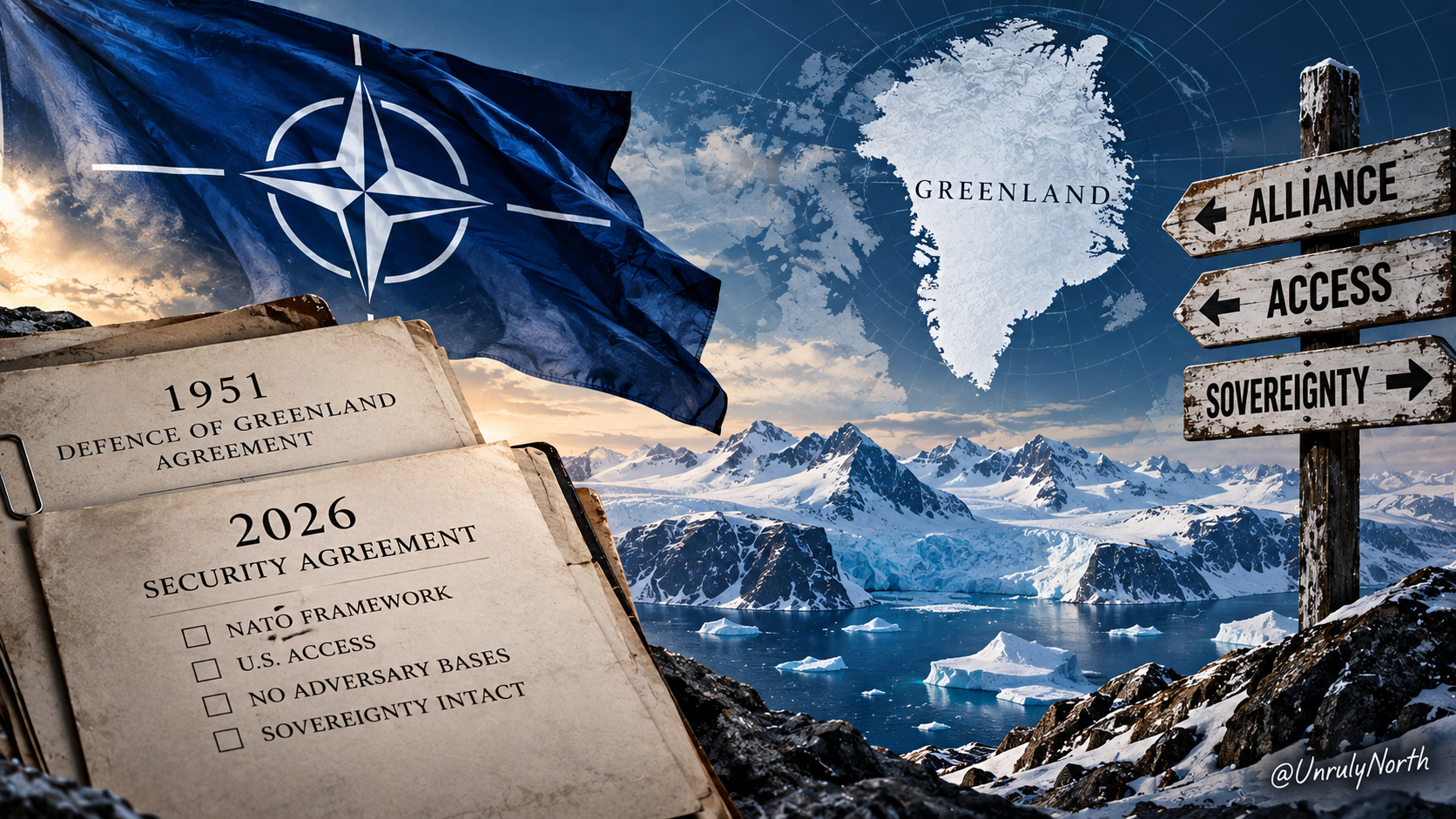
Donald Trump now has a Greenland deal. What he does not have is Greenland.
Trump announced on September 18 that the United States had reached an agreement with Denmark and Greenland giving Washington what he described as “permanent control” over security and other American requirements on the island. Denmark and Greenland describe something considerably less dramatic: an expanded security arrangement that leaves sovereignty and territorial integrity intact while explicitly recognizing Greenlanders’ right to self-determination.
That is not diplomatic fine print. A country exercising political control over another territory does not normally require that territory’s government to approve its military presence while simultaneously reaffirming the population’s right to determine its own future.
More importantly, much of the military access now being presented as a historic American breakthrough is not new. The United States has possessed sweeping military rights in Greenland since 1951. There is also an irony buried beneath the victory rhetoric: those rights were built on NATO, the same alliance Trump has spent years berating, threatening and at various points describing as “obsolete.”
Strip away the language of conquest and the agreement starts looking much more familiar. Washington has negotiated an updated version of a security relationship created during Harry Truman’s presidency, resting on an alliance system Trump has repeatedly portrayed as outdated, unfair to the United States or undeserving of unconditional American protection.
The Greenland Deal America Already Had
On April 27, 1951, the United States and Denmark signed the Defence of Greenland Agreement. It was not merely a bilateral arrangement between Washington and Copenhagen. NATO is woven into the agreement from its opening paragraphs.
The treaty states that the United States and Denmark were acting as parties to the North Atlantic Treaty and records that NATO had requested negotiations allowing allied armed forces to use facilities in Greenland for the defence of the island and the wider North Atlantic region.
Article I required the two governments to carry out their responsibilities in Greenland “in accordance with NATO plans.” Article II provided for American defence areas based on NATO planning. Article XIV was even clearer: the agreement was concluded in implementation of the North Atlantic Treaty and would remain in force for the duration of that treaty.
The legal foundation for the modern American military presence in Greenland was therefore NATO architecture from the beginning.
And it gave Washington extraordinary access. The United States could establish and operate agreed defence areas, construct military installations, station personnel, maintain equipment, store supplies and move American aircraft, ships and military forces through Greenland. American aircraft received extensive overflight and landing rights, while Washington could construct the infrastructure required to support its operations and exercise substantial authority within American-operated defence areas.
Yet the same agreement explicitly preserved Danish sovereignty.
That distinction is central to understanding the current dispute. American military access and American political ownership were deliberately separated in 1951. They remain separate today.
Harry Truman did not acquire Greenland in 1951. Donald Trump has not acquired it in 2026.
The NATO Alliance Trump Spent Years Attacking Made This Possible
This is where the political sales pitch becomes particularly awkward.
Trump has spent much of his political career treating NATO less as the foundation of American power in Europe and the North Atlantic than as a bad contract from which other countries were extracting too much from the United States.
During his 2016 presidential campaign, he repeatedly called NATO “obsolete.” He questioned whether the alliance had outlived its usefulness, complained that the United States paid too much and accused other members of enjoying a “free ride.” In 2017, after taking office, he reversed course and declared that NATO was “no longer obsolete,” but his underlying scepticism never disappeared.
During the 2024 campaign, Trump said he would not necessarily protect NATO countries that failed to meet defence-spending commitments. He also recounted telling an ally that, if it had not spent enough on defence, he would encourage Russia to “do whatever the hell they want.”
Those tensions have continued. Trump has again portrayed the alliance as a “one-way street” and complained that NATO was absent when America supposedly needed it. European governments have responded by increasingly questioning how dependable the American commitment to collective defence may be over the long term.
Yet when Washington wanted durable security access in Greenland, it did not need to invent a new imperial structure or establish American sovereignty over the island.
It returned to the architecture NATO helped build.
That contradiction sits at the centre of Trump’s Greenland victory lap. The United States can operate so extensively in Greenland precisely because Denmark and the United States are allies. Greenland is covered by NATO through the Kingdom of Denmark. The original American access agreement was negotiated for NATO purposes, and the strategic logic behind preventing hostile military forces from establishing themselves there is collective North Atlantic defence.
The alliance Trump has repeatedly treated as a burden turns out to be remarkably useful when an American president wants secure, long-term access to the Arctic.
Preventing Enemy Bases Is Hardly an Arctic Revolution
The new agreement does appear to contain additional provisions, and those should not simply be dismissed.
Public descriptions indicate that Washington could expand its military presence, that hostile powers would be prevented from establishing bases in Greenland and that certain strategic investments by American adversaries could be restricted. The arrangement also reportedly seeks to guarantee continued American military access if Greenland eventually becomes independent from Denmark.
Some of those provisions could be significant, particularly those governing a future independent Greenland and foreign investment in strategically sensitive sectors. The complete agreement should be examined carefully once its text is public.
But some of what is being presented as a dramatic concession amounts to formalizing what has long been geopolitical reality.
Greenland has been covered by NATO since Denmark joined the alliance in 1949. The United States has maintained a military presence there for generations. Pituffik Space Base remains strategically important to American missile warning, missile defence and space surveillance.
The idea that Greenland might casually permit Russia or China to establish military bases on NATO territory was never a realistic status quo.
Writing that prohibition more explicitly into an agreement may be prudent. It is not equivalent to transferring Greenland to American control.
If anything, presenting the provision as a major territorial victory demonstrates how inflated the confrontation became. Washington spent months demanding extraordinary control before celebrating guarantees against outcomes that Denmark, Greenland, the United States and NATO already had overwhelming reasons to prevent.
The 1951 Framework Has Been Modernized Before
The Truman-era arrangement was never frozen in time.
In 2004, the United States, Denmark and Greenland’s Home Rule Government amended the defence relationship to reflect Greenland’s changing political status and contemporary military requirements. The updated framework incorporated Greenlandic authorities more directly and revised arrangements surrounding what was then Thule Air Base, now Pituffik Space Base.
That history makes the 2026 agreement easier to understand.
The pattern is not one of American acquisition followed by American rule. It is a continuing negotiation among the United States, Denmark and Greenland over the operation of an American military presence whose modern legal foundation reaches back three-quarters of a century.
The latest agreement may prove consequential. It may allow new facilities, establish stronger guarantees, tighten investment restrictions or make American access more durable under future political circumstances.
But modernizing a defence agreement is not annexation.
“Permanent Control” Is Doing an Extraordinary Amount of Work
The central question is therefore what Trump means when he says “control.”
If he means the United States has secured durable authority over its own military operations and additional guarantees protecting American security interests, there is a substantive agreement to discuss.
If “permanent control” is supposed to suggest that Washington has acquired political authority over Greenland itself, however, the governments responsible for Greenland say otherwise.
Denmark maintains that the Kingdom’s territorial integrity remains intact. Greenland’s government maintains its right to self-determination. Based on the information publicly available, the agreement does not transfer Greenlandic legislative authority, ownership of the territory or general governmental powers to Washington.
It is extensive military access, not territorial acquisition.
Trump’s presentation turns a negotiated security arrangement into something resembling an imperial conquest because that version produces a much larger political victory. The historical comparison makes the exaggeration difficult to ignore.
In 1951, the United States obtained broad military access while Denmark retained sovereignty. In 2026, Washington is obtaining broad military access while Denmark and Greenland again insist that sovereignty remains unchanged.
The conditions have evolved. The underlying structure has not.
The Imperial Crisis Led Back to an Allied Solution
There is no serious dispute that the United States has legitimate strategic interests in Greenland. Its geography makes that unavoidable.
Greenland occupies a critical position between North America, the Arctic and the North Atlantic. Russian military activity, Chinese strategic ambitions, ballistic missile trajectories and emerging Arctic shipping routes all give Washington strong reasons to ensure that the island cannot become a security vulnerability.
None of that required treating Greenland as property waiting to change hands.
Denmark was already an American ally. Greenland was already inside the NATO security system. The United States already had extensive military access. A mechanism already existed for negotiating additional facilities and adapting the relationship as strategic conditions changed.
After months of talking about ownership and control, Washington therefore ended up negotiating with the same allies whose sovereignty had been placed under pressure, using the same alliance architecture that had already protected American interests for decades.
The episode also exposes the weakness in treating alliances as protection rackets or commercial contracts whose value can be measured solely by which member spent what percentage of GDP in a given year.
The United States derives enormous strategic advantages from NATO that are difficult to reduce to an invoice. Greenland is one of the clearest examples.
America does not need to own Greenland because an allied Denmark and Greenland have permitted an American military presence there for generations. NATO turned strategically vital foreign territory into a place from which the United States could help defend North America without annexing a square kilometre of it.
That is not evidence of NATO’s irrelevance. It is almost a textbook example of what alliances are designed to accomplish.
Trump can argue that his pressure helped push NATO governments to spend more on defence. He can also point to additional Greenland security provisions obtained through the latest negotiations. Those claims can be examined on their own merits.
But neither turns military access into territorial ownership, and neither erases the alliance system that made American access possible in the first place.
That system predates MAGA by generations. It was built by the postwar alliance structure Trump has repeatedly questioned and formalized in Greenland under Harry Truman in 1951.
After all the talk of taking Greenland, buying Greenland and establishing permanent American control, Washington has arrived at something remarkably recognizable: Denmark retains sovereignty, Greenland retains self-determination, the United States receives extensive military access, and NATO remains underneath the entire arrangement.
The United States did not win Greenland.
It renegotiated access to territory an ally had already allowed it to defend.