Carney’s Answer, Without the Alarm
Mark Carney gave a reasonable answer about an extreme possibility. He announced no war policy and predicted no invasion. Before a contingency becomes a social-media countdown to conflict, his words deserve to be read in context.
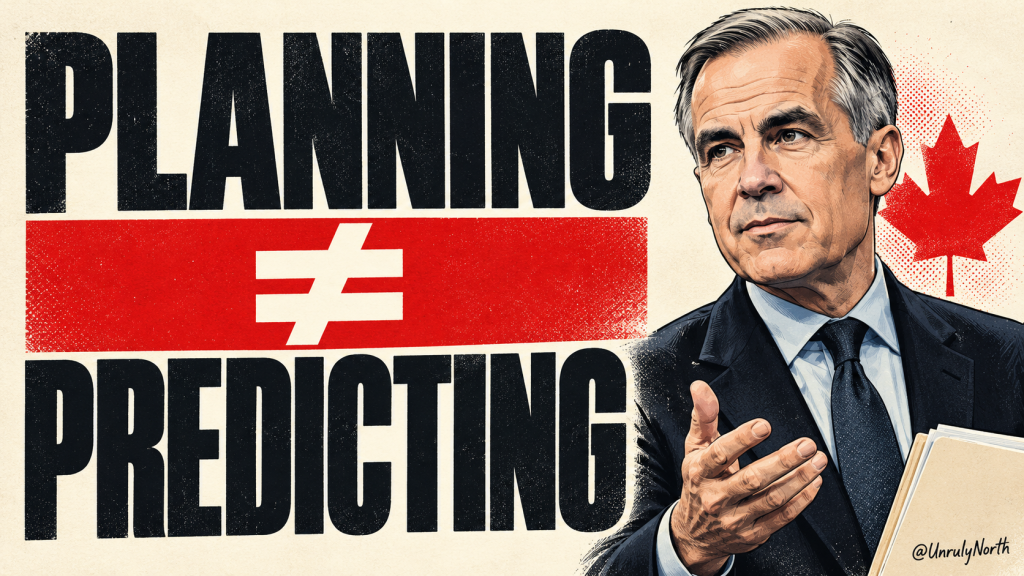
Mark Carney was asked whether he had taken seriously the possibility of American military action against Canada. He acknowledged examining an extreme risk and explained why someone in his position had a responsibility to do so. That was a reasonable answer to a reasonable question. It was not a prediction of war, an announcement of military policy, or a declaration that Canada expects an invasion. theedgesingapore.com
That distinction needs to survive the journey from an interview to a headline and then into a social-media feed. Put the words “Canada,” “Trump” and “invasion” together, and the most frightening interpretation can quickly become the accepted one. By the time the original answer enters the conversation, people may already be debating a war the prime minister never said was coming.
The question deserves attention. So does the answer’s actual meaning.
In his September 23 interview with The New York Times, Carney described possible American military action as an “extreme tail risk.” The Canadian Press reported his explanation: “That’s just risk management. That’s not a base case.” He declined to discuss the details of what he had examined. rdnewsnow.com
Those words are central to the story. They tell us how Carney assessed the scenario: grave enough to consider, sufficiently remote that it was outside his central expectation. Removing that qualification changes the meaning of his answer.
What the answer actually tells us
A base case is the central scenario used in planning. An extreme tail risk sits far outside that expectation: an unlikely event whose consequences could nevertheless be severe. Considering such a possibility does not mean deciding that it will happen. It means recognising that probability and consequence are different questions.
Governments have to consider both. The most likely outcome does not account for every event against which a country should prepare. If officials examined only what they expected to happen, their planning would offer little protection when events departed sharply from those expectations.
Carney’s answer belongs in that context. He acknowledged the responsibility to examine a dangerous possibility without describing it as an approaching reality. His refusal to disclose details also leaves us without a basis for claiming that he announced a particular military response or predicted an outcome.
There was a legitimate reason to ask the question. Donald Trump has repeatedly talked about making Canada the 51st state. The Canadian Press also noted that, in January 2025, he ruled out military force against Canada while suggesting economic pressure instead. Both parts of that record matter. The annexation rhetoric explains the concern; it does not establish that an invasion is planned. rdnewsnow.com
A Canadian prime minister cannot responsibly treat another president’s remarks about absorbing Canada as irrelevant. Canadians are entitled to ask whether their government has considered the implications. An acknowledgement that it has done so should not automatically become evidence that the worst implication is now likely.
Consider the alternative answer: an assurance that the government had never examined the possibility because it was too uncomfortable or too improbable to discuss. That might produce a less dramatic headline. It would hardly demonstrate better judgment.
Carney was explaining the work that responsible judgment requires. Readers can recognise that without endorsing every decision his government makes.
A headline cannot carry the whole interview
Reporting this exchange is entirely legitimate. A prime minister’s assessment of a threat to Canadian sovereignty is newsworthy, even when he considers that threat remote. The problem arises when the possibility becomes detached from the language describing its likelihood.
A headline saying Carney studied potential American military action can be accurate. A reader who interprets it as a warning that American troops are coming has travelled considerably beyond what the answer establishes.
The wider interview also matters. It addressed Canada’s efforts to reduce dependence on American technology and suppliers, including satellite services and fighter aircraft. Carney reportedly disclosed that he and Trump continued to speak frequently, including after the breakdown in trade negotiations. It was a discussion of a difficult, evolving relationship and Canada’s response to it. Political Press
That context does not erase the seriousness of the military question. It places the exchange within a broader discussion of vulnerability, bargaining power and national resilience. Canada can seek greater independence while maintaining communication with Washington. It can examine severe risks while working to keep them remote.
Social media makes those distinctions harder to preserve. A short post can turn “the government examined an unlikely possibility” into “the government is preparing for the event everyone should now fear.” The first describes a planning responsibility. The second supplies an expectation the speaker expressly declined to adopt.
There is no need to invent a reassuring certainty in the opposite direction, either. Carney did not promise that nothing could ever happen. His answer recognised uncertainty and the obligation to consider it. That is a sensible position for a government to take.
The barriers the invasion scenario leaves out
The political and international context supplies further reasons to resist the leap from this interview to an approaching war. None offers an absolute guarantee. Together, they show how much an invasion narrative leaves out.
American public opinion provides one such constraint. A Reuters/Ipsos poll published September 1 found that 57 per cent of respondents opposed higher tariffs on Canadian goods, while only 20 per cent supported them. That survey did not ask about an invasion. It nevertheless gives substantial reason to question the assumption that Americans would enthusiastically support a far more destructive confrontation with a country they already oppose punishing economically. www.reuters.com
An administration would have to overcome that political resistance, explain its objectives and defend the consequences. Disapproval of a trade war is relevant evidence when assessing the plausibility of public enthusiasm for military escalation. It supports caution about the invasion scenario without pretending to predict every future voter reaction.
Congress matters as well. A change in House control could materially alter the administration’s ability to avoid scrutiny. Last week’s Hegseth impeachment dispute illustrated the importance of who controls the chamber: Speaker Mike Johnson recessed the House early amid Representative Thomas Massie’s effort to force action against the defence secretary. An opposing majority could pursue hearings, investigations and impeachment votes with very different priorities. apnews.com
The House also has a role in funding government and exercising Congress’s war powers. A majority willing to use those powers could impose significant political and practical costs on an administration. The extent would depend on its actions and the wider constitutional struggle, but losing a protective majority could have real consequences. constitution.congress.gov
Canada’s international relationships add another layer. An armed attack on Canada would raise its collective-defence rights directly. NATO’s Article 5 allows different forms of assistance; it does not automatically require every member to enter an all-out war. Each ally determines the action it considers necessary. www.nato.int
An attack by a NATO member would create an extraordinary crisis within the alliance, whose collective decisions depend on consensus. Even then, individual countries could assist Canada through their own decisions. Financial pressure, sanctions, equipment and other support would belong among the possible responses. Their exact form cannot be known in advance. www.nato.int
The response to Russia’s invasion of Ukraine demonstrates the range of tools available. Countries have imposed sanctions and provided military and financial assistance to Ukraine, which is not a NATO member, without collectively declaring war on Russia. That experience does not provide a ready-made forecast for a crisis involving the United States. It does show why the imagined choice between a world war and international inaction is inadequate. www.international.gc.ca
These considerations help explain why the military scenario is so remote. They are context for assessing an extreme contingency, rather than evidence that anyone has selected a course of action.
Read the qualification
The responsible response to Carney’s remarks is to give readers the distinction he made: a government can examine an event it does not expect. It can acknowledge that work without announcing a policy to confront the event, predicting its arrival or declaring how it would end.
There is a serious story here about the strain in the Canada–U.S. relationship. Canadians should be able to discuss that strain, and ask difficult questions about sovereignty, without every candid answer becoming another reason to panic.
The interviewer was entitled to ask. Carney was responsible to answer seriously. His description of an extreme risk belongs alongside the acknowledgement that he considered it; it cannot be treated as a disposable qualification.
Before sharing a headline as evidence that Canada is heading towards war, read the answer underneath it. The clearest statement of Carney’s expectation was already there.
Sources
- Bloomberg: Carney’s response when pressed about the risk of American military action
- The Canadian Press: Carney explains his assessment of an extreme risk
- Reuters/Ipsos: Americans’ views on higher tariffs against Canada
- Associated Press: House recess amid the Hegseth impeachment push
- NATO: Collective defence and Article 5
- Library of Congress: Congressional war powers
- Government of Canada: Sanctions and assistance in response to Russia’s invasion of Ukraine