The Trump Administration Says It Wants Lower Prices. Its Own Policies Are Raising Them
Americans are being told that affordability is a priority while tariffs raise import costs, the Iran war drives an energy shock, federal spending remains enormous, and promised rebate checks repeatedly fail to arrive.
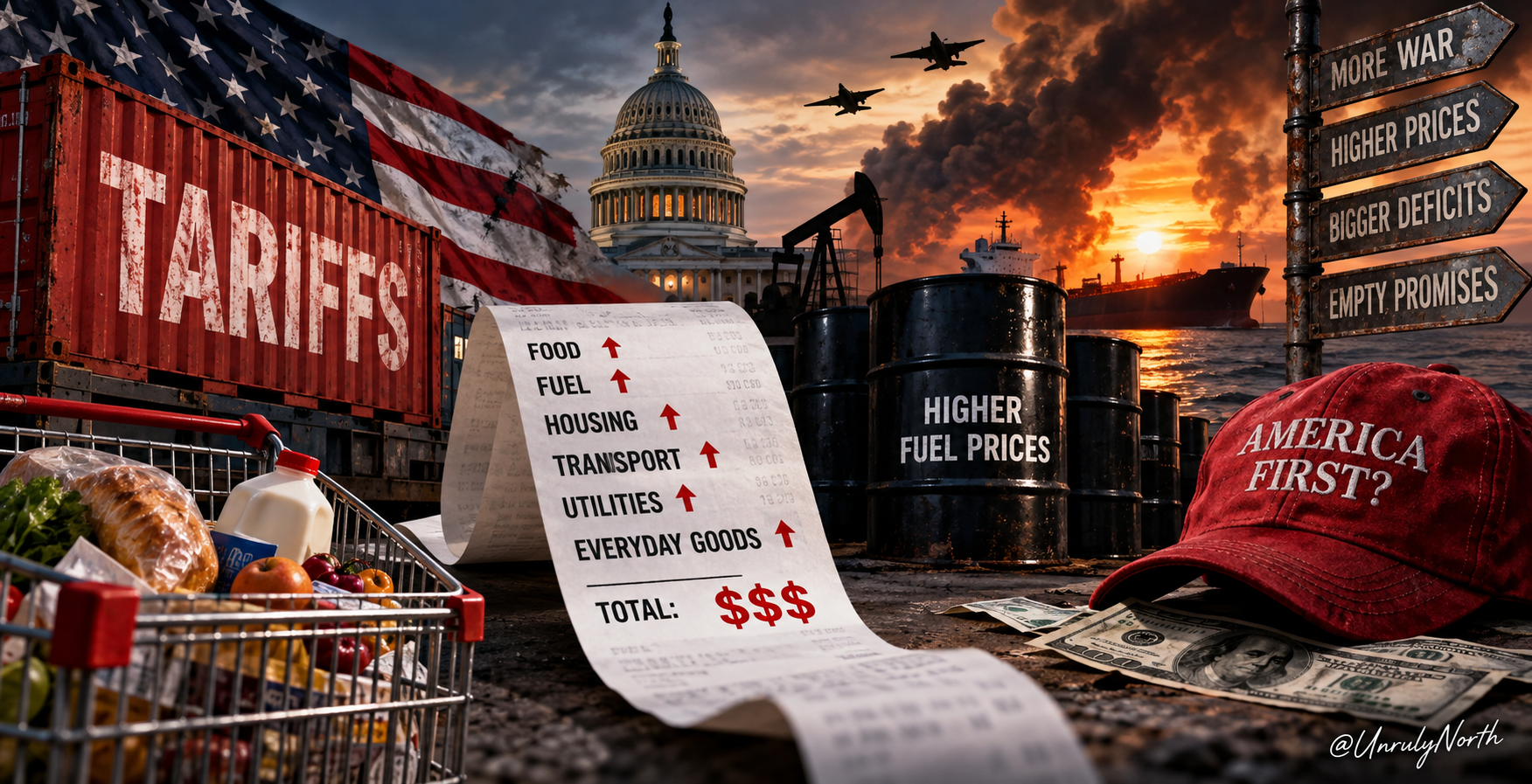
Americans do not experience inflation as an economic theory. They experience it at the gas pump, in a grocery aisle, on a utility bill and when the price of something ordinary suddenly costs more than it did a month ago.
That is what makes the Trump administration’s affordability message increasingly difficult to reconcile with its own policies.
The administration cannot reasonably be blamed for every expensive house, medical bill or grocery item in the United States. Many of America’s affordability problems predate Donald Trump’s return to office. But Washington has direct control over two policies that are now adding pressure to household budgets: a broad tariff regime that raises the cost of imported goods and production inputs, and a war with Iran that has disrupted global energy markets and helped send American fuel prices sharply higher.
The numbers are no longer subtle. The Consumer Price Index rose 3.4 percent over the year ending in August. Energy prices rose 16.3 percent. Gasoline was 27.4 percent more expensive than a year earlier. Fuel oil jumped 52 percent. Gasoline alone accounted for more than one-third of August’s monthly increase in consumer prices, according to the Bureau of Labor Statistics.
Diesel may be even more important because most Americans pay for it without ever touching a diesel pump.
The average U.S. on-highway diesel price reached $6.285 a gallon on September 14, according to the Energy Information Administration. Five weeks earlier, it stood at $5.257. California diesel had climbed above $8 a gallon.
Diesel powers trucks, farm machinery, construction equipment and large parts of the freight system. Businesses cannot absorb increases of that size forever. A trucking company can eat part of the cost. A farmer can accept a smaller margin. A retailer can squeeze a supplier. Eventually, however, someone raises a price.
The consumer is standing at the end of that chain.
Tariffs do not make foreign governments pay the bill
The administration continues to speak about tariffs as though they represent money extracted from foreign countries. That description obscures how tariffs actually work.
The duty is charged when a product enters the United States. The American importer pays it. The importer then decides what to do with the additional cost. It can reduce its profit, pressure the supplier, change its sourcing, stop selling the product or raise its price.
Usually the cost gets divided among several of those options.
Research from the Federal Reserve Bank of New York now gives us a clearer picture of what happened after the 2025 tariffs. Its researchers found that about 26 percent of the tariff increase passed through to consumer prices. Tariffs also raised prices on American-made products because U.S. manufacturers use imported inputs and because domestic producers facing less competition gained room to increase their own prices.
The Budget Lab at Yale estimates that the current tariff regime will ultimately increase consumer prices by about 0.7 percent and cost the average household roughly $1,100 a year.
That makes the tariff argument remarkably circular. Washington imposes a tax at the border. American companies pay it. Part of the cost moves through supply chains. American consumers pay more. The government then points to the revenue collected by Washington as evidence that the tariffs are enriching the country.
Tariff revenue is real government revenue. But it did not materialize from another country’s treasury. It entered the federal government’s accounts after a tax was imposed on commerce entering the United States.
The checks keep being promised
The administration’s answer has repeatedly included another promise: eventually, Americans will get some of the money back.
In February 2025, Trump said his administration was considering returning 20 percent of savings from the Department of Government Efficiency to the public. The proposal behind the idea envisioned checks of roughly $5,000 for taxpaying households if DOGE achieved savings on the scale originally discussed.
Those checks never arrived.
Neither did the savings required to support the original proposal. The Government Accountability Office later examined DOGE’s published savings claims and found serious weaknesses. As of July 2026, DOGE’s so-called Wall of Receipts reported $110 billion in savings from contracts, grants and leases. GAO found incorrect estimates, insufficient supporting evidence and unclear methodology. For 96 percent of reported grant savings, DOGE did not provide enough information for GAO to verify how the savings had been calculated. GAO also found that 108 leases credited to DOGE were already being phased out before DOGE existed.
Then came the tariff dividend.
Trump said in November 2025 that lower- and middle-income Americans would receive payments of about $2,000 from tariff revenue. The White House later said he remained committed to the proposal. By January 2026, Trump was still talking about issuing the payments.
No $2,000 tariff dividend was enacted.
Now the promise is larger.
In September, the White House promoted Trump’s pledge to pay every adult American citizen $5,000 if Republicans retain control of Congress. Trump described the country’s finances as strong enough to support the payments. Congressional approval would be required, and estimates put the potential cost well above $1 trillion.
The federal government’s accounts tell a less comfortable story.
The Congressional Budget Office estimates that the federal deficit reached roughly $2 trillion during the first 11 months of fiscal 2026. After adjusting for the timing of payments, CBO estimated that the deficit was larger than during the comparable period a year earlier. Federal spending remains measured in trillions of dollars, not in the dramatically smaller government that DOGE rhetoric once suggested.
DOGE was supposed to demonstrate that Washington could slash waste and return the proceeds. Spending did not collapse. The deficit did not disappear. The promised DOGE checks did not arrive. The promised tariff checks did not arrive either.
Now Americans are being offered another, larger check in the future.
That does not prove that the administration is deliberately trying to distract voters. Motive requires evidence. But the pattern deserves scrutiny. Each time the cost of current policy becomes harder to ignore, the public hears about a larger future benefit.
The Iran war has a price tag far beyond the Pentagon
The same question of cost applies to Iran.
The current Iran war has already required tens of billions of dollars in American military spending. Continued operations add billions more. That covers aircraft, ships, missiles, logistics, personnel, replacement weapons and the enormous support network required to sustain modern warfare.
Those figures cover only part of the bill.
The war has reduced energy shipments through critical waterways and intensified disruption across the Middle East. That has pushed up crude prices, disrupted refining and raised the prices of gasoline, diesel and jet fuel. Because freight costs touch almost every product sold in America, the effects spread far beyond the gas station.
So who pays for this war?
The federal government pays for missiles, aircraft operations, logistics and replacement weapons. Taxpayers ultimately service that spending and the debt associated with it. Businesses pay more for fuel and freight. Households pay at the pump. Consumers pay again when transportation costs appear in the price of food, construction materials and manufactured goods.
The war creates several bills, and Americans receive more than one of them.
What exactly is the war supposed to achieve?
That question becomes unavoidable when the administration presents Iran’s nuclear program as a central justification for military action.
The obvious comparison is the Joint Comprehensive Plan of Action, the Iran nuclear agreement reached in 2015.
The JCPOA was not a peace treaty. It did not resolve Iran’s ballistic missile program, its regional activities or its support for armed groups. Critics of the agreement made legitimate arguments about those omissions.
But on the nuclear issue itself, the terms were concrete.
Iran reduced its installed centrifuges, capped enrichment at 3.67 percent, reduced its stockpile of low-enriched uranium to 300 kilograms, stopped uranium enrichment at Fordow and accepted extensive International Atomic Energy Agency monitoring. The agreement was designed to extend Iran’s estimated nuclear breakout time from roughly two or three months to at least one year.
The Trump administration withdrew the United States from the agreement in 2018. Before that withdrawal, the administration had certified Iranian compliance with the agreement. Iran subsequently expanded its nuclear activities beyond JCPOA limits.
That history makes the current war’s objective a legitimate subject for much harder questioning.
What result now justifies tens of billions of dollars in military spending, depleted missile inventories, disrupted oil routes and higher consumer prices?
If the answer is another negotiated restriction on Iran’s nuclear program, then the administration has to explain how the eventual arrangement improves substantially on the one the United States abandoned.
The question becomes even more important when military confrontation eventually leads back to negotiation. War does not eliminate the need for diplomacy. It changes the circumstances under which diplomacy takes place and dramatically increases the cost of reaching that table.
The administration may eventually negotiate an agreement that contains stronger restrictions than the JCPOA. If it does, that agreement should be judged on its actual provisions.
But until such terms exist, the government still owes Americans an answer to a basic question: what has the war purchased that could not have been achieved through negotiation?
If Washington spends tens of billions of dollars, drives fuel prices sharply higher and disrupts global commerce only to emerge with another agreement limiting Iranian enrichment, the comparison with the JCPOA will become impossible to avoid.
America is reaching back to 1930 for its trade policy
The Canada trade fight adds another layer to the affordability problem, and history makes the choice especially striking.
The administration has imposed major duties on categories of Canadian products and has used legal authority that includes Section 338 of the Tariff Act of 1930.
That is the same Tariff Act better known to history as Smoot-Hawley.
Smoot-Hawley did not cause the Great Depression by itself. Monetary failure, banking collapse and other forces played larger roles. But economists have spent decades documenting the damage caused by the tariff escalation and the retaliation that followed. The law became one of the most frequently cited warnings against trying to protect a domestic economy by raising trade barriers while other countries respond in kind.
Canada was not a footnote to that history.
Canada retaliated against American tariffs in 1930 and deliberately redirected purchases toward Britain and other markets. Canada became one of the clearest historical examples of how American protectionism could encourage trading partners to restructure commerce away from the United States.
Nearly a century later, Washington is again reaching for tools from that era while engaging in a trade confrontation with Canada.
And Canada is again looking elsewhere.
Prime Minister Mark Carney’s government has set a goal of doubling Canada’s non-U.S. trade within a decade. Carney has spent recent months deepening economic and strategic relationships in Europe and other markets. His government has pursued closer cooperation in defence, energy, critical minerals, technology and trade.
Canada still sends roughly 72 percent of its exports to the United States. That explains why diversification cannot happen overnight.
It also explains why Ottawa now treats dependence on a single market as a strategic vulnerability.
For decades, the extraordinary integration of the Canadian and American economies gave both countries an advantage. Factories could build products across the border. Energy moved through continental networks. Companies planned around a stable trading relationship. Defence and intelligence cooperation reinforced the economic partnership.
The United States was not simply another Canadian trading partner. It was Canada’s dominant economic relationship and arguably its closest international ally.
A trade war puts a price on that trust.
Once Canadian businesses build new customers in Europe or Asia, once governments finance new ports and transport routes, and once companies redesign supply chains to reduce exposure to Washington, those relationships do not automatically disappear when American policy changes.
Prime Minister Carney’s increasingly active diplomacy should therefore matter to Americans. Canada is not merely looking for temporary relief from one round of tariffs. Ottawa is trying to make sure that Canada never again depends so heavily on a single ally that decisions made in Washington can threaten large parts of the Canadian economy.
That is a structural change.
The Trump administration may view tariffs as leverage over Canada today. But leverage works only while the other country remains dependent. Every new Canadian trade agreement, defence partnership, energy route and overseas customer reduces that dependence.
Tariffs can therefore impose costs that never appear on a customs receipt.
The affordability contradiction
The Trump administration cannot control every price in America, and it should not be judged as though it can. Housing shortages, health-care costs, insurance premiums and long-standing structural problems have many causes.
But government also cannot create new costs and then speak about affordability as though those costs arrived from somewhere else.
Tariffs raise the cost of imported products and industrial inputs. Federal Reserve research shows that part of those increases reaches consumers and that domestic producers can raise prices as well.
The Iran war has required tens of billions of dollars in military spending while an energy shock moves through the economy.
Diesel above $6 a gallon moves through the price of almost everything that travels by truck.
Federal spending remains enormous. The deficit is near $2 trillion. DOGE savings proved far smaller and less verifiable than the numbers originally used to discuss $5,000 household dividends.
The DOGE checks never arrived.
The $2,000 tariff checks never arrived.
Now the administration is talking about $5,000 payments in the future.
Meanwhile, a trade confrontation with Canada is encouraging one of America’s oldest and most deeply integrated partners to build permanent alternatives to American dependence, while Washington reaches back to a tariff statute enacted in 1930.
This is no longer an abstract debate over economic ideology.
Americans are paying for these choices now.
They pay through import prices. They pay through freight costs. They pay through energy bills. They pay for military operations through the federal budget. They may pay again through higher interest costs and a larger national debt.
The administration can defend tariffs. It can defend the Iran war. It can defend its spending priorities. It can argue that each policy produces benefits worth those costs.
But the economic costs still exist.
If affordability is truly the priority, the relevant question is no longer whether the administration understands that Americans are angry about prices.
The question is why policies intended to advance other objectives are adding to the bill Americans already struggle to pay.