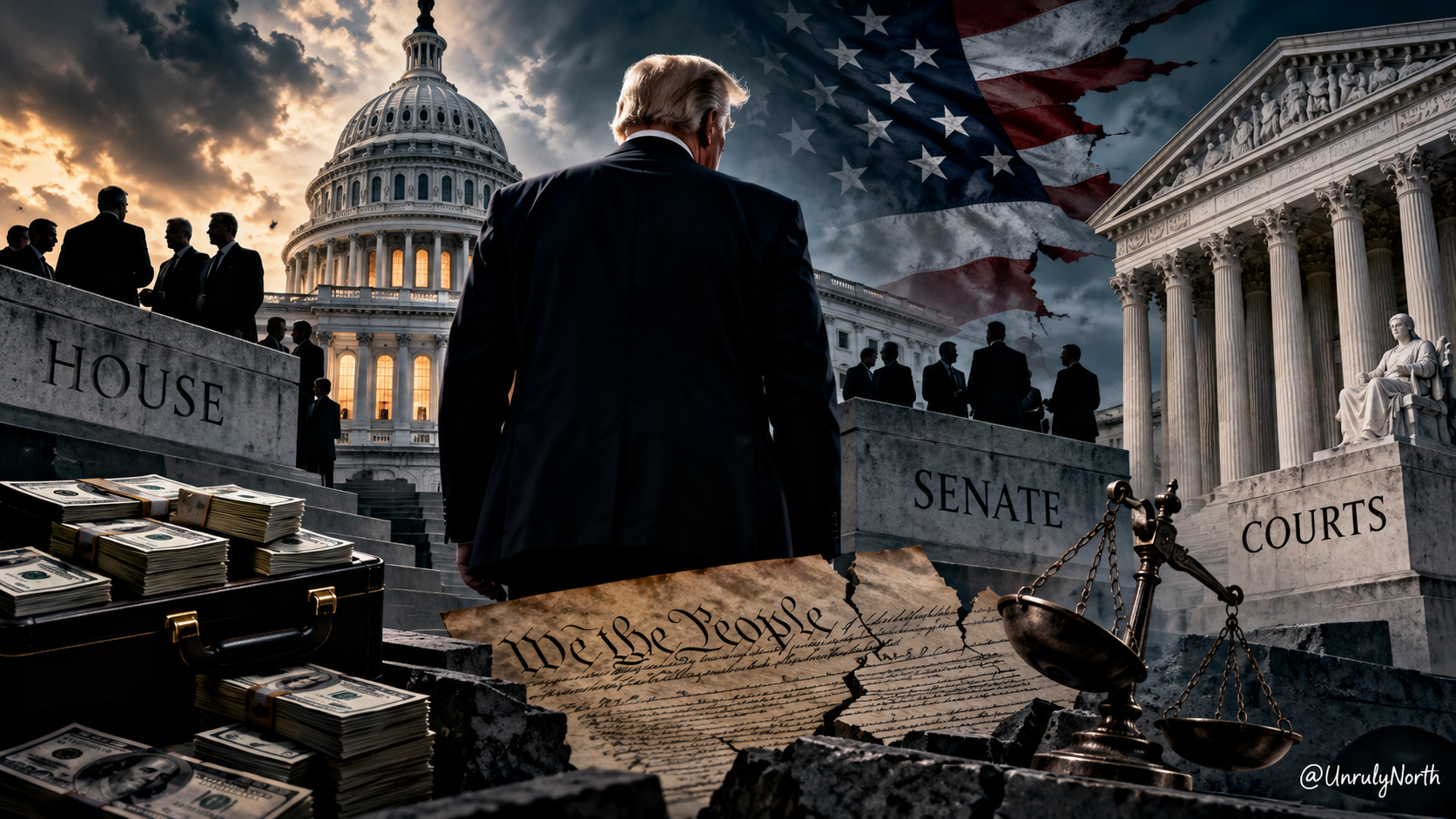
How the House, Senate and Courts Weakened the Checks on Trump’s Second Presidency
Trump’s second presidency has exposed a widening gap between constitutional checks and effective restraint. Congress often hesitates, courts sometimes arrive too late, and decades of delegated power have left the executive with room to act first and force everyone else to catch up.
In July 1973, the Senate Watergate Committee voted unanimously to subpoena Richard Nixon’s White House tapes. Republicans on the committee did not stop being Republicans, and Democrats were hardly disinterested observers, but the Senate still behaved as a branch of government with institutional interests separate from those of the president. Nixon resisted the subpoena, Congress continued investigating, and the confrontation eventually reached the Supreme Court, which unanimously ordered him to surrender the recordings. The evidence helped drive the House Judiciary Committee toward impeachment, and when Republican congressional leaders finally told Nixon that his remaining support was collapsing, he resigned. The system was slow, political and imperfect, but its competing institutions eventually competed. Supreme Court
That history matters in 2026, not because Donald Trump is simply Richard Nixon with a different cast of characters, but because it demonstrates something fundamental about checks and balances: constitutional powers do not operate themselves. Congress must be willing to investigate, control spending, reject nominees, restrict presidential action and confront a president even when he leads the congressional majority’s own party. Courts must be willing to restrain executive action, but they must also be able to do so quickly enough that the remedy still matters. A ruling that arrives after the official has been fired, the money withheld, the agency dismantled or the war begun may establish an important legal principle while doing little to reverse what already happened.
Trump has not abolished those institutions. The House and Senate continue to legislate. Senators have rejected or derailed administration choices. Federal judges regularly rule against the government, and the Supreme Court has handed Trump significant defeats, including its February 2026 ruling that the International Emergency Economic Powers Act did not authorize the sweeping tariffs he had imposed under it. Just this month, the Court also refused to allow the administration to impose new Postal Service restrictions on mail ballots before the midterm elections. Those decisions matter because they show that legal constraints remain real. Supreme Court
The more troubling question is whether those constraints remain effective enough to restrain presidential power before executive action becomes reality. Trump’s second administration has repeatedly exposed a gap between possessing constitutional checks and successfully exercising them. The presidency can move with speed and unity that neither Congress nor the judiciary can easily match, while polarization makes legislative resistance increasingly dependent upon members of the president’s own party turning against him. When they refuse, presidential power does not need to become unlimited to become extraordinarily difficult to check.
Congress Has Power. Using It Is Another Matter.
As of September 2026, Republicans hold 218 House seats, Democrats 214 and an independent one, with two vacancies. In the Senate, Republicans hold 53 seats, Democrats 45 and two independents caucus with the Democrats. Those numbers give Trump’s party control over the committees, hearing schedules, subpoenas, confirmation process and legislative agenda through which congressional oversight becomes more than rhetoric. House Radio-Television Gallery
The constitutional design assumes that members of Congress will defend congressional power because Congress is a separate branch of government. Modern political parties complicate that assumption. Republican legislators are simultaneously members of an institution that is supposed to check the president and members of a political coalition whose dominant national figure occupies the White House. Every serious confrontation with Trump therefore creates two competing incentives: protect the authority of Congress or protect the political fortunes of the Republican administration. The Constitution provides no mechanism for ensuring that institutional loyalty wins.
Trump’s removal of federal inspectors general shortly after returning to office illustrated the consequences. The law required advance notice to Congress and justification for removing these independent watchdogs, yet the administration dismissed numerous inspectors general without complying with those requirements. When eight of them challenged their removals, U.S. District Judge Ana Reyes concluded in September 2025 that Trump had violated the law. She nevertheless declined to reinstate them, noting that the president could legally remove them later if he followed the required procedure. Reuters
The distinction between winning the legal argument and restoring the status quo could hardly be clearer. Congress had enacted a safeguard. The administration disregarded it. A court later determined that the administration had acted unlawfully, yet the officials remained out of their jobs. Nothing about that episode suggests that the law ceased to exist; instead, it shows how an executive willing to act first can sometimes obtain the practical result it wants before another branch successfully intervenes.
The Power of the Purse Is Only Powerful If Congress Defends It
Congress’s control over federal spending should be one of its strongest weapons. The Impoundment Control Act of 1974 emerged directly from the Nixon-era struggle over executive power and was designed to prevent presidents from simply refusing to spend money that Congress had appropriated. A president can seek rescissions or use limited statutory procedures to delay spending, but the executive is not supposed to replace Congress’s spending decisions with its own.
The Trump administration repeatedly tested that boundary during 2025. The Government Accountability Office found that the Institute of Museum and Library Services violated the Impoundment Control Act after an executive order directed the agency to reduce its functions and appropriated money was withheld. GAO separately concluded that withholding Head Start funds violated the act and later reached another violation finding involving National Institutes of Health grant funding. These were not partisan characterizations of policy disagreements; they were legal conclusions issued by the congressional watchdog charged with protecting Congress’s appropriations authority. GAO
The constitutional stakes are much larger than libraries, grants or individual programs. If Congress appropriates money and the executive can simply decline to spend it, presidential power begins to resemble a line-item veto that Congress never granted. Lawmakers can challenge the withholding, demand records, hold hearings and eventually litigate, but every additional step consumes time while the executive decision remains in effect. A presidency willing to exploit that asymmetry starts the contest with an enormous practical advantage: it can create the situation Congress must subsequently try to undo.
This pattern extends beyond spending. In September, a federal appeals court heard a challenge to Trump’s attempt to effectively dismantle three congressionally created agencies by dismissing most of their employees and ending much of their work. Judges questioned how an administration could leave an agency unable to perform the duties Congress assigned to it when only Congress can abolish the agency itself. Whatever the courts ultimately decide, the case again poses the same institutional question: what remains of congressional authority if an administration can achieve through personnel decisions what it could not persuade Congress to enact through legislation? Reuters
Congress Helped Build the Presidency It Now Struggles to Control
It would be bad history to pretend Trump invented the powerful modern presidency. Congress spent decades delegating authority in trade, national security, emergencies and foreign policy to presidents of both parties. Successive administrations stretched those authorities, often with congressional acquiescence, and legislators frequently discovered that transferring difficult decisions to the White House was politically easier than making those decisions themselves. Trump inherited that machinery. What distinguishes his administration is how aggressively it has been willing to test the machinery’s outer limits.
War powers expose the problem particularly well. Congress passed the War Powers Resolution in 1973 because lawmakers believed presidents had accumulated too much unilateral military authority, yet presidents of both parties continued claiming broad power to deploy American forces without traditional declarations of war. More than half a century later, Congress is still attempting to recover authority it supposedly reclaimed after Vietnam.
On September 15, 2026, the House voted 220-204 to seek an end to U.S. military operations in Iran, with seven Republicans joining Democrats. It was the chamber’s third effort to restrain the conflict, which by then had continued for nearly seven months. Earlier attempts had failed to reach Trump, and any measure that does reach him can be vetoed, requiring the much higher threshold of two-thirds of each chamber to override him. AP News
That does not mean Congress lacks war powers. It demonstrates how those powers can become weaker in practice once military operations are already underway. The president commits American forces, the consequences begin immediately, Congress debates whether the action was authorized, legislators assemble a majority to halt it, and the president can then veto their attempt. By that point, servicemembers have deployed, money has been spent, international commitments have been made and adversaries have responded. The constitutional check has not vanished, but it is operating from behind.
The Senate Can Resist Trump, but Resistance Often Requires Republicans to Defy Him
The Senate’s advice-and-consent power remains another genuine presidential constraint. Trump learned that before his second term even began, when Matt Gaetz withdrew from consideration for attorney general after it became apparent that resistance among Republican senators threatened his confirmation. The Senate was capable of saying no, and Trump adjusted accordingly.
Other nominations demonstrated how narrow that independence could become. Pete Hegseth was confirmed as secretary of defense only after the Senate divided 50-50 and Vice President JD Vance cast the deciding vote. Robert F. Kennedy Jr. became health secretary by a 52-48 vote. At the same time, other nominees faced little resistance, demonstrating that Senate behaviour cannot honestly be described by a single partisan formula.
The important institutional point is not that every Trump nominee should have been rejected. That would substitute political preference for constitutional analysis. It is that under unified party government, one of the Senate’s major checks on executive power increasingly depends upon a handful of senators being prepared to oppose the president who leads their own party. The formal authority of the Senate remains unchanged, while the political conditions under which that authority is exercised have changed dramatically.
The Courts Are Both Restraining Trump and Enlarging the Presidency
The judiciary is where simplistic arguments fail most quickly. Federal courts have repeatedly restrained the Trump administration, and the Supreme Court itself has rejected major assertions of presidential authority. Its February ruling on Trump’s emergency tariffs was unequivocal: Congress had not given the president authority under IEEPA to impose tariffs at his sole discretion. The decision reaffirmed an important limit on executive power and forced Trump to pursue his trade agenda through other legal mechanisms. Supreme Court
Yet the Court has simultaneously changed constitutional doctrine in ways that give the presidency greater operating freedom. In Trump v. United States in 2024, the Court held that a former president possesses absolute criminal immunity for actions within his conclusive constitutional authority and at least presumptive immunity for other official acts. Unofficial conduct remains prosecutable. The ruling did not legalize misconduct simply because a president performed it in office, but it substantially changed the conditions under which presidential conduct can later produce criminal liability. Supreme Court
A year later, Trump v. CASA limited the use of universal injunctions by federal district courts. The case arose from challenges to Trump’s attempt to restrict birthright citizenship, but the Supreme Court deliberately did not decide that policy’s constitutionality in the ruling. Instead, it held that injunctions generally should not protect people beyond the plaintiffs entitled to relief. That decision narrowed one of the tools lower courts had used to stop nationwide executive policies quickly while their legality was being litigated. Legal Information Institute
These developments do not make the Supreme Court an arm of the Trump administration; its recent decisions against him demonstrate otherwise. They do, however, alter the environment in which presidential power operates. Greater immunity for official conduct and narrower availability of universal injunctions can make it harder to impose immediate consequences or immediate nationwide restraints, even while courts retain the authority to decide that the administration has acted unlawfully.
That distinction matters because an eventual judicial victory can arrive after an administration has already obtained much of what it wanted. The law may ultimately prevail, but the passage of time can turn a temporary executive action into an institutional reality.
The Weakness Lies in the Interaction of the Institutions
American presidents have accumulated power for generations. Nixon asserted executive privilege. Ronald Reagan’s administration produced Iran-Contra. George W. Bush claimed expansive national-security powers after September 11. Barack Obama relied on executive action when legislation stalled. Trump’s first administration generated its own fights over immigration, investigations, appropriations and presidential authority. Examining the second Trump administration therefore requires more than compiling a list of conduct that sounds alarming and declaring everything unprecedented.
What stands out is the combination of circumstances. A president unusually willing to push statutory and institutional boundaries is operating alongside a House majority politically dependent on the same party coalition, a Senate where effective resistance frequently requires defections from that coalition, and a judiciary that continues to enforce important limits while also developing doctrines that strengthen presidential control or reduce some immediate remedies against executive action. Add decades of legislative delegation and a collection of restraints that depend partly on voluntary norms, and the presidency gains room to manoeuvre that earlier generations may have assumed competing institutions would deny it.
Watergate provides a useful contrast precisely because it should not be romanticized. Republicans defended Nixon during much of the scandal, congressional action was slow, and political calculation influenced nearly everyone involved. Yet the Senate committee investigating him issued its tape subpoena unanimously, Republicans participated fully in the investigation, the Supreme Court unanimously rejected Nixon’s attempt to withhold the tapes, and eventually Republican congressional leaders concluded that defending the president could no longer override the evidence or Congress’s institutional responsibilities.
The American constitutional system assumes that ambition will counter ambition. It works best when Congress wants to protect congressional authority, courts protect judicial authority and presidents encounter institutions prepared to tell them that their power has ended at a recognizable boundary. Partisan government does not eliminate those boundaries, but it can make some of the people responsible for defending them politically reluctant to do so.
The President’s Greatest Institutional Advantage Is Time
That may be the most consequential lesson of Trump’s second term. An inspector general can be fired long before litigation establishes that the removal violated federal law. Appropriated money can remain withheld while Congress and GAO argue over impoundment. Military operations can continue while legislators debate whether they were properly authorized. Executive policies can alter government operations while cases travel through district courts, appellate courts and eventually the Supreme Court.
By the time another institution acts, restoring the world that existed before the presidential decision may be impossible. Personnel have changed, agencies have been reorganized, money has gone unspent, diplomatic relationships have shifted and businesses or individuals have changed their behaviour in response to government policy. The executive branch does not need to win every legal dispute if it can obtain enough of the practical result before losing.
That is the distinction between being legally unchecked and being virtually unchecked in important areas of government. Trump remains subject to courts, statutes, elections and congressional authority. The evidence of the past two years nevertheless shows how much presidential power can expand when congressional majorities hesitate to confront their own president, when authority delegated over decades is pushed to its limits, and when judicial remedies often arrive after executive action has already changed the circumstances they were intended to govern.
No constitutional amendment was required to produce that result. Congress did not have to surrender its powers formally, and the courts did not have to stop functioning. The balance could shift simply because one institution became more aggressive while the institutions designed to restrain it became slower, more partisan or less capable of reversing actions after the fact.
Future historians will decide how exceptional the Trump era ultimately proves to have been. They will have the advantage of knowing what survived, what disappeared after he left office and which precedents future presidents chose to use. What can be documented now is more immediate: the House possesses extensive powers, the Senate retains formidable checks, and the judiciary continues to enforce constitutional and statutory limits. Yet possessing a check is not the same thing as exercising it effectively.
The central question of Trump’s second presidency is therefore not whether checks and balances still exist. They plainly do. It is whether they still operate quickly, independently and forcefully enough to prevent presidential power from becoming established fact before anyone succeeds in checking it.